The most revealing part of the latest wave of corporate layoffs is not simply that artificial intelligence is taking over tasks once performed by people. It is that companies are becoming inc
The most revealing part of the latest wave of corporate layoffs is not simply that artificial intelligence is taking over tasks once performed by people. It is that companies are becoming increasingly comfortable saying so.
Artificial intelligence entered the workplace conversation with a promise to help employees work faster, remove repetitive tasks and create new categories of employment. However, in the first half of 2026, that promise took a more uncomfortable turn as companies increasingly linked workforce reductions to automation, AI adoption, and the need to operate with smaller teams.
At some companies, AI is directly performing work previously handled by employees. At others, workers are being removed so that more money can be redirected towards data centres, AI infrastructure and new products. In several cases, AI is only one part of a broader effort to address pandemic-era overhiring, streamline management structures, or ultimately achieve profitability.

The companies behind the H1 2026 layoff wave
1. Microsoft announced in July that it would cut 4,800 jobs, representing about 2.1 per cent of its global workforce. Around 3,200 of the affected roles were linked to an overhaul of its Xbox gaming division, which included the planned divestment of several studios.
Microsoft specifically said the eliminated positions were not being replaced by AI. That distinction matters. The layoffs were largely about improving returns from the gaming business rather than automating thousands of individual jobs.
Still, the cuts came as Microsoft continued to spend heavily on AI infrastructure and use AI tools to improve productivity across its operations. Its case represents an indirect form of AI disruption: employees may not be replaced by a chatbot, but jobs are being cut while capital and organisational attention shift towards AI.
2. Amazon announced about 16,000 corporate job cuts in January 2026, following an earlier round affecting 14,000 positions in October 2025. CEO Andy Jassy has repeatedly argued that AI will allow the company to reduce bureaucracy, automate routine work and operate with fewer management layers.
However, the layoffs were also part of Amazon’s longer effort to correct pandemic-era overhiring and simplify its corporate structure. Amazon therefore represents the overlap between AI adoption and a restructuring programme that had already been underway for years. The company also has a significant African technology footprint through AWS, including its cloud region in Cape Town.
3. Uber’s latest cuts offer a more direct example of AI affecting employment.
On July 22, the company said it had eliminated about 10 per cent of the jobs in its community operations team, which handles customer support. Uber said the changes were intended to simplify operations, strengthen in-person collaboration and increase its use of AI.
Customer service is emerging as one of the first major corporate functions to experience large-scale AI disruption. Many customer enquiries are repetitive, follow predictable patterns and can be resolved using information already contained in company databases.
That makes support teams an obvious target for AI agents capable of answering questions, processing complaints and directing more difficult cases to human employees.

4. Salesforce has become one of the strongest advocates of replacing routine corporate work with autonomous AI agents.
The company reduced its customer support workforce from about 9,000 to roughly 5,000 after deploying AI agents to handle a significant portion of customer interactions. CEO Marc Benioff has argued that the technology reduced the number of human workers required in the department. Salesforce also reportedly cut fewer than 1,000 additional roles in February 2026, including positions in marketing, product management, data analytics and its Agentforce AI division.
The irony is difficult to ignore. Salesforce is cutting some workers while hiring others to build and sell the AI products that could help its customers reduce their own workforces. This is not the disappearance of work. It is a transfer of demand from routine operational roles towards AI engineering, enterprise sales and system oversight.
5. IBM offers a more complicated picture of AI-led displacement.
CEO Arvind Krishna confirmed in 2025 that AI agents had replaced several hundred employees in the company’s human resources department. IBM’s AskHR system reportedly handles about 94% of routine HR tasks, including requests involving pay statements and employee information. Yet IBM said its overall workforce increased as it hired more people in programming, marketing and sales.
That makes IBM an important counterpoint to the idea that every job automated by AI creates a permanent reduction in total employment. AI eliminated some administrative positions, but productivity gains allowed the company to expand in areas where human judgement, technical expertise and customer relationships remained important.
The problem is that the employees losing routine HR jobs are not automatically qualified for the new programming or enterprise sales positions being created. A company can claim that AI created more jobs than it removed, while individual workers still face displacement.

6. Jumia disclosed plans to cut about 200 jobs, or roughly 10% of its workforce, as it expanded AI-powered workflows across logistics, finance, marketing, customer service and other operations. The reductions are part of a wider attempt to reach breakeven by the final quarter of 2026 and record a full-year profit in 2027.
Jumia’s workforce has already fallen from more than 4,300 employees at the end of 2022 to around 1,980 by March 2026. AI did not create the company’s profitability problem, but it is helping management continue growing transactions without rebuilding the large workforce it previously maintained.
7. Zap Africa’s numbers are smaller, but the proportion of its workforce affected is significant.
The Nigerian cryptocurrency startup reduced its staff from 18 to 10 employees in February, cutting 44% of its workforce. The affected positions reportedly included roles in design, operations, marketing and customer support.
Some responsibilities were transferred to automation tools, including the company’s AI-powered support system. Although the number of workers involved was small compared with the thousands affected at global companies, eliminating almost half of a startup’s workforce represents a major transformation of how that business operates.
8. Cisco announced plans in May to eliminate fewer than 4,000 jobs, representing less than 5% of its workforce. The networking company described the move as part of an AI-focused restructuring intended to redirect investment towards artificial intelligence and other high-growth technologies.
Cisco’s reductions were announced despite strong demand for its products from large cloud and AI infrastructure customers. This is another important feature of the current layoff cycle: companies do not necessarily need to be struggling before cutting jobs.
In previous downturns, layoffs were often evidence of falling revenue or financial distress. In the AI era, profitable companies are reducing staff because investors expect technology to deliver wider margins and more output from smaller teams.
9. Standard Chartered announced plans in May to reduce about 15 per cent of its corporate-function workforce by 2030, potentially affecting nearly 8,000 positions. CEO Bill Winters attracted criticism after describing the strategy as replacing “lower-value human capital” with technology. He later sought to reassure employees and emphasised the bank’s commitment to retraining and redeployment.
Standard Chartered’s inclusion carries particular significance for Africa because the bank has operated on the continent for more than 170 years and maintains a presence across several African markets. Changes to global corporate functions could therefore have implications for employees and operations connected to the region, even where the final distribution of the cuts remains unclear.
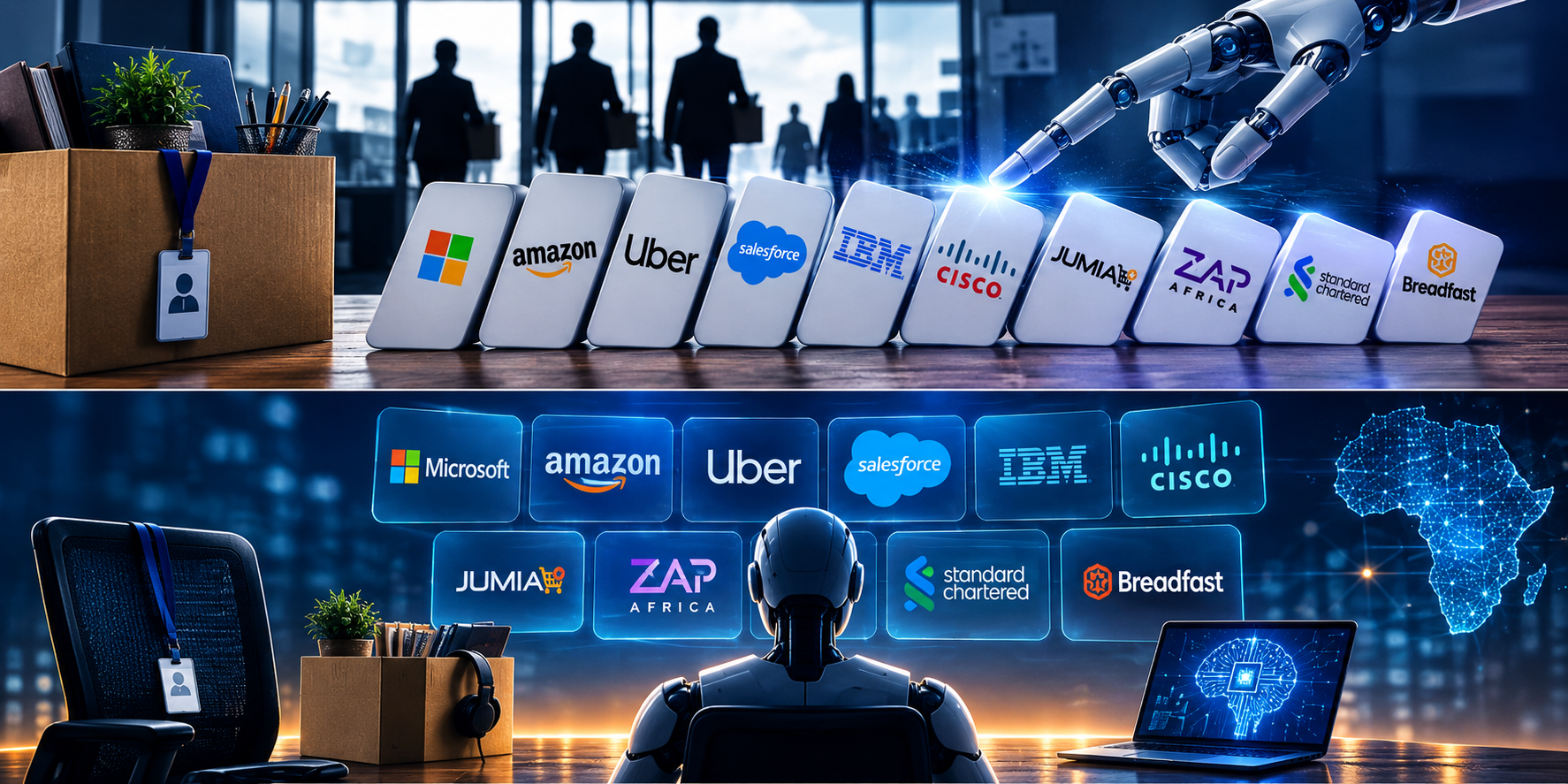
10.Breadfast cut 58 employees across its engineering, product and data departments in May, less than three months after raising $50 million in a pre-Series C funding round. The Egyptian grocery-delivery company described the move as a decision not to renew contracts when they expired.
Unlike Jumia and Zap Africa, Breadfast did not publicly identify AI as the direct reason for the reductions. Its inclusion is nevertheless important because it exposes a weakness in the wider AI-layoff narrative: once AI becomes the dominant explanation for technology-sector job losses, conventional cost-cutting and restructuring can easily be mislabelled as automation.
Presenting every layoff as inevitable technological progress can protect companies from deeper scrutiny. A business struggling with overhiring, high operating costs or poor strategic decisions may find it easier to tell investors that it is becoming “AI-first” than to admit that its previous model was unsustainable. AI may be changing work, but it can also become a convenient corporate explanation for decisions primarily motivated by cost.
For African workers, the risk is greater because the continent has fewer formal jobs, weaker unemployment protection and limited access to large-scale retraining. The H1 2026 layoffs are therefore not simply evidence that machines are taking jobs. They show that companies now expect smaller teams to produce more with AI and that workers, rather than shareholders or customers, are likely to carry most of the immediate cost of that transition.
Also read: Uber cuts 10% of customer service workforce in major AI push
