For most of the history of recorded video, ‘seeing’ was a reasonable starting point for ‘believing’. A video would show something that had happened somewhere, at some point, in front of a cam
For most of the history of recorded video, ‘seeing’ was a reasonable starting point for ‘believing’. A video would show something that had happened somewhere, at some point, in front of a camera, and that was typically how we judged that certain events took place, but now, that assumption is breaking down.
Today’s AI-generated video can produce people, places, voices, movements, and events that never existed. The technology has advanced from obvious visual glitches to systems capable of generating convincing video with synchronized dialogue, sound effects, realistic physics, and increasingly detailed human expressions. Google’s current Veo 3.1, for example, generates video with native audio and supports 1080p and 4K output, while OpenAI’s Sora 2 was designed around greater realism, physical accuracy, and synchronized sound.
The more important development, however, is not that AI can make impressive movies but that human beings are becoming less reliable at determining whether a video is authentic simply by watching it.
Humans Are Surprisingly Bad at Spotting Deepfakes
One of the most revealing findings comes from an experiment involving 1,276 participants. Overall, accuracy in identifying synthetic media was about 55.5%. For video specifically, accuracy was approximately 57.3%, with confidence intervals that crossed the 50% chance level. The researchers concluded that humans generally struggle to distinguish high-quality synthetic media from authentic content.

Mean detection accuracy by media type. Source:
ACM Digital Library
The experiment found average performance close to chance when people were asked to distinguish authentic from AI-generated images, audio, video, and audiovisual material.

Top row: synthetic images from each category most often misclassified as authentic. Bottom row: synthetic images most often correctly identified as synthetic. Beneath each image is its corresponding mean accuracy rate. Source:
ACM Digital Library
The researchers also found that people were less accurate when content involved foreign languages and when media contained only one modality, such as video without accompanying information that might provide additional clues.
However, humans are not completely incapable of detecting synthetic media; a 2026 Scientific Reportsstudyfound that participants could distinguish some AI-generated faces and voices from real ones at better-than-chance rates, but the researchers found that this ability did not reliably generalize between different types of synthetic content. Being relatively good at spotting an artificial face does not automatically make someone good at spotting an artificial voice, and that is important because real-world deception rarely looks like a clean laboratory experiment.
A scammer can combine a real photograph, an AI-generated video, a cloned voice, a genuine company logo, and a convincing website, and the victim doesn’t have to believe every component, only enough.
Take This Quick Fun Test and See How You Do
The Deepfake Is No Longer the Whole Story
This is one of the least appreciated changes in AI video deception, as early discussions of deepfakes focused heavily on visual imperfections: strange hands, unnatural facial movements, inconsistent lighting, or distorted backgrounds. Those clues still occasionally appear, but relying on them is becoming increasingly unreliable.
Modern video generators are improving not only individual frames but also temporal consistency, physical movement, and audio-video relationships. Google’s description of Veo 3.1, for example, highlights improvements in realism, physics, prompt adherence and audio synchronisation.
This has prompted researchers to respond with increasingly sophisticated detection systems. One 2026 benchmark, GenVidBench, contains 6.78 million videos and examples from 11 state-of-the-art video generators. Another 2026 benchmark, FVBench, contains more than 120,000 videos spanning real, AI-edited, and fully AI-generated material, produced by 42 video synthesis and editing models.
These companies have shown that detecting AI video is no longer simply a matter of teaching a computer what a deepfake looks like. Detectors must recognise content generated by systems they may never have encountered before.

AI image of late Pope Francis in a white puffer jacket
An AI-generated image depicting Pope Francis wearing an oversized white puffer jacket went viral, with many people initially believing it was a genuine photograph. Fact-checkers later confirmed it was AI-generated.
Imagine a fabricated video claiming that a bank has collapsed, a company has stopped withdrawals, a celebrity has endorsed an investment scheme, or a public official has announced an emergency. The video’s power comes partly from its realism, but also from its speed. A convincing fake can be created, distributed, and copied across multiple platforms before journalists or fact-checkers have established what actually happened, creating what might be called an information verification gap whereby creating false evidence can take minutes, and establishing that it is false may take hours or days.
Deepfakes Are Already Being Used in Financial Fraud
The FBI’s 2025 Internet Crime Report, released in April 2026, recorded 1,008,597 complaints and reported nearly $21 billion in losses from cyber-enabled crime in the United States. Cryptocurrency-related complaints alone accounted for more than $11 billion in reported losses.
The FBI also recorded 22,364 complaints involving artificial intelligence, associated with nearly $893 million in losses. It said criminals used fake social profiles, voice clones, fake identification documents, and believable videos depicting public figures or people known to victims. The FBI has separately warned that scammers use AI-generated videos to impersonate FBI officials and direct victims to fraudulent websites.
In one scheme, scammers created videos portraying a senior FBI leader encouraging people to submit complaints through a spoofed IC3 website. The FBI also reportedthat criminals used AI-generated videos during supposed real-time video chats to impersonate company executives, law enforcement officials, and other authorities.
The Problem for Journalism Is Bigger Than Deepfakes
Journalists have always had to verify photographs and videos, but verification is increasingly less about whether a video looks real and more about its origin, requiring a fundamental shift in how they verify video.
A newsroom covering a breaking event may receive a video from social media claiming to show the event. The newsroom cannot simply inspect the pixels and assume it can visually establish authenticity. It may need to establish who recorded the footage, when it was recorded, whether the original file exists, whether other independent footage confirms it, and whether the video’s source can be established. In the coming days, the future of digital evidence may depend more on provenance and less on visual realism.
The Technology Being Built to Restore Trust
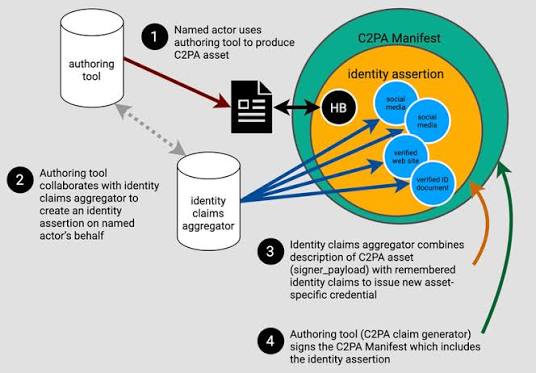
The Coalition for Content Provenance and Authenticity, or C2PA, is one of the most significant responses to this growing problem, and it uses its Content Credentials standard to attach cryptographically bound provenance information to digital content.

C2PA logo Source:
CineD
That information can record aspects of an asset’s origin, modifications, and use of AI, and more than 500 companies and organisations have been involved in the broader Content Credentials ecosystem, including Adobe, Microsoft, Google, Meta, Sony, Amazon, OpenAI and the BBC, but there is an important detail that is frequently misunderstood.
Provenance does not prove a video is true, and C2PA explicitly says provenance can show where content came from and how it was handled, but it alone cannot establish whether the underlying content accurately represents reality. This could become fundamental to digital literacy, as a video can have excellent provenance and still contain a false claim.
On the flip side, a genuine video that has been downloaded, edited, or stripped of metadata may have incomplete provenance without being fake.
We May Need to Stop Treating Video as Proof
The more pressing problem is not only that AI can create convincing fakes, but it is also that the internet has trained people to treat visual evidence as a shortcut to truth. If seeing is no longer enough, society needs another layer of verification, and while that could include cryptographic provenance, trusted recording devices, independent corroboration, forensic detection systems, and stronger institutional verification, it still has a long way to go to change public perception.
AI detectors can fail, metadata can disappear, genuine footage can be manipulated after recording, and a technically authentic video can still be misleading when taken out of context. The goal therefore cannot be to create a magical tool that labels every video REAL or FAKE; the more realistic goal is to build an information system in which people have stronger evidence about where content came from, what happened to it, and who is vouching for it.
The Next Crisis May Be the Video Nobody Believes
An even stranger possibility is that synthetic video becomes sufficiently common, and the problem isn’t only people believing things that never happened, but also people refusing to believe things that actually happened. A genuine recording could be dismissed as AI-generated, a real victim could be told that the evidence is fake, and a real event could become entangled in arguments about whether the footage itself can be trusted.
This is sometimes called the “liar’s dividend”: once people know convincing fakes exist, deepfakes can provide a convenient excuse for dismissing authentic evidence, and that may be more damaging than any individual fake. The central challenge of AI-generated video is therefore not simply technological but epistemological.
For more than a century, cameras gave society a powerful way to record reality, and although AI has not destroyed that capability, it has weakened the assumption that a recording necessarily corresponds to something that happened. The question is no longer whether AI can make us see something that never happened, because it can. The harder question is whether we can build systems that tell us what actually happened.
Disclaimer: This article is intended solely for informational purposes and should not be considered trading or investment advice. Nothing herein should be construed as financial, legal, or tax advice. Trading or investing in cryptocurrencies carries a considerable risk of financial loss. Always conduct due diligence.
Enjoyed this? BookmarkDeFi Planet, explore related topics, and follow us onTwitter,LinkedIn,Facebook,Instagram,Threads, and CoinMarketCap Community for seamless access to high-quality industry insights.
Take control of your crypto portfolio with DEFI PLANET PRO, DeFi Planet’s suite of analytics tools.
The post AI Can Now Fool Humans With Video, We Are Not Ready for What Comes Next appeared first on DeFi Planet.