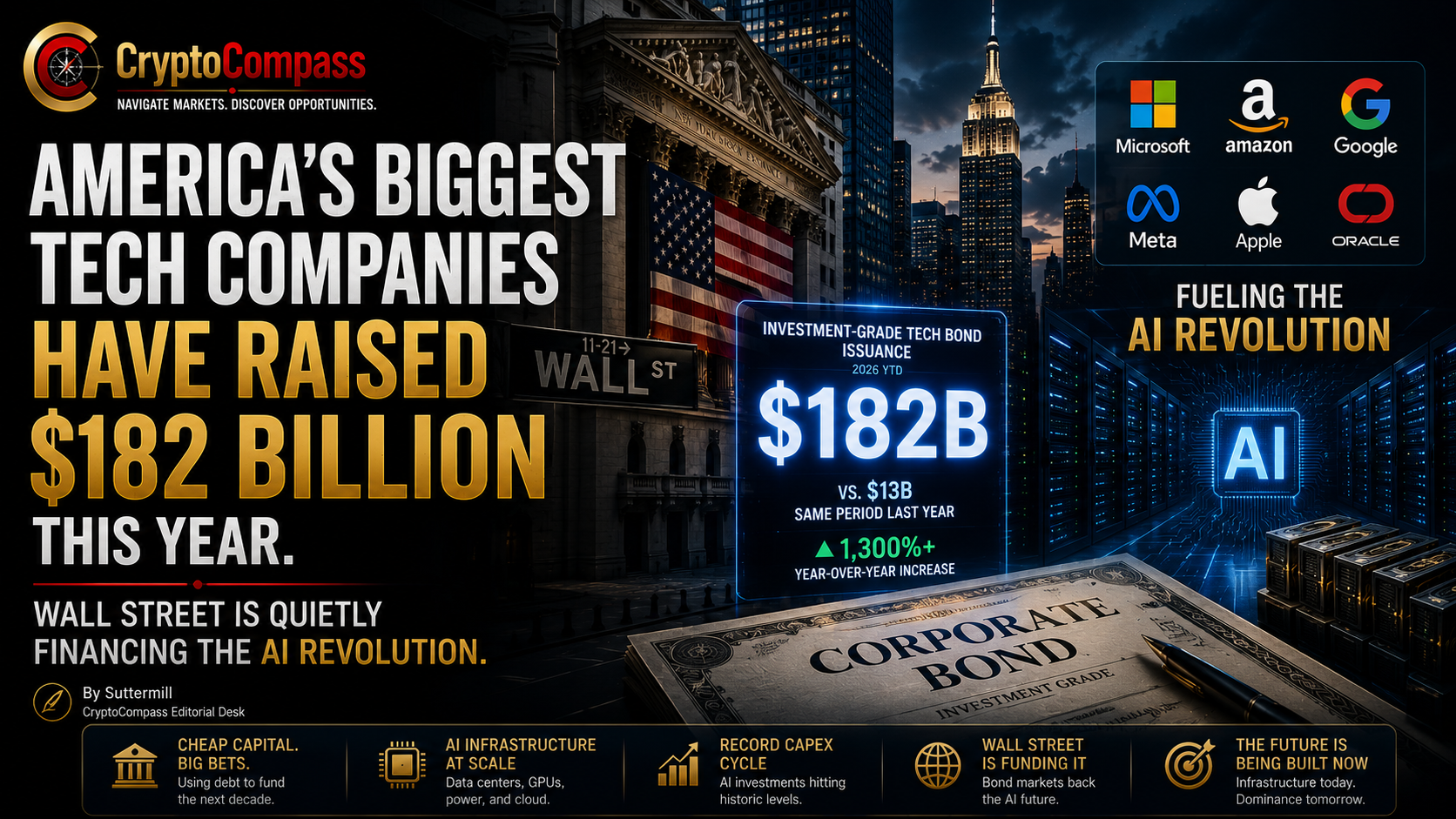
America's Biggest Tech Companies Have Raised $182 Billion This Year. Wall Street Is Quietly Financing The AI Revolution.
During the same period last year, they raised only around $13 billion. That represents an increase of well over 1,300% in just twelve months, making this one of the fastest accelerations in corporate borrowing ever recorded within the U.S.
A
AnonymousCryptoCompass newsroom
July 8, 2026
5 min read
ANALYSIS
CryptoCompass editorial visual for markets coverage.
Technology companies have never spent money at today's pace.
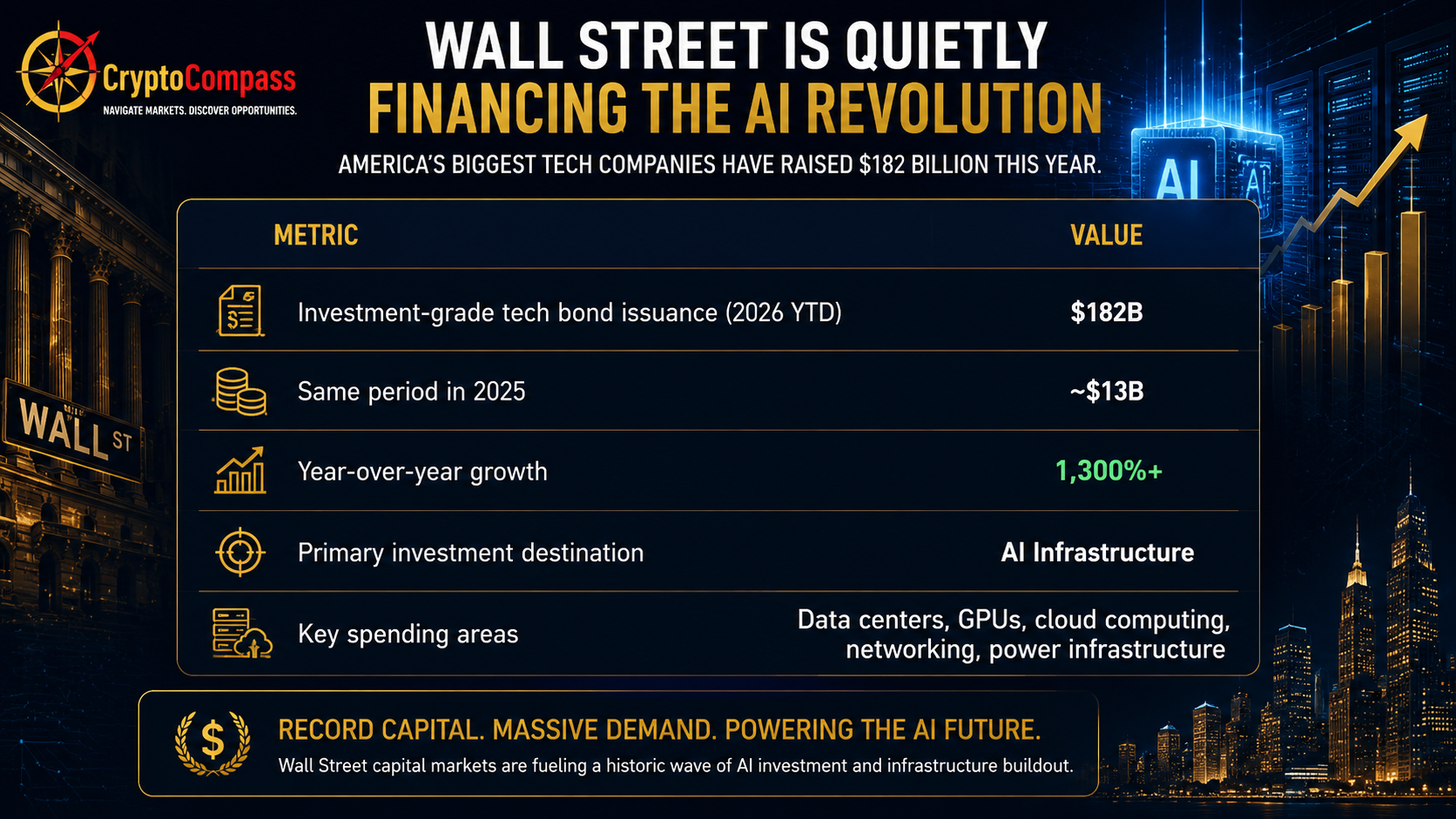
Since the beginning of 2026, America's largest technology firms have collectively raised approximately $182 billion through investment-grade bond offerings, according to market estimates. During the same period last year, they raised only around $13 billion. That represents an increase of well over 1,300% in just twelve months, making this one of the fastest accelerations in corporate borrowing ever recorded within the U.S. technology sector.
At first glance, the numbers appear contradictory. Why would companies with some of the strongest balance sheets in the world suddenly borrow so aggressively? Apple alone continues to hold tens of billions of dollars in cash. Microsoft consistently generates enormous free cash flow every quarter. Alphabet, Amazon and Meta are all producing operating profits that most global corporations could only dream of.
The answer is surprisingly simple.
This borrowing spree is not a sign of weakness.
It is a sign that corporate America believes the artificial intelligence race has entered a phase where speed matters more than conserving cash.
Unlike previous technology cycles, AI requires unprecedented physical infrastructure. Training and operating frontier AI models is no longer simply a software problem. It requires enormous computing clusters filled with advanced GPUs, hyperscale data centers capable of consuming hundreds of megawatts of electricity, high-speed networking equipment, dedicated semiconductor supply chains and long-term investments in energy generation and cooling systems. Every major technology company is now competing to build this infrastructure before its competitors do.
By The Numbers
The sheer scale of investment illustrates how dramatically corporate priorities have changed. Just a few years ago, technology companies focused primarily on software subscriptions, digital advertising and consumer platforms. Today, the industry's largest spending category has become physical infrastructure. The AI economy is increasingly beginning to resemble the construction of railroads, power grids and telecommunications networks rather than the relatively asset-light internet businesses that dominated the previous decade.
This explains why debt markets have suddenly become so important.
When interest rates remain manageable and a company possesses an investment-grade credit rating, issuing bonds is often a more efficient financing strategy than drawing down cash reserves. Instead of reducing liquidity, companies preserve financial flexibility while securing billions of dollars that can immediately be deployed into projects expected to generate returns over many years. Institutional investors purchasing these bonds are effectively financing the next generation of artificial intelligence infrastructure.
Perhaps the most remarkable aspect of this investment cycle is that the spending is occurring before the full economic benefits of AI have been realized. Previous technology revolutions often followed rising demand. This time, supply is being built first. Companies are constructing massive computing capacity based on expectations that future demand will continue expanding rapidly. In many respects, Wall Street is funding tomorrow's digital economy before it fully exists.
The companies leading this investment wave are already familiar names. Microsoft continues investing heavily in cloud infrastructure and its partnership with OpenAI. Amazon is expanding AWS while increasing capital expenditures for generative AI services. Alphabet remains committed to strengthening Google's AI ecosystem and custom silicon development. Meta has publicly stated that artificial intelligence infrastructure will remain one of its highest capital allocation priorities for years to come. Apple, although taking a different strategic approach, is also increasing investments across AI hardware and services.
The ripple effects extend far beyond Silicon Valley. Semiconductor manufacturers such as NVIDIA, AMD, Broadcom and TSMC benefit directly from surging demand for AI hardware. Construction firms specializing in hyperscale facilities are experiencing record project pipelines. Power producers are seeing electricity demand forecasts revised sharply higher as AI data centers become some of the largest industrial consumers of energy. Network equipment providers, fiber infrastructure companies and cooling technology manufacturers are also becoming critical components of the AI supply chain.
Some analysts have begun comparing today's investment environment with the early internet boom. There are similarities, but there are also important differences. During the dot-com era, much of the capital came from venture funding and speculative equity issuance. Today's AI leaders are largely profitable, mature companies with investment-grade balance sheets and access to global credit markets. Rather than relying on speculative financing, they are using some of the cheapest and most liquid capital available anywhere in the financial system.
That distinction significantly reduces financial risk. Investors purchasing these bonds are not betting on unproven startups. They are lending money to companies that collectively generate hundreds of billions of dollars in annual cash flow. The market is effectively expressing confidence that artificial intelligence will produce productivity gains substantial enough to justify today's enormous capital expenditures.
The implications extend beyond the technology industry itself. Large-scale corporate borrowing influences bond markets, interest rates, industrial production, semiconductor demand, energy consumption and labor markets. The AI race is no longer confined to software developers. It is reshaping manufacturing, utilities, real estate, construction and global capital allocation. Every new data center represents billions of dollars flowing into multiple industries simultaneously.
Crypto investors should also pay close attention. Although these investments are directed primarily toward artificial intelligence, history shows that major infrastructure cycles often create opportunities far beyond their original purpose. The internet enabled cloud computing. Cloud computing accelerated mobile applications. Mobile platforms created entirely new digital economies. Artificial intelligence could similarly accelerate demand for decentralized computing, blockchain infrastructure, tokenized assets, digital identity systems and autonomous financial networks. The technologies may evolve independently, but they increasingly share the same institutional capital base and long-term infrastructure requirements.
The most important takeaway is not that technology companies have borrowed $182 billion. The more significant story is that financial markets are willingly providing that capital because they believe the next decade of economic growth will be driven by artificial intelligence. Wall Street is not financing yesterday's businesses. It is financing tomorrow's infrastructure.
CryptoCompass View
History suggests that periods of extraordinary corporate investment often coincide with major technological transformations. Railroads reshaped the nineteenth century. Electricity transformed the twentieth. The internet redefined the global economy over the past three decades. Artificial intelligence now appears to be entering that same category. The companies issuing record amounts of debt are making a clear statement. They believe the opportunity ahead is worth spending hundreds of billions of dollars today. Whether every project succeeds remains uncertain, but one conclusion is increasingly difficult to ignore. The next phase of global competition will not be determined solely by who builds the smartest AI models. It will be determined by who owns the infrastructure capable of powering them.
Commerce Clears the Way for a Broad GPT-5.6 Release OpenAI is on the verge of putting its most powerful AI model family in the hands of the general public. The U.S. Department of Commerce has
Shiba Inu burned more than 110 million $SHIB on July 8, marking the largest single-day total in six months, according to Shibburn. Weekly burns have climbed to 152 million SHIB over the same
Zcash ($ZEC) surged as much as 16% on July 8 after Project Tachyon reported significant progress toward formally verifying the security of the network's upcoming Ironwood upgrade, pushing the