Anthropic, as reported by Reuters on Thursday, was in discussions about acquiring MatX, a startup focusing on chip technology, for approximately $7 billion in an effort to strengthen its cust
Anthropic, as reported by Reuters on Thursday, was in discussions about acquiring MatX, a startup focusing on chip technology, for approximately $7 billion in an effort to strengthen its custom silicon plan and lessen its reliance on Nvidia, but the negotiations have been halted.
The abandoned acquisition demonstrates just how obsessed the Claude creator is with securing control of its hardware. Anthropic is already utilizing many of Google’s TPUs, Amazon’s Trainium, and Nvidia’s GPUs and announced this plan back in October 2025 in their announcement about expanding their use of Google Cloud. Buying a semiconductor chip designer would further secure Anthropic’s position, helping it shift from buying and leasing chips to actually producing them.
Why a lab that rents millions of chips wants to design its own
The attraction of MatX boils down to its size. By the end of July, Anthropic’s annualized revenue run rate reached $65 billion, climbing from $47 billion in May and nearly $9 billion at the close of 2025. The sheer level of growth results in a constant demand for computing power that is needed for training and running Claude.
In April, Anthropic committed more than $100 billion to AWS over ten years for up to 5 gigawatts of capacity. Amazon also invested $5 billion and pledged as much as $20 billion more.
Thanks to these cloud agreements, it is possible to access vast computing power, but they do not allow Anthropic to fully control its own hardware plans. However, if it owns a chip company, then it can.
According to two sources who spoke to Reuters, the estimated $7 billion MatX negotiations aimed to speed up Anthropic’s own chip research. Meanwhile, according to another source, the discussions are now leaning more towards a collaboration than a merger.
The engineers Anthropic wanted, and the price that moved
MatX is a logical target for that strategy. Founder and CEO Reiner Pope previously ran AI software for Google’s TPUs, while co-founder Mike Gunter was a lead designer of the same TPU hardware, according to TechCrunch. They started MatX in 2023.
The startup raised a $500 million Series B in February led by Jane Street and Situational Awareness, the fund created by former OpenAI researcher Leopold Aschenbrenner. MatX plans to manufacture its chips at TSMC and begin shipping them in 2027.
The valuation of the company has changed quite rapidly. According to Reuters, MatX is currently in the process of seeking new funds with an estimated valuation close to $4 billion, significantly less than the $7 billion valuation in the previous merger talks. Reuters says it could not establish what led to the end of the negotiations.
A training bet, with inference as the open question
MatX positions itself as a maker of high-throughput chips for large language models, with hardware designed heavily around training and reinforcement learning workloads. That lines up with one of Anthropic’s biggest expenses: training frontier AI models.
But Anthropic is also looking beyond training. Cryptopolitan previously reported that the company is spreading its bets across inference-focused chipmakers, including a preliminary agreement to purchase about $250 million of chips from British startup Fractile. Those processors target inference, the stage where trained models generate responses for users.
The common thread is vendor independence. Anthropic said on August 5 that it was building its own chip engineering team while continuing to buy hardware from Amazon, Google, Nvidia and AMD. Acquiring MatX would have folded an entire chip design operation into that effort.
Anthropic declined to comment on the talks, while MatX did not respond to Reuters.
Is buying access to MatX’s chip expertise better than buying the entire company?
Anthropic’s AI infrastructure ambitions dwarf the MatX deal. The company is simultaneously pursuing tens of billions of dollars in compute capacity while considering whether to bring AI-chip design in-house. The reported ~$7 billion MatX acquisition was abandoned, with MatX instead seeking a valuation of roughly $4 billion.
MetricFigureTiming / horizonWhat it representsMatX acquisition talks~$7B2026Reported price Anthropic was considering for MatX before abandoning the acquisition talksMatX fundraising target~$4B valuationAug. 2026Valuation MatX is reportedly seeking after the acquisition discussions endedAnthropic revenue run rate~$30BApril 2026Annualized revenue pace, not cumulative revenueAWS commitment>$100B10 yearsAnthropic’s planned spending on AWS technologies and infrastructureAmazon Trainium capacityUp to 5 GWMulti-yearCompute capacity Anthropic plans to secure from AmazonGoogle TPU capacity3.5 GWFrom 2027Next-generation Google AI accelerators planned for AnthropicNscale compute deal$45B6 yearsPlanned spending to rent AI computing capacityAMD server supplyTens of billions of dollarsMulti-yearPlanned AI-server supply arrangementAMD investmentUp to $5B2026Potential AMD investment in AnthropicMatX ship timing2027Reported planTarget timeframe associated with MatX’s next-generation AI hardware Anthropic–MatX: the numbers behind the chip strategy
The newest piece of the puzzle is Nscale: Reuters reported Aug. 26 that Anthropic plans to spend $45 billion over six years on computing capacity, while its projected revenue target rises to $190B–$200B by 2028, versus a reported $47B current run rate.
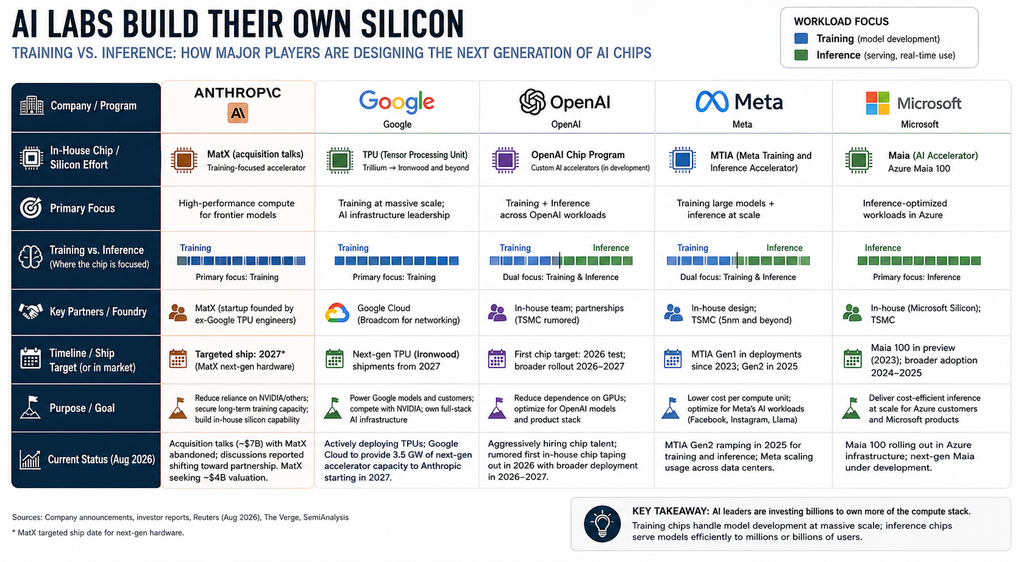
A partnership could plausibly be cheaper and faster than the abandoned ~$7 billion acquisition, but there is no reported MatX partnership price yet. Reuters says Anthropic is exploring a partnership after abandoning the acquisition and has not yet selected its final approach. That matters because the original acquisition was explicitly intended to accelerate Anthropic’s custom-hardware development. MatX’s founders and team also have relevant Google TPU experience.
FactorAcquire MatXPartner with MatXReported headline cost~$7BUndisclosedUpfront capitalVery high — acquisition considerationPotentially much lower — likely contracts, milestones or investment rather than purchase priceOwnership100% control of MatX technology/teamShared/contractual accessEngineering talentAcquired immediatelyAccess through partnershipChip IPGreater controlRights would depend on agreementIntegration workHigh — absorb team, systems and roadmapLower — MatX remains independentDevelopment speedPotentially fast because Anthropic controls roadmapPotentially fastest if MatX’s existing design work can be adapted directly to Claude workloadsFinancial riskHigh — $7B acquisition premiumLower — capital can be staged against milestonesStrategic flexibilityLower after committing $7BHigher — Anthropic can work with MatX while evaluating other chip startupsCurrent statusAbandonedBeing exploredMatX valuation contextProposed purchase reportedly ~$7BMatX reportedly seeking funding at ~$4B valuation Acquisition vs. MatX partnership: cost and speed
Don’t just read crypto news. Understand it. Subscribe to our newsletter. It's free.
