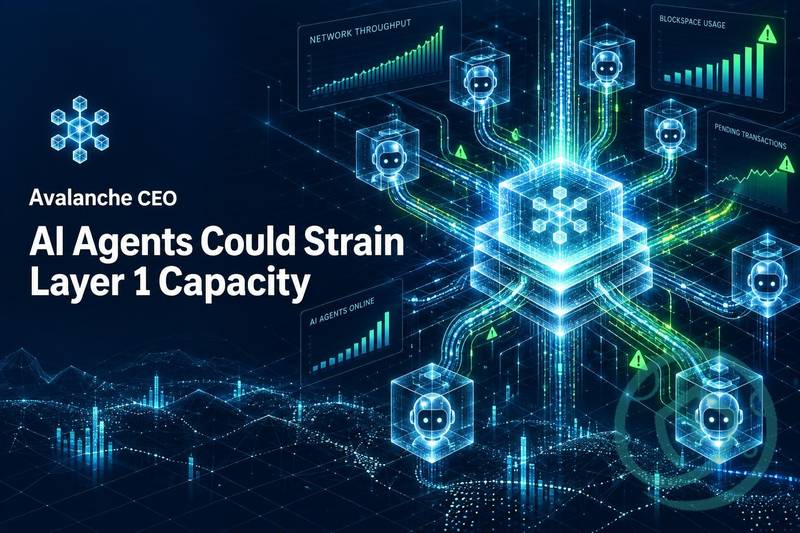
According to unconfirmed reports, the CEO of Avalanche Treasury warned that the growing volume of AI-agent activity could create insufficient block space on layer-1 blockchains, raising quest
According to unconfirmed reports, the CEO of Avalanche Treasury warned that the growing volume of AI-agent activity could create insufficient block space on layer-1 blockchains, raising questions about whether current execution architectures are built for the demands of autonomous on-chain systems.
The reported warning, attributed to an Avalanche Treasury executive in a report from The Block, frames a concern that has been building quietly in developer circles: AI agents executing transactions, deploying contracts, managing wallets, and coordinating on-chain workflows do not operate at human cadence. They operate continuously, and at scale. For related coverage, see Bitwise's Upcoming Avalanche Staking ETF.
Why AI Agents Place Distinct Demands on Layer-1 Networks
Unlike a human submitting a single swap or signing a one-time transaction, autonomous agents can initiate sustained bursts of on-chain activity without interruption. Avalanche's own integration documentation for 0xGasless AgentKit describes the range of actions agents can execute on the C-Chain: transaction signing, smart-contract interaction, token swaps, contract deployment, and wallet management, all with AVAX as the native gas token. Each of these actions competes for the same block space as every other participant on the network.
Key Points
- An Avalanche Treasury CEO said, according to unconfirmed reports, that AI-agent demand could strain layer-1 block space.
- AI agents can execute transaction signing, contract deployment, and wallet management autonomously and continuously, competing directly for network capacity.
- Layer-1 infrastructure must accommodate not just current throughput but the compounding demand of agent-driven workflows that do not pause.
The capacity question is not hypothetical for Avalanche's engineering team. The network's Continuous Execution architecture introduced ACP-176, which set a documented gas rate of 30M gas per second on the C-Chain. A separate proposal, ACP-194, decoupled consensus from execution to enable parallel processing and improve throughput. These are architectural responses to anticipated load, not idle research.
Documented C-Chain gas rate
30M gas/sec
ACP-176 introduced this documented gas rate.
Architecture context only; it does not verify the reported AI-agent demand forecast.
The Continuous Execution design also streams transaction results immediately as each transaction completes, with settlement following approximately five seconds later. That latency profile matters for agent workflows: an agent waiting for confirmed state before issuing the next instruction compounds confirmation delays across hundreds or thousands of sequential calls.
What a Capacity Warning Means for Blockchain Scaling Strategy
The reported concern is forward-looking, not a declaration that Avalanche or any other layer-1 has already hit its ceiling. No congestion event or measured throughput breach was independently verified in the underlying research. What the warning signals is a design-time problem: networks optimized for current human-driven transaction volumes may need to re-examine assumptions before agent populations scale.
Scaling paths for base-layer networks generally fall into three categories: lifting raw throughput at the execution layer (as Avalanche's ACP-194 attempts), routing agent workloads to application-specific subnets or rollups that do not compete with general-purpose block space, or moving certain agent operations off the base layer while anchoring state commitments on-chain. Avalanche's subnet architecture, highlighted in coverage of its ¥440B Progmat migration from Corda 5, illustrates the third path: isolating high-throughput workloads without burdening the primary network.
Interest in Avalanche as institutional infrastructure has also grown through products like the VanEck Avalanche ETF and the Bitwise Avalanche ETF, both of which bring new capital attention to the network's long-term scalability story. Institutional LPs have an interest in whether the underlying chain can absorb automated, high-frequency agent activity without degrading performance for other users.
AVAX traded at $7.58, up 4.74% over the prior 24 hours, with a market capitalization of approximately $3.36 billion at the time of this report.
AVAX market snapshot
$7.58
24-hour change: +4.74%
Supplied CoinGecko market-data snapshot; public asset page linked.
The signals that would confirm whether AI-agent demand is becoming material are measurable: sustained elevation in C-Chain gas consumption, rising median transaction fees, growing congestion in the mempool during off-peak hours (when human activity is lowest but agents would continue uninterrupted), and an increase in AVAX burn rates as fee volume climbs. None of those thresholds have been publicly reported as breached. The reported warning is a thesis about trajectory, and the infrastructure choices being made now, at the architecture and subnet-design level, will determine whether that thesis proves correct.
Disclaimer: This article is for informational purposes only and does not constitute financial or investment advice. Cryptocurrency and digital asset markets carry significant risk. Always do your own research before making decisions.
Read original article on aicryptocore.com