CLARITY Act News: Key Officials Leave as Talks on the Next Draft Begin The latest CLARITY Act News centers on a simple question: who will write the next version of the bill? The Senate failed
CLARITY Act News: Key Officials Leave as Talks on the Next Draft Begin
The latest CLARITY Act News centers on a simple question: who will write the next version of the bill? The Senate failed to advance the crypto market structure legislation in a procedural vote on September 15.
Since then, several people who shaped the debate have announced their exit from Washington or their industry roles. Banks, crypto firms, regulators and lawmakers all say they still want a bill. They disagree on what it should say.
At a Glance
Status: The bill stalled in the Senate and has not become law.
Vote: It did not reach the 60 Senate votes needed to move forward.
Departures: Sen. Thom Tillis, Sen. Cynthia Lummis, and SEC Commissioner Hester Peirce are leaving.
Main disputes: DeFi, tokenization, CFTC authority, stablecoin yields, enforcement and ethics.
Lobbying: The crypto industry spent over $13 million in the first half of 2026.
Next steps: A lame-duck push, agency rulemaking or a new bill in the next Congress.
Why Did the CLARITY Act Fail to Move Forward?
The bill needed 60 votes to advance and fell short. Several issues played a part. Early drafts drew criticism over DeFi, tokenization, CFTC authority and stablecoin yield rules. Coinbase CEO Brian Armstrong said he opposed the January draft for those reasons and later backed a revised version.
Ethics became another sticking point. Filings released in June showed President Donald Trump had about $1.4 billion in crypto gains, according to the source reporting. Senate Democrats said they could not support a bill that might let the president profit from the industry. No single issue explains the outcome.
Source: Cleve Mesidor
Who Wants Changes to the CLARITY Act?
Each group wants something different.
Crypto firms and trade groups want clear market structure rules.
Banks want changes to stablecoin yield policy and protection for lending businesses. The Bank Policy Institute said it will keep working with other groups.
Law enforcement raised concerns about developer protections and illicit finance.
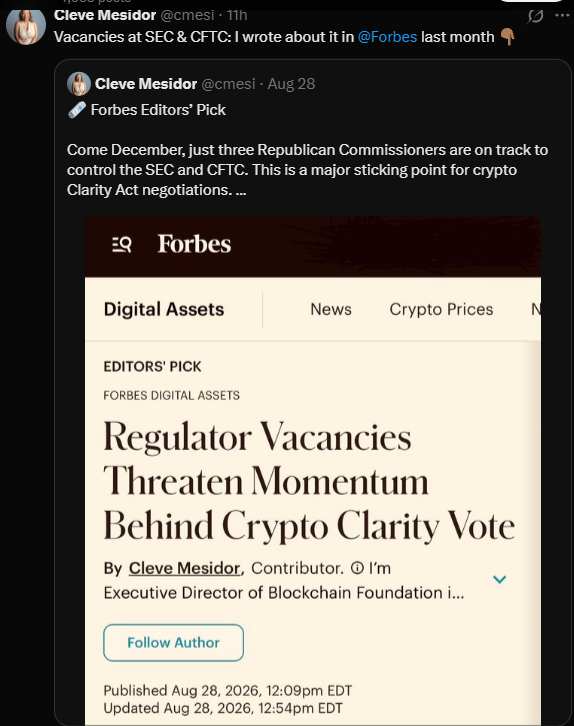
Regulators face questions about SEC and CFTC jurisdiction. Both agencies also have vacant commissioner seats.
Lawmakers are still negotiating across party lines, with ethics rules at the center.
Key Officials Leaving as CLARITY Act Talks Continue
Sen. Thom Tillis will not seek a third term and leaves office at the end of the year. He worked with Democratic Sens. Angela Alsobrooks and Ruben Gallego on a benefit-sharing compromise and ethics language.
Sen. Cynthia Lummis, who chairs the Senate Banking Subcommittee on Digital Assets, is not running again. She led work on the bill and earlier partnered with Sen. Kirsten Gillibrand on the GENIUS Act.
SEC Commissioner Hester Peirce is scheduled to leave on October 2 and return to academia. She has been a prominent voice on crypto regulation since 2018.
Summer Mersinger also announced she will step down as CEO of the Blockchain Association. Founding head Kristin Smith returns as interim CEO.
Losing experienced negotiators can make new talks harder. It does not decide the outcome.

Source: Wu Blockchain
CLARITY Act: Key Events and Timeline
Date or Period
Key Development
January 2026
Senate version faced objections over DeFi, tokenization, CFTC authority and stablecoin yields
2026
Stakeholders pushed for changes as bipartisan talks continued
Sept. 15, 2026
Senate procedural vote failed to advance the bill
Sept. 30, 2026
Stand With Crypto announced its first round of Senate endorsements
Oct. 2, 2026
Hester Peirce scheduled to leave the SEC
After midterms
Lawmakers may revisit the issue in the lame-duck period or next Congress
Crypto Lobbying and Political Pressure After the Failed Vote
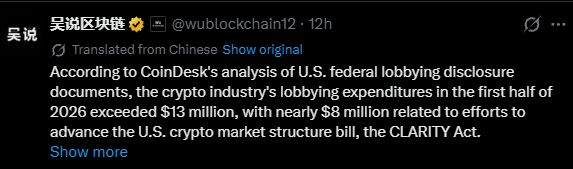
CoinDesk's review of federal lobbying disclosures found the crypto industry spent more than $13 million on lobbying in the first half of 2026. Nearly $8 million related to the CLARITY Act 2026. About $2.4 million went to outside lobbying firms and about $2.1 million to in-house lobbyists at industry groups. Coinbase spent roughly $2.2 million on the bill, and Kraken spent close to $1 million.
After the vote, Stand With Crypto said it would turn its focus to elections. It endorsed Sen. Jon Husted in Ohio, Ashley Hinson in Iowa and Chris Pappas in New Hampshire. It also plans more advertising in six House races. The group says it has more than three million supporters. Ongoing lobbying and campaign activity suggest stakeholders plan to stay involved.
Source: Wu Blockchain
What Happens to the CLARITY Act Next?
The source material points to three possible paths:
A lame-duck revival after the midterm elections.
Agency rules that fill some gaps without new legislation.
A revised bill taken up by the next Congress.
Some observers believe the bill is finished, so none of these outcomes is certain. Any new version would need to balance the aims of crypto firms, banks, regulators, law enforcement and lawmakers. Bipartisan compromise bills tend to have the best chance of surviving Congress.
Conclusion
The bill is stalled but not formally dead. The next phase depends on negotiations, stakeholder input and who controls the next Congress. With Tillis, Lummis and Peirce leaving, new voices will help shape the next draft. Readers following CLARITY Act News should watch for post-election announcements and any updates from the SEC and CFTC.
Disclaimer: This article is for informational purposes only. It is not financial, investment, legal or political advice. Cryptocurrency investments carry risk, including the loss of your full investment. Laws and regulations change often, so verify developments through official government sources and do your own research before making decisions.