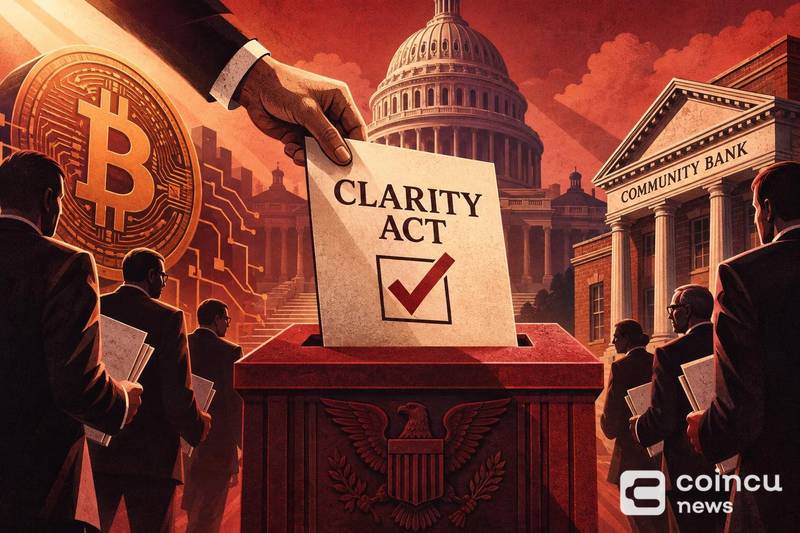
The Independent Community Bankers of America is pressing Congress to widen the CLARITY Act's ban on stablecoin yield, projecting more than a trillion dollars in modeled community-bank deposit
The Independent Community Bankers of America is pressing Congress to widen the CLARITY Act's ban on stablecoin yield, projecting more than a trillion dollars in modeled community-bank deposit losses, even as unconfirmed reports point to a September 15 procedural vote and parallel crypto-industry lobbying that the primary evidence does not independently confirm.
ICBA's public campaign asks lawmakers to extend the prohibition on interest or yield on payment stablecoins to all digital asset market participants, per the group's payment stablecoins campaign. The request targets not just issuers but the broader distribution chain that could route rewards to holders. For related coverage, see Senate Keeps Clarity Act Alive With Crypto Bill Vote Set for September.
In its legislative advocacy update, the trade group says it is seeking CLARITY Act amendments covering yield or yield equivalents paid to stablecoin holders by affiliates, exchanges and other digital asset intermediaries, and says it continues a grassroots campaign, according to its Advocacy in Action page. The same page identifies the measure as H.R. 3633 and states that the Senate Banking Committee passed the CLARITY Act on May 14. For related coverage, see Trump Pushes Crypto Clarity Amid SEC Rules and CFTC Warnings.
ICBA's campaign estimates $1.3 trillion in potential lost community-bank deposits under modeled stablecoin adoption scenarios. That figure is an association advocacy projection, not a realized deposit outflow.
ICBA projects potential community-bank deposit losses
$1.3 trillion
ICBA estimates $1.3 trillion in potential lost community-bank deposits under modeled stablecoin adoption scenarios. This is an association advocacy projection, not observed deposit outflows. Source: ICBA payment stablecoins campaign.
The campaign pairs that with an estimated $850 billion decline in lending activity, again a modeled risk rather than a measured credit contraction. ICBA frames the concern as a migration of deposits that fund local lending.
ICBA projects a potential decline in lending
$850 billion
ICBA estimates an $850 billion decline in lending activity under modeled stablecoin adoption scenarios. This is an association advocacy projection, not an observed lending decline or realized credit losses. Source: ICBA payment stablecoins campaign.
The methodology hinges on whether holders can earn yield: ICBA models a stablecoin market of $1.22 trillion with no direct or indirect interest to holders, rising to $5.01 trillion when holders can collect interest at the federal funds rate. ICBA says it applied macroeconomic model estimates to state deposit and lending data from FDIC, FFIEC, SBA and CRA sources.
The gap between those two scenarios is the crux of the bank campaign: the larger the yield-eligible stablecoin market, the larger the modeled deposit migration, which is why ICBA wants the yield prohibition extended beyond issuers to intermediaries.
What is confirmed versus what is still reported
The CLARITY Act's committee passage and ICBA's amendment requests are directly attributable to the group's own pages. The reported September 15 procedural vote is not: no official Senate calendar or readable independent report confirming the date, year or procedural mechanism was verified in this review.
A procedural vote, if it occurs, would not enact the bill; it governs whether and how the chamber proceeds, and should not be read as final passage. The Senate's willingness to keep the measure moving was covered when the chamber kept the CLARITY Act alive with a September crypto-bill vote.
Claims that crypto-industry groups and community banks are simultaneously lobbying senators ahead of that specific vote, including in senators' home states, rest on unconfirmed reports; a matching Reuters headline was indexed but its body was inaccessible. ICBA's own campaign is the one verified strand here, distinct from any documented crypto-side effort.
Where this fits the wider CLARITY debate
The stablecoin-yield fight sits alongside broader market-structure expectations, including comments that the SEC chair expects the CLARITY Act to pass this month and warnings that the CFTC would ready its own crypto rules if the CLARITY Act fails. Publicly traded issuers and exchanges have also traded on the bill's progress, with Coinbase, Circle and Bullish gaining on CLARITY Act optimism.
What to watch next is narrow and concrete: an official Senate calendar entry confirming the date and procedural stage, published amendment text on stablecoin yield, and any on-the-record statements naming the crypto groups reportedly lobbying. Until those surface, the deposit and lending figures remain ICBA's modeled advocacy case, not established outcomes.
Disclaimer: This article is for informational purposes only and does not constitute financial or investment advice. Cryptocurrency and digital asset markets carry significant risk. Always do your own research before making decisions.
The post Clarity Act Vote: Crypto and Community Banks Lobby Ahead was initially published on Coincu.