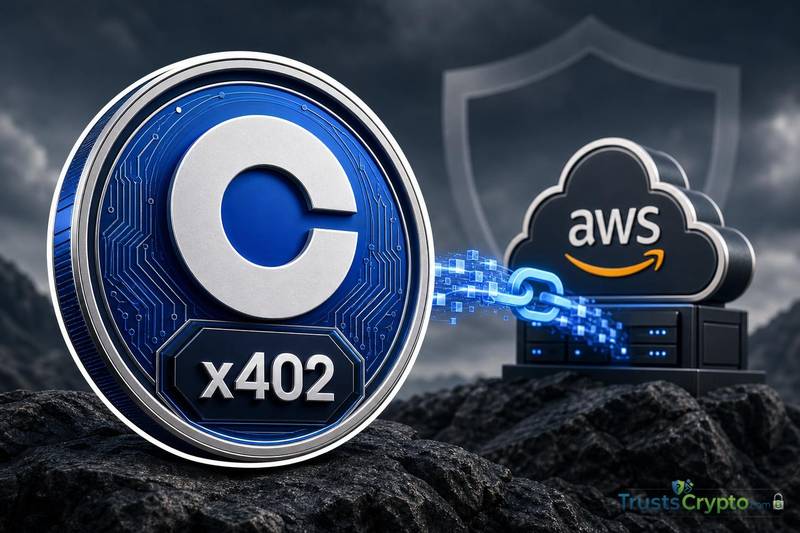
Coinbase and Amazon Web Services have introduced x402, a new payment protocol designed to let publishers accept autonomous AI agents as paying customers. The collaboration bridges crypto paym
Coinbase and Amazon Web Services have introduced x402, a new payment protocol designed to let publishers accept autonomous AI agents as paying customers. The collaboration bridges crypto payment infrastructure with cloud-based AI services, positioning x402 as a tool for machine-native commerce.
What x402 is and why it targets publishers
The x402 protocol takes its name from the HTTP 402 status code, which was originally reserved for "Payment Required" but never widely implemented. Coinbase and AWS are now repurposing that concept for a world where AI agents, not just humans, need to pay for access to digital content and services.
According to a Coinbase blog post, the integration works with Amazon Bedrock AgentCore, allowing AI agents built on AWS infrastructure to make payments through Coinbase's crypto rails. The system is designed so that when an agent encounters a paywall or paid API, it can autonomously complete the transaction using stablecoins.
The publisher focus is deliberate. Content providers, data vendors, and API operators have long struggled to monetize access from automated systems. Traditional payment methods require human intervention, credit card forms, and identity verification, all of which break down when the "customer" is a piece of software.
What "agents as customers" means in practice
The phrase "agents as customers" describes a shift where AI systems independently browse, evaluate, and purchase digital goods or services on behalf of their human operators. Instead of a person subscribing to a data feed, their AI agent would pay per query or per article accessed.
For publishers, this could open a new revenue channel. A news outlet could charge an AI agent a fraction of a cent to read and summarize an article. A research firm could sell individual data points to agents that aggregate information across dozens of sources. The x402 protocol would handle the payment handshake automatically.
This model differs from traditional API pricing in a key way: the agent decides what to buy and when, based on its task, rather than a developer pre-purchasing a fixed quota. That distinction matters as AI agents become more autonomous in how they gather and process information, a trend that has implications for how digital payments are evolving beyond simple human-to-merchant transactions.
Why a Coinbase-AWS partnership matters here
Coinbase brings crypto payment infrastructure, including stablecoin settlement on its Base layer-2 network. AWS brings the largest cloud computing platform, where a significant share of enterprise AI agents are built and deployed. The combination means x402 could reach developers where they already work.
Coinbase CEO Brian Armstrong highlighted the announcement on X, signaling that the company views agent-to-agent payments as a strategic priority. The integration with Amazon Bedrock AgentCore suggests AWS sees crypto-native micropayments as a practical solution for agent commerce, rather than trying to retrofit traditional payment processors.
The partnership also sits at the intersection of two fast-moving sectors. As AI capabilities expand and agents handle more complex workflows, the need for seamless machine-readable payment protocols grows. This mirrors broader momentum in crypto infrastructure, where projects like cross-chain swap integrations are making digital asset transfers more fluid.
What publishers should watch next
The announcement leaves several practical questions unanswered. Publishers evaluating x402 will need clarity on integration requirements, including what SDKs or APIs are needed to add x402 support to existing paywalls and content systems.
Fee structures are another open question. Micropayments have historically struggled with transaction costs eating into small payments. Whether Coinbase's Base network can keep fees low enough to make per-article or per-query pricing viable will be a key factor in adoption.
Compliance and access control also need attention. Publishers will want to know how x402 handles fraud prevention, rate limiting, and content licensing when the buyer is an autonomous agent rather than an identifiable human. Settlement timing, currency denomination, and reporting tools are all details that will determine whether x402 moves from announcement to adoption.
The concept of institutional crypto product adoption has accelerated in recent months, and x402 represents another step toward embedding crypto rails into mainstream business infrastructure. Whether publishers embrace it will depend on the operational details that follow this initial launch.
FAQ about Coinbase, AWS, and x402
What is x402? x402 is a payment protocol introduced by Coinbase and AWS that enables AI agents to make autonomous crypto payments when accessing digital content or services. It references the HTTP 402 "Payment Required" status code.
Why are Coinbase and AWS involved? Coinbase provides the crypto payment and stablecoin infrastructure, while AWS hosts the AI agent platform (Amazon Bedrock AgentCore) where developers build and deploy autonomous agents. Together they cover both sides of the transaction.
What does it mean for agents to be customers? It means AI software can independently discover, negotiate, and pay for digital goods, such as articles, data feeds, or API calls, without requiring a human to manually complete each purchase.
How could publishers use x402? Publishers could integrate x402 into their paywalls or APIs so that AI agents can pay per access. This would let content providers monetize machine traffic that currently either gets blocked or passes through for free.
Additional source references: source document 1.
Disclaimer: This article is for informational purposes only and does not constitute financial or investment advice. Cryptocurrency and digital asset markets carry significant risk. Always do your own research before making any investment decisions.
Read original article on trustscrypto.com