Brian Armstrong, the co-founder and CEO of the Coinbase Global (Nasdaq: COIN) cryptocurrency trading exchange, has been among the most aggressive industry figures to get the Digital Asset Mar
Brian Armstrong, the co-founder and CEO of the Coinbase Global (Nasdaq: COIN) cryptocurrency trading exchange, has been among the most aggressive industry figures to get the Digital Asset Market Clarity Act passed in the U.S. Congress.
But the legislation, which seeks to establish a comprehensive regulatory framework for crypto assets in the United States, has been facing a challenge from the banking industry.
Related: Coinbase CEO has a radical fix for America's $36 trillion debt
Why banks are opposing Clarity Act
A provision of the bill allows limited rewards for stablecoin holders in which users can earn yields on payments, transfers, settlements, etc.
The banks are worried their customers could withdraw their deposits and convert them into stablecoins, as the latter are more rewarding than the bank accounts.
The Independent Community Bankers of America (ICBA), which represents about 4,000 small community banks across the country, last month called on senators to amend the Clarity Act to completely prohibit any interest, yield, or rewards on stablecoin holdings.
As per the ICBA, a failure to prohibit stablecoin yield could reduce deposits held by community banks by $1.3 trillion.
Trending on TheStreet Roundtable:
Coinbase CEO spots 'narrative violation' of banks' argument
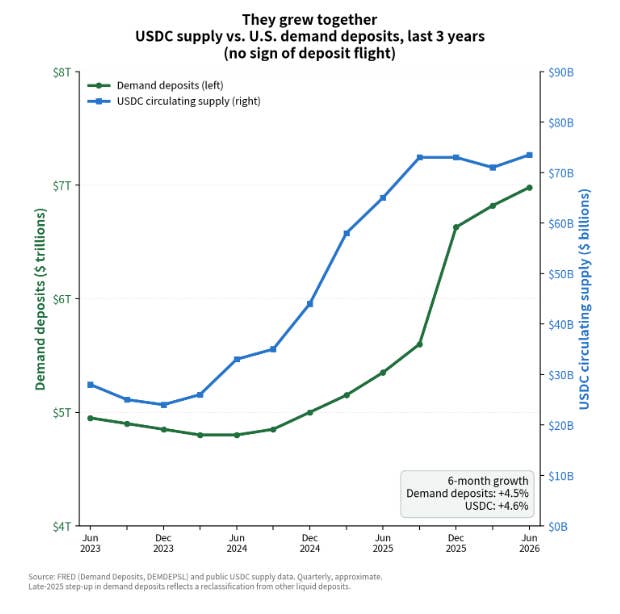
Coinbase's chief policy officer Faryar Shirzad recently shared a paper by the crypto exchange to argue that there is no meaningful link between stablecoin growth and bank deposits.
As the circulating supply of Circle's USDC stablecoin grew to around $75 billion (Circle is a Coinbase partner), overall bank and community bank deposits also grew to around $7 trillion, he cited from a dataset in the paper.
Over the last six months, USDC has grown 4.6%, and total demand deposits have grown 4.5%, he claimed.
"No displacement there."
Shirzad argued that stablecoins enable these 4,000 community and regional banks to "punch above their weight" as they can execute 24/7 settlement and cross-border rails like global systemically important banks (GSIBs) without expensive IT budgets or crypto teams.
Source: USDC circulating supply and demand deposits
Armstrong had a characteristic 2-word response to Shirzad's post on bank deposits, "Narrative violation."
The Coinbase CEO's dramatic response underscores an attempt to contradict the argument put forward by banks that stablecoin yields threaten deposits.
Related: 4,000 U.S. local banks warn key bill could drain $1.3 trillion