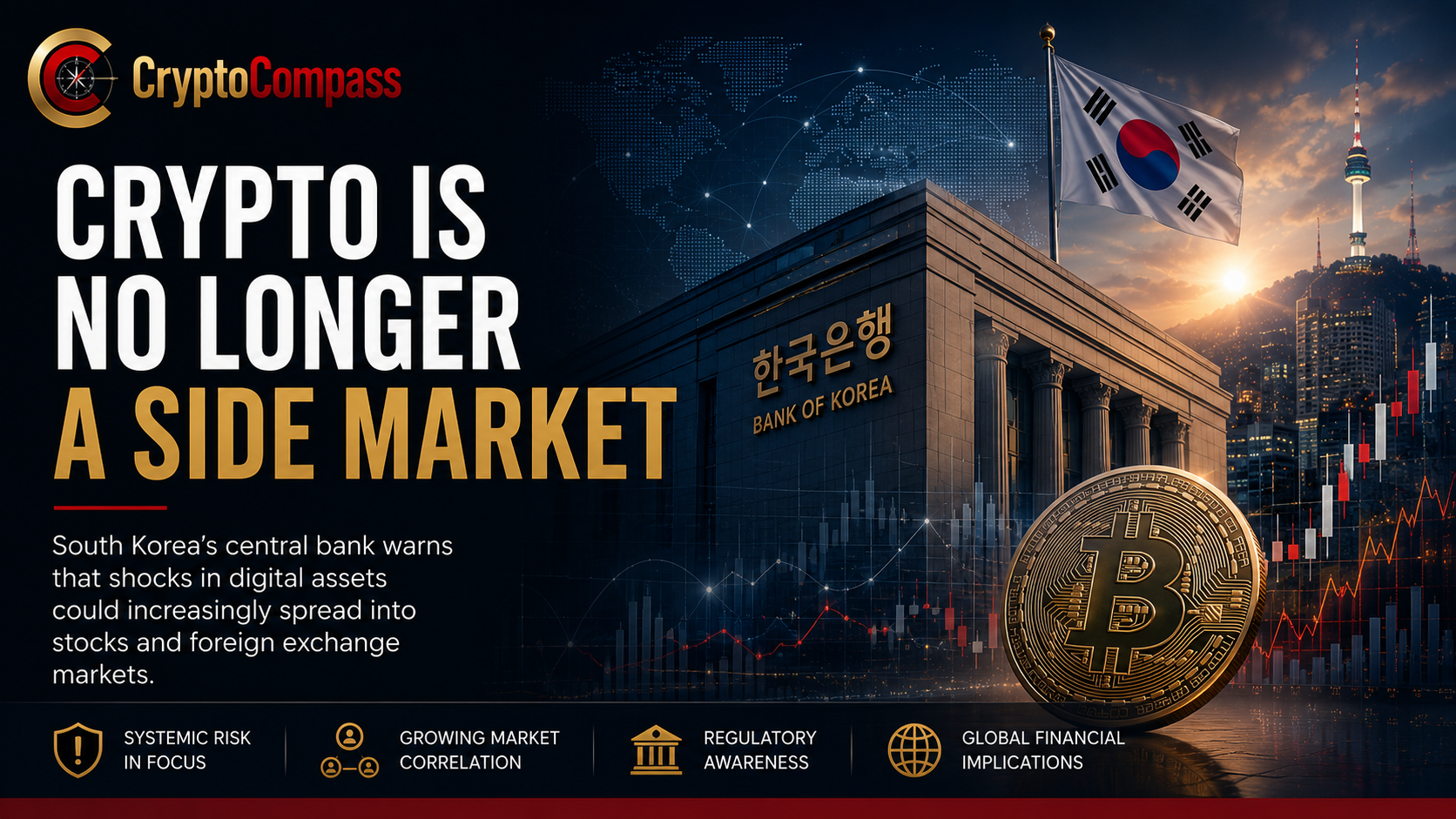
For years, cryptocurrencies were viewed as a separate ecosystem operating largely outside the traditional financial system. According to South Korea's central bank, that era may be ending. As institutional participation grows and financial integration deepens, shocks originating
For most of the past decade, regulators treated crypto as a contained experiment.
Volatile.
Speculative.
Highly visible.
Yet largely disconnected from the financial system that matters most.
Banks remained insulated.
Pension funds stayed away.
Institutional exposure was limited.
When crypto crashed, traditional finance largely moved on.
That assumption is becoming increasingly difficult to defend.
According to South Korea's central bank, digital assets are becoming sufficiently integrated with broader financial markets that major disruptions in crypto may eventually spill into stocks, currencies, and other parts of the financial system.
The warning is significant not because it predicts an imminent crisis.
But because it reflects a fundamental shift in how central banks now view crypto.
Not as a side market.
But as a market that is gradually becoming part of the system.
The Warning Is About Correlation
The Bank of Korea's concern is not Bitcoin itself.
Nor is it focused on a specific token, exchange, or protocol.
The concern is correlation.
As crypto adoption expands, the investor base is changing.
Retail traders are no longer the only participants.
Asset managers, institutions, corporations, ETFs, and professional investors are increasingly entering the ecosystem.
As a result, the same capital that participates in equity markets is beginning to participate in crypto markets as well.
The same macroeconomic forces influence both.
The same interest-rate expectations affect both.
The same risk sentiment drives both.
When two markets become increasingly owned by the same investors, they tend to react together.
That is where systemic risk begins to emerge.
From Independent Market To Financial Network
Historically, crypto operated as a relatively isolated asset class.
A sharp Bitcoin decline rarely threatened stock markets.
A token collapse rarely affected foreign exchange markets.
The channels of transmission were limited.
Today, those channels are expanding.
Spot Bitcoin ETFs have connected crypto directly to traditional investment portfolios.
Stablecoins are increasingly linked to banking infrastructure.
Institutional custody solutions continue to grow.
Asset managers now discuss Bitcoin alongside bonds, commodities, and equities.
The more integrated crypto becomes, the more difficult it becomes to separate crypto risk from broader financial risk.
Success creates connectivity.
Connectivity creates exposure.
Exposure creates systemic importance.
Why South Korea Still Faces Limited Risk
Interestingly, the Bank of Korea does not believe the country's financial system currently faces substantial direct crypto-related threats.
There is a reason.
South Korea has not yet approved spot cryptocurrency ETFs.
Crypto futures ETFs remain unavailable.
Institutional and corporate participation remains heavily restricted.
These limitations create a protective buffer between digital assets and the traditional financial system.
For now.
The central bank's concern is what happens if those barriers eventually disappear.
The Future Risk Scenario
The warning issued by the Bank of Korea is fundamentally forward-looking.
Imagine a future where:
Pension funds allocate capital to Bitcoin.
Corporations hold digital assets on balance sheets.
Banks offer crypto products directly to clients.
Investment funds gain broad exposure through regulated ETFs.
Under such conditions, a severe crypto market crash would no longer remain confined to crypto.
Portfolio losses could affect broader investment behavior.
Risk appetite could deteriorate.
Capital flows could shift across multiple asset classes simultaneously.
Foreign exchange markets, equity markets, and credit markets could all feel secondary effects.
In other words, crypto would become part of the same financial transmission system that already links stocks, bonds, and currencies together.
Recent Market Events Offer A Preview
The timing of the warning is notable.
Global markets have recently experienced significant volatility.
South Korea's own equity market has shown how rapidly stress can spread through interconnected financial systems.
Large declines in major technology companies and sharp moves in broader equity indices have highlighted the vulnerability of modern markets to concentrated risk and investor sentiment.
The lesson is straightforward.
Markets no longer operate in isolation.
Financial systems have become networks.
And networks transmit shocks.
The Global Trend Is Moving In One Direction
South Korea is not alone in recognizing this shift.
Across the world, regulators are increasingly treating crypto as a financial stability issue rather than a purely technological or speculative phenomenon.
The conversation has evolved.
A few years ago, policymakers debated whether crypto mattered.
Today, they are debating how much it matters.
That distinction is important.
It signals that digital assets have progressed beyond the experimental phase.
The debate is no longer about relevance.
It is about integration.
CryptoCompass View
The Bank of Korea's warning should not be interpreted as an argument against crypto.
If anything, it reflects crypto's growing success.
Financial systems do not worry about irrelevant markets.
They worry about important ones.
For years, crypto advocates argued that digital assets would eventually become part of the global financial architecture.
That vision is increasingly becoming reality.
The challenge now is different.
The more integrated crypto becomes, the more responsibility it inherits.
Volatility is manageable when a market stands alone.
It becomes far more significant when that market is connected to banks, pension funds, corporations, and national financial systems.
The future of crypto may not be defined by adoption alone.
It may be defined by whether integration can occur without importing the systemic vulnerabilities that have historically challenged traditional finance.
That is the question regulators are beginning to ask.
And increasingly, it is the question investors should be asking as well.
—
By Suttermill
CryptoCompass Editorial Desk