Isabel Schnabel, a member of the European Central Bank’s Executive Board, told central bankers at the Jackson Hole symposium on Friday that they should stop treating blockchain as someone els
Isabel Schnabel, a member of the European Central Bank’s Executive Board, told central bankers at the Jackson Hole symposium on Friday that they should stop treating blockchain as someone else’s infrastructure. “Central banks should go on-chain themselves,” she said, arguing that central bank reserves need to become a natively programmable asset to keep anchoring settlement as finance moves onto distributed ledgers.
The timing sharpens the point. Pontes, the Eurosystem’s system for settling tokenized transactions in central bank money, is due to go live in September. It is reportedly moving forward as a production service rather than a pilot, after quietly dropping that label.
- Central bank money has to go on-chain itself, or risk losing its anchor role as finance moves onto blockchain.
- Stablecoins can complement that system, but not replace it, because only a central bank can expand liquidity without limit in a crisis.
- Whichever architecture the ECB picks, it still has to settle who is liable, who gets admitted, and who approves upgrades, before it can be trusted with real settlement.
A launch with open legal questions
In the same speech, Schnabel raised three questions the ECB has not answered. Who is liable if a smart contract fails. How are new participants admitted to the system. Who decides on software upgrades. She named all three without resolving any of them.
That gap matters because Pontes settles real money for institutions with direct access to TARGET Services, the ECB’s core payment system. Switzerland’s central bank spent several years running phased pilots under its own wholesale digital currency project, Helvetia, working through comparable governance questions before it settled tokenized bonds in central bank money for cantonal governments.
The ECB’s public timeline shows Pontes moving from exploratory work toward a production launch without a comparable governance framework published yet.
A firm no to
CENTRAL BANK MONEY VS. STABLECOINS Central bank moneyStablecoinsIssuerCentral bankPrivate companySupply in a crisisExpands without limitCapped by reserves heldCredit riskNoneTied to the issuer’s reserves
Schnabel also drew a hard line on stablecoins, tokens issued by private companies and pegged to a currency like the dollar or euro. She said they are best understood as complements to central bank money, not substitutes for it. The table below shows why.
This builds on a position she took as early as June, when she reportedly called the digital euro the ECB’s best answer to stablecoin risk.
A longer, slower project underneath
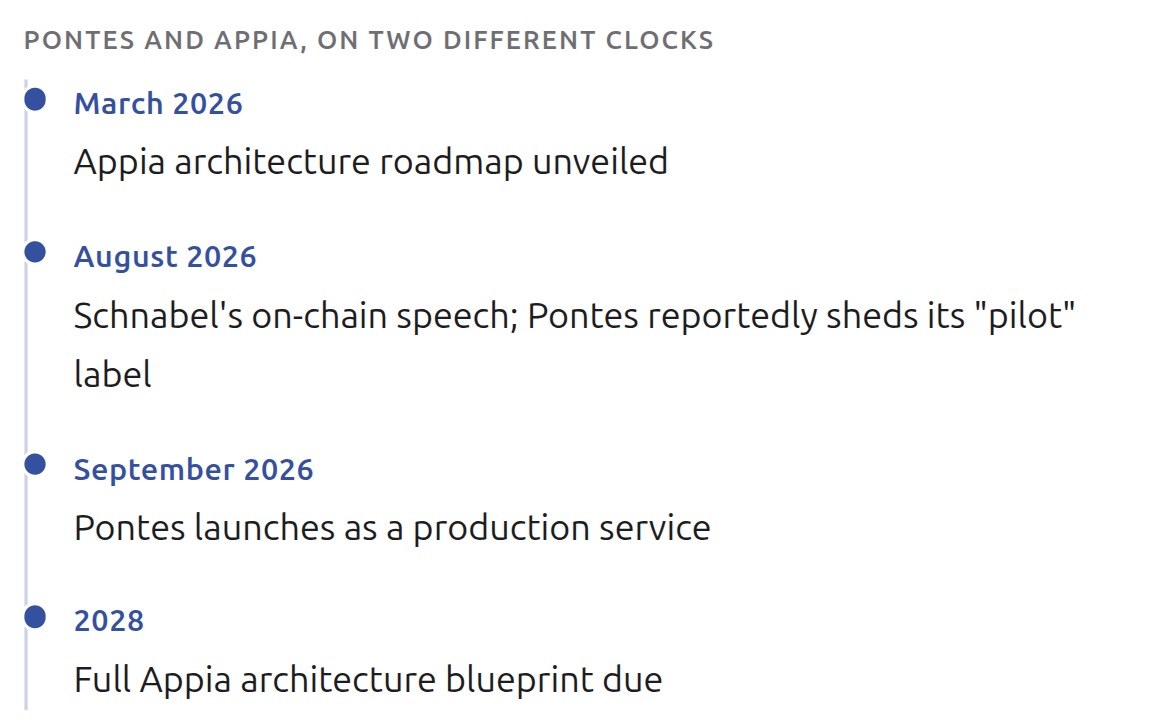 Pontes and Appia: Two Different Clocks
Pontes is the near-term piece. The ECB’s longer architecture project, Appia, unveiled in March, is still weighing whether Europe’s tokenized markets should run on a single unified ledger or a network of interconnected ones. The two projects sit on very different clocks, shown below.
If the ECB publishes clear rules on liability, participant admission, and upgrade authority before or alongside Pontes’s launch, the gap Schnabel described in her own speech closes before it can cause a problem. Until then, the system she wants to build Europe’s tokenized future on is going live carrying the exact questions she raised without answering.