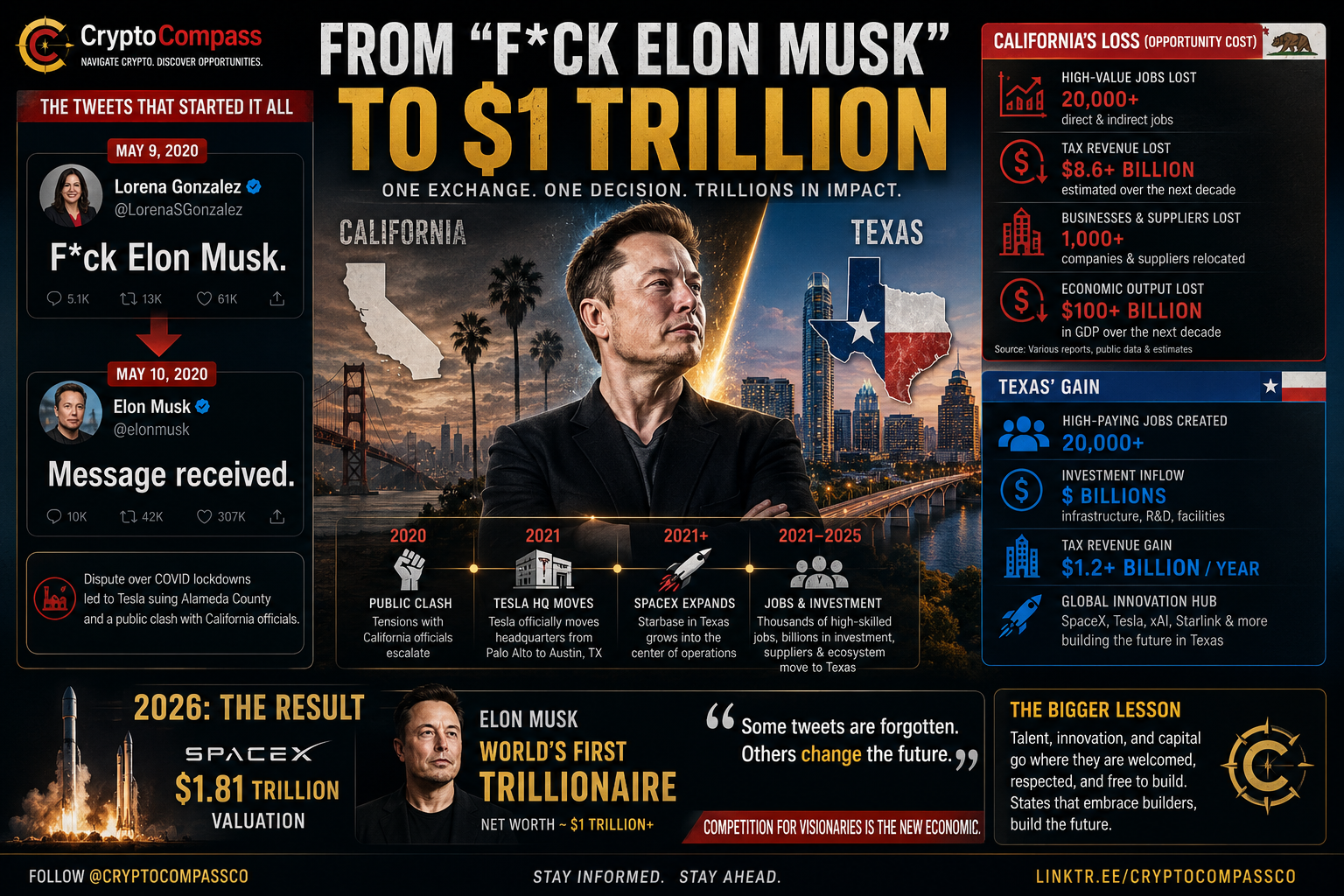
As tensions escalated, California Assemblymember Lorena Gonzalez posted a tweet that would become one of the most famous political-business exchanges of the decade
From “F*ck Elon Musk” to $1 Trillion:
Did California Push Away One of the Greatest Wealth Creators of Our Time?
In May 2020, during the height of the COVID lockdowns, a public clash erupted between Tesla CEO Elon Musk and California officials over factory shutdown orders.
As tensions escalated, California Assemblymember Lorena Gonzalez posted a tweet that would become one of the most famous political-business exchanges of the decade:
“F*ck Elon Musk.”
https://x.com/LorenaSGonzalez/status/1259287879177531392?s=20
Musk responded with just two words:
“Message received.”
https://x.com/elonmusk/status/1259638112688304129?s=20
At the time, few people viewed the exchange as anything more than another social media argument.
In hindsight, it may have symbolized something much larger.
The Departure
Within the following years, Tesla officially moved its headquarters from Palo Alto, California, to Austin, Texas.
SpaceX expanded aggressively in Texas through Starbase.
New manufacturing facilities, engineering teams, suppliers, contractors, and infrastructure investments increasingly concentrated around Texas rather than California.
The migration wasn't driven by a single tweet.
It was the result of years of growing tensions surrounding regulation, taxation, labor policies, housing costs, and the broader business environment.
Yet the tweet became a powerful symbol of a deeper question:
What happens when innovators feel unwelcome?
California's Opportunity Cost
California remains one of the world's largest economies and continues to be a global center for technology and innovation.
However, it is difficult to ignore what followed after Musk shifted his center of gravity toward Texas.
Since then:
Tesla grew into one of the most valuable companies in the world.
SpaceX became the dominant force in commercial space.
Starlink emerged as a global communications network.
xAI entered the artificial intelligence race.
Elon Musk's combined business empire expanded dramatically.
Today, SpaceX alone is valued at approximately $1.8 trillion, making it one of the most valuable private-to-public transitions in modern history.
The question is not whether California collapsed.
It clearly did not.
The question is:
How much future economic value was created elsewhere that might once have been created in California?
Texas' Gain
Texas positioned itself differently.
Lower taxes.
Lower regulatory burdens.
Faster development approvals.
A political culture that openly competed for entrepreneurs and large employers.
The result was more than a headquarters relocation.
It became a transfer of talent, capital, infrastructure investment, and long-term economic activity.
Thousands of highly skilled jobs followed.
Billions of dollars in investment followed.
Entire ecosystems of suppliers and startups followed.
The Trillion-Dollar Irony
In 2020, Elon Musk was being told to leave.
In 2026, he became the world's first trillionaire.
Whether one admires him or not, the contrast is difficult to ignore.
The story is no longer about a tweet.
It is about the competition between regions, states, and nations to attract the builders of the future.
Innovation has always been mobile.
Capital is mobile.
Talent is mobile.
And increasingly, the future is mobile too.
Final Thought
History may not remember the tweet itself.
But history may remember what happened after it.
A politician said:
“F*ck Elon Musk.”
Elon Musk replied:
“Message received.”
The economic consequences of that message are still being measured today.
CryptoCompass Insight
The greatest competition of the 21st century may not be between companies.
It may be between jurisdictions competing to attract the people who build them. 🚀