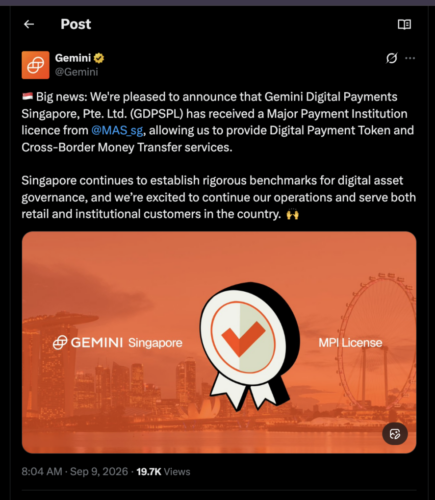
BitcoinWorld Gemini’s Singapore unit now holds a full Major Payment Institution (MPI) licence Key Takeaways Gemini’s Singapore unit now holds a full Major Payment Institution (MPI) licence, r
BitcoinWorld Gemini’s Singapore unit now holds a full Major Payment Institution (MPI) licence
Key Takeaways
- Gemini’s Singapore unit now holds a full Major Payment Institution (MPI) licence, roughly 23 months after receiving in-principle approval.
- The licence removes transaction-volume caps but pulls Gemini into a heavier supervisory regime covering AML, tech risk and reporting.
- Singapore’s approval queue is slow by design — and that slowness is becoming the region’s competitive filter.
The Real Story Isn’t the Licence. It’s the Wait.
Most coverage of Gemini’s Singapore approval will read like a press release. The more interesting number is the calendar.
MAS issued in-principle approval in October 2024. Final authorisation arrived this week. Nearly two years passed between “yes, in principle” and “yes.” For an exchange with a US public listing, an established institutional book and a decade of operating history, that is a long time to sit in a regulatory waiting room – and it tells you more about Singapore’s posture than any policy speech.
Timeline
- 2020 – Gemini begins serving Singapore customers, initially through its US entity under an exemption.
- October 2024 – MAS grants in-principle approval for an MPI licence covering digital payment tokens and cross-border transfers.
- April 2025 – Customers are migrated from Gemini Trust Company into the locally incorporated Gemini Digital Payments Singapore while the application matures.
- September 9, 2026 – Full MPI licence granted.
What Changes Operationally
The headline benefit is structural. MPI holders operate without the transaction-volume ceilings that constrain standard payment institutions – which matters enormously for an exchange whose Singapore business skews institutional. Volume caps are a ceiling on ambition; removing them turns Singapore from a compliance outpost into a viable booking centre.
The trade-off is supervisory weight. MAS applies broader obligations to MPIs precisely because scale creates larger risk, with continuing requirements around anti-money laundering, customer due diligence, technology risk and regulatory reporting. This is not a licence you win once. It is one you re-earn quarterly.
Why It Matters Beyond Gemini
Singapore has quietly assembled a short, curated list. Coinbase, Crypto.com, OKX, Bitstamp and Cumberland already hold MPI authorisation – and the roster is notable for who isn’t on it. MAS has been deliberate about the distinction between locally licensed firms and offshore platforms that merely happen to be reachable from a Singapore IP address.
That distinction is the strategic point. Global scale confers nothing locally. For years, exchanges arbitraged jurisdictional ambiguity across Asia. Singapore has made that arbitrage expensive by making the licence slow, costly and revocable.
Looking Forward
Expect the licensed cohort to consolidate rather than expand. Approvals of this weight function as moats – each one raises the credible-entry cost for the next applicant, and Hong Kong, Japan and the UAE are converging on similar architecture.
Conclusion
Gemini’s licence is a milestone, but the durable signal is Singapore’s willingness to make firms wait two years for legitimacy. In a sector built on speed, the jurisdictions setting the terms are the ones refusing to hurry.
This post Gemini’s Singapore unit now holds a full Major Payment Institution (MPI) licence first appeared on BitcoinWorld.