A lawsuit has been filed against AI chipmaker Groq’s board of directors by two of its ex-engineers. It is alleged that the deal in question was executed in an inequitable manner. The controve
A lawsuit has been filed against AI chipmaker Groq’s board of directors by two of its ex-engineers. It is alleged that the deal in question was executed in an inequitable manner. The controversy now provides an addition of shareholders’ litigation to an already scrutinized deal on the antitrust front in the United States.
The proposed class action, Serebrin v. Ross, Del. Ch., No. 2026-1291, was filed under seal on September 29 and unsealed October 5. Nvidia is not named as a defendant.
What the engineers allege
According to Benjamin Serebrin and Joshua Rubin, ex-employees of Groq who were also stakeholders of the company, Groq handed some of its biggest technological advances and engineering talent over to Nvidia, leaving other investors with a weakened business.
According to the Financial Times, the plaintiffs say the board was conflicted, failed to secure the best terms for all shareholders, and denied some investors a vote.
How the roughly $20 billion was split
According to the lawsuit, there are two things to be considered: one is the $17 billion licensing fee and the other is the $3 billion stock bonus pool given to selected engineers who joined Nvidia after it made the payments.
This agreement was announced by Groq on December 24, 2025, and described as a non-exclusive licensing agreement. Founder Jonathan Ross, President Sunny Madra, and other employees went to work at Nvidia, but Groq stayed on as an independent company under the leadership of CEO Simon Edwards and continued operating GroqCloud.
According to the lawsuit, Nvidia has employed virtually all of Groq’s engineers, probably around 200 people. It has also claimed that its classification of the $17 billion deal as licensing income put a related tax burden on Groq. Later, the value of the remaining Groq was estimated at approximately $3.5 billion in another round of investment, which only confirms the plaintiffs’ assertion that the shareholders who left were compensated inadequately.
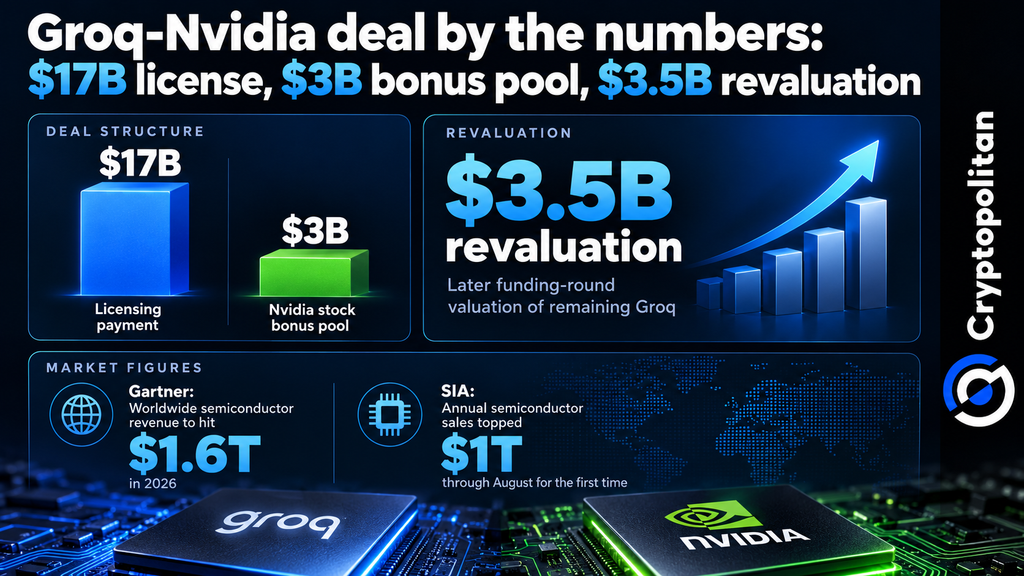 Groq-Nvidia deal by the numbers: $17B license, $3B bonus pool, $3.5B revaluation
Regulators were already circling the deal
As per the New York Times article, the Department of Justice (DOJ) began an investigation a few weeks after the announcement in December and sent Nvidia a formal demand for information. However, the article did not indicate when that request was made.
The regulatory scrutiny went beyond Nvidia and Groq. The Federal Trade Commission and the DOJ began a joint public inquiry on February 23, 2006, into new guidelines for collaboration among competitors covering licensing agreements.
Why the structure matters beyond Nvidia and Groq
Licensing-and-hiring deals have become more common as major tech companies pursue AI technology and talent without buying entire startups. That puts this case at the center of a broader question: when does a licensing deal and talent transfer start to look like an acquisition in everything but name?
That question matters even more as competition for AI infrastructure intensifies. The larger the semiconductor market becomes, the more valuable scarce chip technology, engineering talent, and inference capacity are likely to be. Gartner expects global semiconductor revenue to reach $1.6 trillion in 2026, while the SIA says worldwide chip sales topped $1 trillion through August for the first time. How courts and regulators treat deals like Nvidia-Groq could therefore shape not just startup exits, but who gets to control valuable AI chip technology and talent in a rapidly expanding market.
Don’t just read crypto news. Understand it. Subscribe to our newsletter. It's free.