Most founders think of market making as a listing expense. It is better understood as the thing that decides whether a token is still tradable in month three. To put numbers on that, TDMM pul
Most founders think of market making as a listing expense. It is better understood as the thing that decides whether a token is still tradable in month three.
To put numbers on that, TDMM pulled daily and hourly candles for every USDT spot pair on Gate, removed tokenised equities, leveraged products and stablecoins, and kept the 1,462 crypto pairs that remained. Of those, 784 recorded their first session inside the 1,000-day window to 25 September 2026, which makes that session a listing we can measure from. We also took a simultaneous level-two snapshot of 1,254 live order books, 1,000 price levels a side. Every figure below is a median across that cohort, with each token indexed to its own first session.

Across 66 listings with a complete first week of hourly data, the median high to low range inside hour one was 41.2%. By hour twenty-four it was 5.7%. By hour 168 it was 3.3%. The first hour is twelve times as wide as the same token one week later.
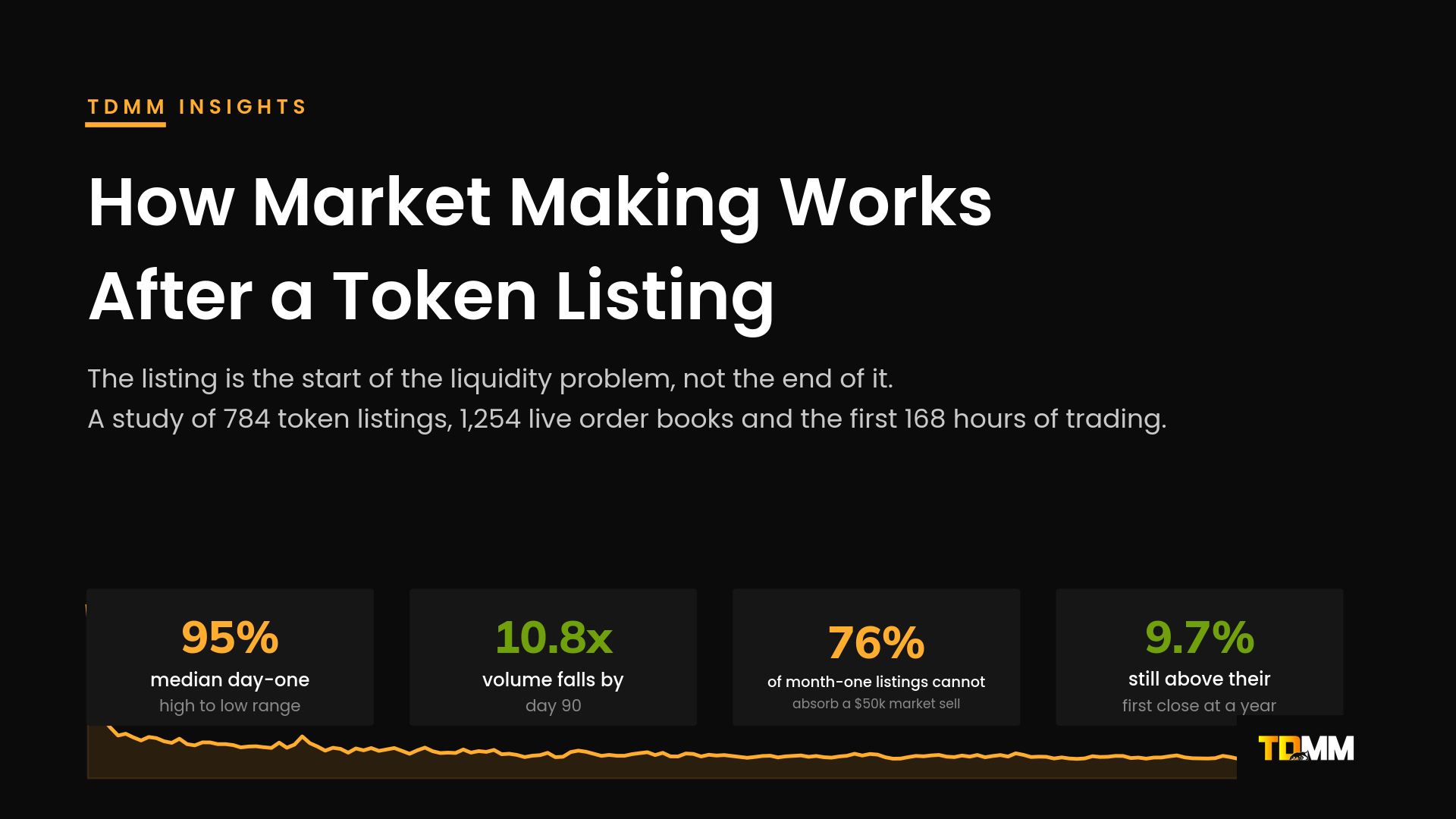
Across all 753 listings with ninety-one sessions of history, the median first full day traded through a range equal to 94.8% of its closing price, with quartile boundaries at 53.6% and 160.4%. A range of half the token’s value is the good case.
This is the part of market making that software does not solve by itself. A quote posted in hour one is pricing an asset an order of magnitude more volatile than the one that exists in seven days. Too tight and the inventory is gone in minutes. Too wide and the exchange’s programme obligations are breached. The answer is wide bands and small size, tightened on a schedule decided before the bell rather than improvised during it.

The price decline of a new token is widely discussed. The volume decline is not, and it is faster and more consequential.
Measured against each token’s own first-day volume, the median listing traded 0.64 times day one at day seven, 0.23 times at day thirty, 0.09 times at day ninety and 0.03 times at day 365. By its first anniversary the median listing trades 3.3% of the volume it did on opening day.
The distribution inside the first quarter is just as lopsided: 3.8% of first-ninety-day volume trades on day one, 20.4% in week one and 59.4% in month one. Only 40.6% is left for months two and three combined.
That is the timing problem in one paragraph. A market maker is least necessary in launch week, when a crowd is already trading, and is the only thing between the token and an empty book between day thirty and day ninety. A twelve-week mandate signed for a launch expires exactly when it starts to matter.

Grouping 1,254 live books by how long the pair has traded produces the clearest picture of the problem.
Age since first session
Pairs
Median spread
1% bid depth
Ask over bid
Depth per $1m of 24h volume
Cannot absorb a $50k sell
0 to 30 days
21
52.3 bps
$823
0.77
$4,168
76.2%
31 to 90 days
10
12.9 bps
$3,061
0.99
$20,448
60.0%
91 to 180 days
24
31.6 bps
$1,757
0.89
$39,119
83.3%
181 to 365 days
104
19.0 bps
$1,886
1.00
$21,192
82.7%
1 to 2 years
256
18.0 bps
$1,219
0.91
$18,412
81.2%
2 years and over
839
31.3 bps
$3,708
0.94
$23,526
57.3%
Three in four books under a month old cannot absorb a $50,000 market sell inside 1,000 price levels. The ask side of a month-one listing holds only 0.77 times the notional of the bid side, which is why new listings gap upward on modest buying.
The bucket table has an honest weakness: the older group trades less, and depth per dollar of volume flatters a quiet token. So we ran it again with the confound removed. For each listing under ninety days old, we compared against the median of every token that had traded over two years and did between half and twice its 24-hour volume. At a comparable $179,018 a day, the young token carried median depth of $1,233 against $6,013, and quoted 19.8 basis points against 12.7. That is 3.26 times less depth and 1.78 times wider, with size held constant.
Walking the visible bid side with a $50,000 market sell cost a median 629 basis points on a book under thirty days old, against 78 basis points on one over two years old, and that figure is computed only on the books that could absorb the order at all.

CoinGecko’s Spot CEX Report 2026, updated 9 April 2026, covering new listings on major exchanges since 1 January 2025, found an average of 32% of new listings positive immediately after listing across the top twelve venues, 25% still in the green after thirty to fifty-nine days, and fewer than 10% above their listing price at twelve months on most venues. Upbit had the best immediate performance at 67%, followed by Binance and OKX at 50%, and every one of Upbit’s listings went underwater by the 300 to 329 day mark.
CryptoRank, publishing 21 July 2026, found 93% of the 113 tokens launched between 2024 and 2026 that reached a $100 million market capitalisation trading below their token generation event price, with a median return of minus 95.7%. Eight were above breakeven.
TDMM’s cohort produces 30.4% above the first close at day thirty and 9.7% at day 365, with a median drawdown from the day-one high to the ninety-day low of minus 85.7%. Different venue, different method, same shape.

A memecoin usually arrives at a centralized exchange having already been price-discovered on a launchpad and a decentralized pool, so its first session is calmer: a median day-one range of 68.5% against 102.6% for other listings.
What happens afterwards is the surprise. At day ninety the median memecoin was still trading 0.50 times its first-day volume against 0.08 times for everything else, roughly six times more retention, and 27.8% were above their first close against 18.9%.
That reading comes with a caveat. CoinGecko’s meme-token category is ranked by market value, so it selects memecoins that lived. CoinGecko Research examined all 18.67 million tokens created on Pump.fun between 14 January 2024 and 18 June 2026, in a study updated 23 June 2026, and found 68.67% recorded their last trade on the same day they were created, 80.37% were gone by the end of the following day, about 1% graduated to an external decentralized exchange, and only 4.55% survived past ninety days.
Graduation is not survival. A constant-product pool always quotes, but it quotes from its own reserves, has no view on where the asset trades elsewhere, and cannot widen when a large seller arrives. The moment a graduated memecoin gets a centralized listing, it has an order book nobody is standing in.

Two structures dominate. Under a retainer, the issuer lends token and quote currency as inventory, pays a recurring fee, and gets the loan back, keeping all the upside. Under a token loan with call options, the issuer lends a slice of supply and grants the market maker calls at strikes above the reference price; no fee is paid.
The second is far more common for a new listing because it costs nothing today. It is not free, and the size of the number is the point.
Take a token with one billion supply listing at $0.10. The issuer lends 1.5% of supply, 15 million tokens, notional $1.5 million, for twelve months, with three equal call tranches struck at 1.25, 1.50 and 2.00 times the reference price. To price those you need a volatility input, and most issuer-side analysis quietly substitutes the volatility of an established token. TDMM measured it directly: across 750 listings, annualised close-to-close volatility over days eight to ninety-eight had a median of 166%, with a quartile range of 128% to 218%.
At 166%, those three tranches are worth $764,723 on Black-Scholes. That is 51.0% of the loan notional.
Volatility assumed
Value of the three call tranches
Share of the $1.5m loan
60%
$172,074
11.5%
100%
$401,108
26.7%
150%
$682,281
45.5%
166% (measured median)
$764,723
51.0%
200%
$923,835
61.6%
Sizing the alternative needs the depth data. A token planning $500,000 of daily volume across three venues, targeting top-third depth inside 1% of mid, needs $77,596 per side, or $465,574 of working capital. At a $15,000 monthly fee and a 5% carry, that is $203,279 a year. Above roughly plus 58% at the twelve-month mark, the call structure costs the treasury more than the retainer. The loan structure is cheap when the token fails and dear when it works.
Ask for the option value in dollars, at the volatility a new listing actually shows, before signing. A firm that will not produce that number has told you something.
On 25 March 2026 Binance published market maker guidelines on its own blog, under “Market Maker Red Flags and Guidelines for Crypto”. They tell issuers to report their market maker’s details, legal entity and contract terms to the listing platform promptly and to define the permitted use of tokens in any loan agreement. They prohibit profit-sharing and guaranteed-profit models between an issuer and its market maker. They list six red flags including selling that clashes with release schedules, one-sided trading, and volume unbalanced against order book depth, and say Binance will take swift, decisive action including blacklisting.
The practical effect is that the market making contract is now a listing document. A firm that will not be named is a listing risk rather than a liquidity solution.
Programme obligations vary more than most summaries admit. Designated market maker schemes publish hard thresholds: BitMEX sets a maximum spread from mid of 0.20% to 0.50%, minimum size per side of $2,000 to $100,000, and required uptime of 90% or more of market hours. Bitstamp’s spot designated programme requires order book presence at least 80% of the time per pair. The largest spot programmes work differently: Binance’s futures programme is volume-gated and treats spread and size as rebate inputs, and Binance.US states it sets no hard maker-volume requirement. On the biggest venues the exchange will not impose a service level on your market maker, so spread, depth and uptime have to be written into your own contract.
On 9 October 2024 the US Department of Justice, District of Massachusetts, charged eighteen individuals and entities, including four market making firms: Gotbit Consulting LLC, ZM Quant Investment LTD, CLS Global FZC LLC and MyTrade MM. The allegation was wash trading and volume inflation services for token projects, with trading bots responsible for millions of dollars’ worth of wash trades across approximately sixty different cryptocurrencies. More than $25 million was seized. Those are allegations and defendants are presumed innocent.
The sentences are not allegations. On 2 April 2025 CLS Global FZC LLC was sentenced to three years of probation and ordered to pay $428,059 in fine and seized cryptocurrency, barred from US crypto markets during probation. Gotbit’s founder Aleksei Andriunin pleaded guilty in March 2025 and was sentenced on 13 June 2025 to eight months in prison and one year of supervised release, forfeiting approximately $23 million. On 30 March 2026 the US Attorney for the Northern District of California charged ten foreign nationals across three indictments over a similar operation, after the FBI created several tokens of its own to identify firms selling the service.
The founder’s test needs no lawyer: ask the market maker to show you the depth behind the volume. Real quoting leaves an order book that an exchange, an aggregator and a competing trader can all see independently, at any moment, without the market maker’s cooperation. Printed volume leaves a number and nothing underneath it.

We tested whether order book quality today is associated with what the price did. Sorted by quoted spread, the tightest third of young listings were 19.9 percentage points more likely to be above their first close at ninety days, with a 95% bootstrap interval of plus 6.8 to plus 33.8. Sorted by depth, the deepest third were 8.9 percentage points less likely, with an interval of minus 22.2 to plus 4.2 that crosses zero and is therefore indistinguishable from chance.
Both are associations on 223 and 218 tokens, with survivorship running in both directions. Nothing here establishes that a market maker causes a higher price. What the evidence supports is narrower: a continuously quotable token is one an exchange keeps listed, an aggregator ranks and a treasury can transact in. Those are the conditions under which a price can be discovered at all.
Any firm that promises price support is either lying or planning something Binance has said it will blacklist for.

TDMM (TradeDog Market Maker) is the market making and token market management arm of TradeDog Group, active in crypto markets since 2015, with more than $10 billion in trading volume, over 100 CEX and DEX integrations, more than 200 markets integrated, 24-hour operations and a team of over thirty people across five continents. Coverage includes DeFi, GameFi, layer one and two infrastructure, real world assets, DEXs, stablecoins, memecoins and NFT finance.
For a new listing, the mandate is built around the shape of the problem set out above: live two-sided quotes from the first second on every venue, with the band tightening on a schedule derived from realised volatility; inventory structured for the mandate, with the option value priced in dollars before either structure is signed and token loans arranged so treasury inventory is never the source of selling; one reference price across centralized, decentralized and perpetual venues; a memecoin and fair-launch practice built for the handover from a bonding curve or pool to a new order book; and reporting the issuer can verify against public order book data without TDMM’s cooperation.
What TDMM does not do is promise a price or a volume number. The data above is the reason.
Disclaimer
This article is published by TDMM (TradeDog Market Maker) for information and education. It is not investment, legal or tax advice, not an offer of any service, and not a recommendation to buy, sell or hold any digital asset. TDMM is not a registered investment adviser, broker-dealer or asset manager, and nothing here is a promise or projection regarding the price, volume or liquidity of any token. All TDMM figures are measurements of public market data taken on the dates stated, drawn from a single venue unless otherwise noted, and are historical; order book figures are single-instant snapshots. Associations reported between order book characteristics and price outcomes are associations only, with no causal relationship established or implied. Cost examples are illustrative arithmetic on stated assumptions, not a quote or an indication of terms. Third-party figures are reproduced as published on the dates given and have not been independently audited by TDMM. Exchange rules and regulatory positions change frequently and should be checked against current sources. Legal charges referenced are allegations unless a conviction or sentence is stated. Digital assets are volatile and you may lose the entire value of a position.
Sources: TDMM analysis of Gate spot market data and a live level-2 order book snapshot, 25 September 2026; TDMM simultaneous snapshot of Gate, MEXC, KuCoin and OKX order books, 25 September 2026. CoinGecko, Spot CEX Report 2026, updated 9 April 2026. CoinGecko Research, The Average Lifespan of Pump.fun Memecoins Is Less Than a Day, updated 23 June 2026. CryptoRank, 21 July 2026. Binance, Market Maker Red Flags and Guidelines for Crypto, 25 March 2026. US Department of Justice, District of Massachusetts, 9 October 2024, 2 April 2025 and 13 June 2025; US Attorney’s Office, Northern District of California, 30 March 2026. Binance Research, Low Float and High FDV, May 2024. Published market maker programme terms for BitMEX, Aster, Bitstamp, Binance Futures and Binance.US, read 25 September 2026.