
Markets3 min read
The World Cup Is Becoming Polymarket's Biggest Liquidity Event
The 2026 FIFA World Cup is no longer just the world's biggest sporting event.
Few currencies illustrate the long-term consequences of inflation, policy mistakes and declining investor confidence better than the Turkish lira.
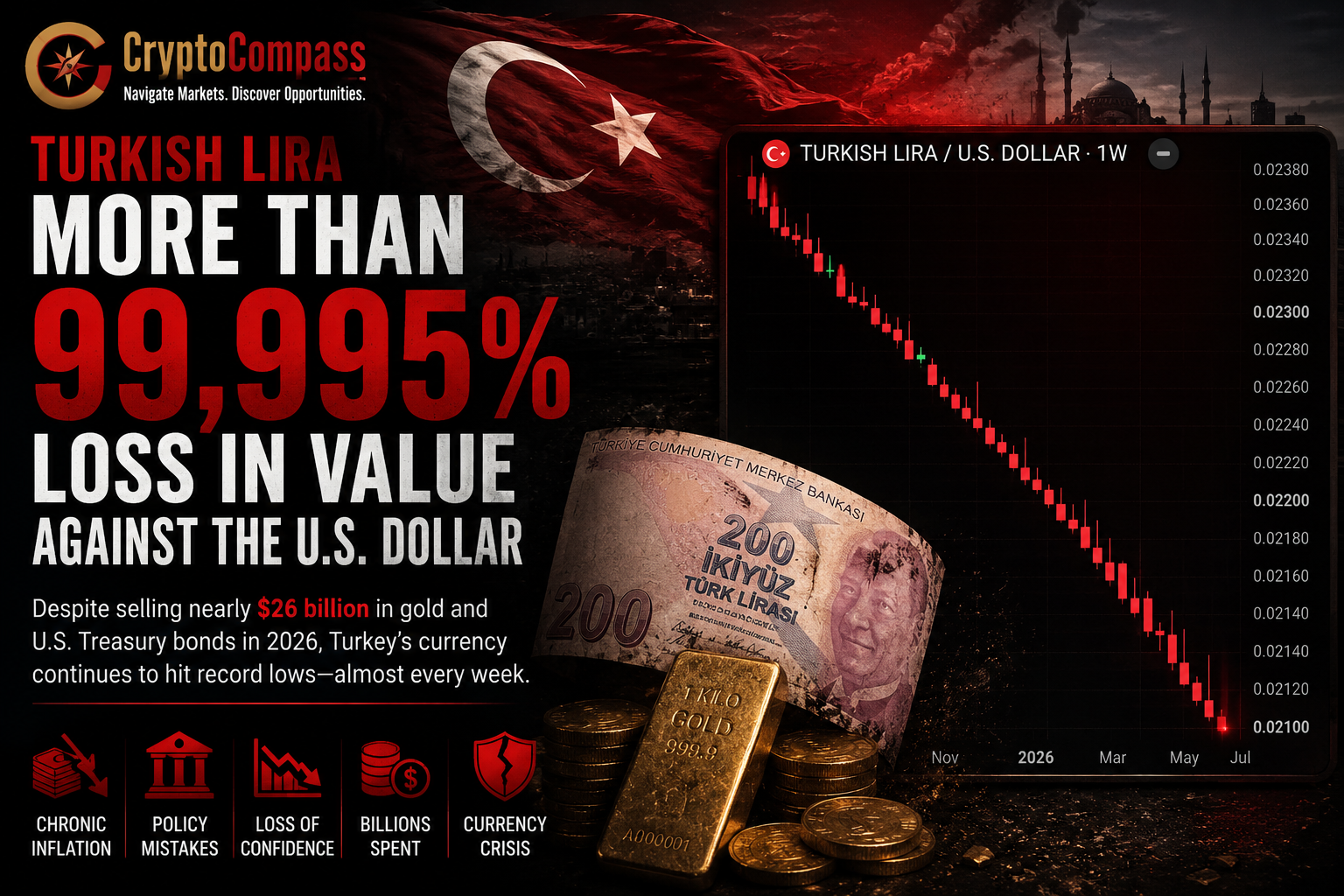
Few currencies illustrate the long-term consequences of inflation, policy mistakes and declining investor confidence better than the Turkish lira.
Over several decades, the lira has lost more than 99.995% of its value against the U.S. dollar, making it one of the most dramatic currency depreciations in modern financial history.
The crisis did not begin in a single year, nor was it triggered by a single event.
Instead, it was the product of decades of persistent inflation, repeated financial crises, political uncertainty, external debt dependence and monetary policies that gradually eroded confidence in Turkey's currency.
Even today, despite billions of dollars in government intervention, the lira continues to reach new record lows.
The Turkish experience has become a powerful reminder that defending a currency requires more than foreign exchange reserves. It requires restoring confidence in the economy itself.
Turkey's economic challenges can be traced back to the 1990s.
The country struggled with chronic inflation, large fiscal deficits and repeated political instability. Prices rose rapidly year after year, steadily reducing the purchasing power of households and businesses.
By the early 2000s, inflation had become so severe that everyday transactions involved millions of lira.
In 2001, Turkey experienced one of the worst financial crises in its modern history. The banking system came under intense pressure, investor confidence collapsed and the lira depreciated sharply.
Supported by an IMF-backed reform program, the government introduced sweeping economic changes. One of the most visible reforms came in 2005, when Turkey launched the New Turkish Lira by removing six zeros from the currency.
The redenomination simplified transactions and symbolized a fresh start.
For a period, it appeared to work.
Inflation declined, foreign investment increased and the Turkish economy enjoyed several years of relatively strong growth.
Unfortunately, those gains would not last.
The modern currency crisis began taking shape during the second half of the 2010s.
Inflation started rising again while the Turkish economy became increasingly dependent on cheap credit and foreign borrowing.
Unlike most central banks, Turkish policymakers frequently argued that higher interest rates caused inflation rather than reducing it.
As a result, borrowing costs remained lower than many economists believed was necessary.
Financial markets responded by selling the lira.
As the currency weakened, imported goods became more expensive.
Turkey imports a large share of its energy, industrial materials and manufactured products.
A weaker exchange rate therefore translated directly into higher inflation.
This created a self-reinforcing cycle.
A weaker currency increased inflation.
Higher inflation reduced confidence.
Lower confidence encouraged capital outflows.
Capital outflows weakened the currency even further.
Each stage reinforced the next.
Throughout 2026, Turkish authorities continued trying to stabilize the currency.
According to market estimates, the country sold nearly 26 billion U.S. dollars worth of gold reserves and U.S. Treasury securities in an effort to support the lira.
These interventions temporarily slowed the pace of depreciation.
They did not reverse it.
The reason is simple.
Foreign exchange reserves influence liquidity.
They do not permanently change investor expectations.
If investors believe inflation will remain high, policy credibility will remain weak or economic risks will continue increasing, selling reserves can only delay market pressure.
Eventually, markets test the currency again.
That is exactly what has happened in Turkey.
Despite repeated interventions, the lira has continued reaching new record lows against the U.S. dollar.
Many people assume that large gold reserves can protect a country's currency indefinitely.
History suggests otherwise.
Gold and foreign exchange reserves are designed to provide temporary stability during periods of market stress.
They buy governments time.
They do not solve structural economic problems.
If inflation remains elevated, productivity remains weak and investors lose confidence in policymaking, reserves gradually become less effective.
This pattern has appeared repeatedly throughout financial history.
The United Kingdom experienced it in 1992.
Several Asian economies experienced it during the Asian Financial Crisis.
Argentina has faced similar challenges for decades.
Turkey is the latest example.
The decline of the Turkish lira cannot be explained by one policy decision alone.
Several structural challenges continue weighing on the economy.
High inflation has reduced the purchasing power of households for many years.
Once inflation becomes deeply embedded, restoring price stability becomes increasingly difficult.
Financial markets place enormous importance on central bank credibility.
When investors believe inflation is no longer the primary policy objective, confidence in the currency weakens.
Turkey relies heavily on international investment and foreign financing.
When global investors reduce exposure, pressure on the lira increases rapidly.
Turkey imports much of the energy required to support its economy.
A weaker currency raises import costs, making inflation even more difficult to control.
Periods of political uncertainty, regional tensions and changing government policies have also contributed to higher risk premiums demanded by international investors.
One of the less discussed consequences of the currency crisis has been the rapid adoption of alternative stores of value.
As confidence in the lira weakened, many Turkish households looked for ways to protect their savings.
Some chose gold.
Others purchased U.S. dollars or euros.
Many turned to cryptocurrencies.
Turkey has become one of the world's most active crypto markets because digital assets offer an alternative to a rapidly depreciating local currency.
For many citizens, buying Bitcoin or dollar-backed stablecoins is no longer primarily a speculative investment.
It is a strategy for preserving purchasing power.
The same trend has been observed in Argentina, Venezuela and several other economies experiencing prolonged inflation.
Turkey's experience offers several important lessons.
First, currency stability depends more on credibility than on reserves.
Second, foreign exchange intervention can slow depreciation but rarely reverses it without broader economic reforms.
Third, inflation remains one of the most destructive forces affecting long-term wealth.
Finally, confidence is one of the most valuable assets any central bank can possess.
Once it is lost, rebuilding it often takes years.
The collapse of the Turkish lira is not simply a story about exchange rates.
It is a story about trust.
Governments can sell gold.
Central banks can spend foreign reserves.
Interest rates can be adjusted.
But lasting currency stability cannot be purchased.
It must be earned through consistent policy, credible institutions and confidence that today's decisions will create a stronger economy tomorrow.
Turkey's experience demonstrates that markets ultimately reward credibility more than intervention.
That lesson extends far beyond one country.
It applies to every economy and every currency.