Demand is usually a positive signal for any crypto asset. In the URM ecosystem, growing demand can also contribute directly to the resources held by the protocol. URM is a soft-pegged stablec
Demand is usually a positive signal for any crypto asset. In the URM ecosystem, growing demand can also contribute directly to the resources held by the protocol.
URM is a soft-pegged stablecoin on Base targeting $1.00. When demand pushes URM above that target and the configured conditions are met, the Fortress can supply URM to the market and receive USDC.
That USDC stays productive within the ecosystem. Part of it strengthens protocol-owned liquidity, while the rest is used to acquire reserve assets.
This creates a simple relationship between demand for URM and the growth of the infrastructure around it.
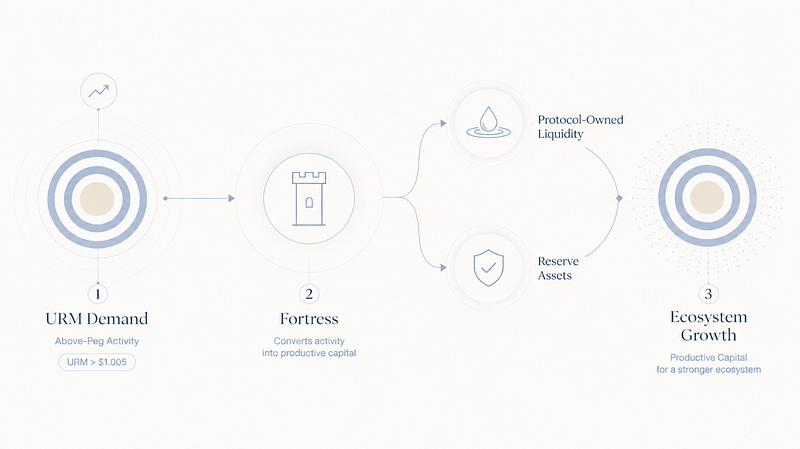
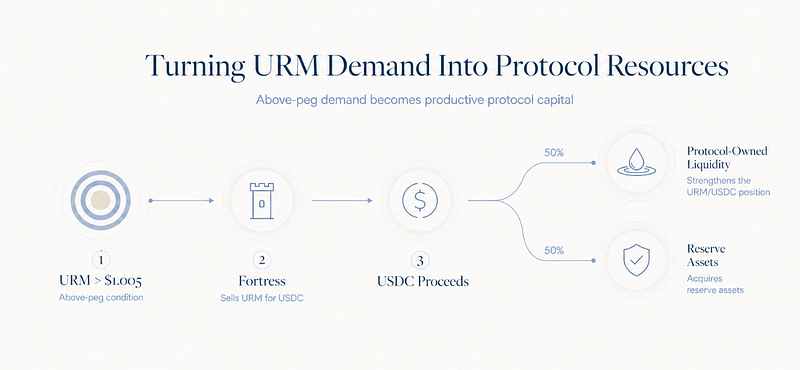
Turning URM demand into protocol resources
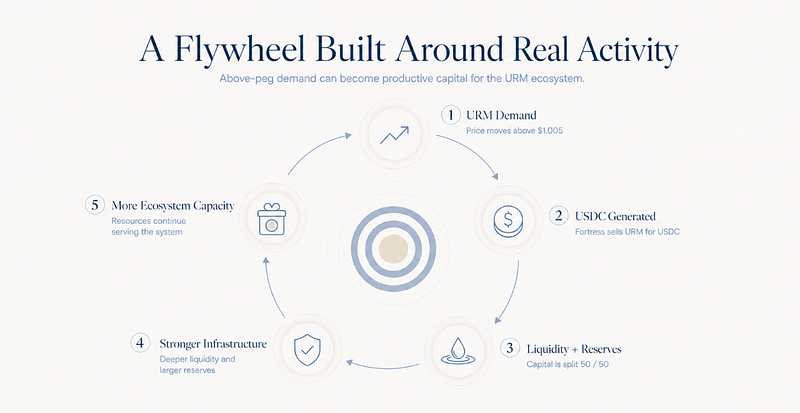
Under the current default configuration, the above-peg mechanism becomes eligible when URM trades above $1.005.
At that point, the Fortress can sell URM for USDC through the URM/USDC Uniswap V3 pool.
The USDC proceeds are then divided equally between two areas.
- 50% strengthens protocol-owned liquidity.
- 50% goes toward reserve-asset acquisition.
Both allocations serve a clear purpose. One builds deeper liquidity around URM’s target price, while the other expands the assets available to the Fortress.
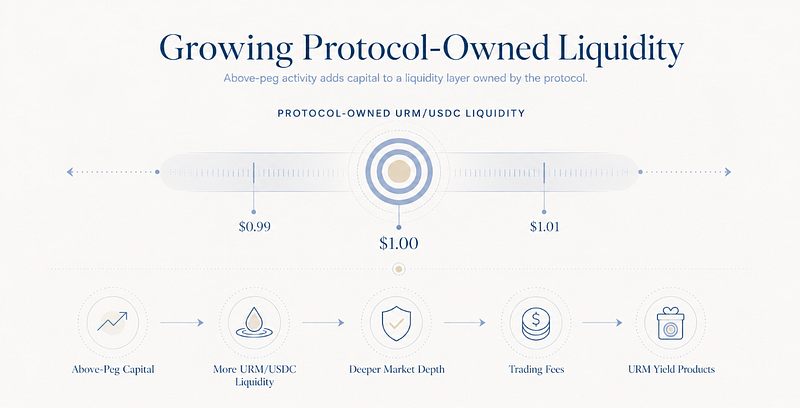
Growing protocol-owned liquidity
URM has a protocol-owned URM/USDC liquidity position concentrated between $0.99 and $1.01.
Because the position belongs to the protocol, above-peg activity can progressively add more capital to a liquidity layer that remains part of the URM system.
A deeper position gives the market more capacity to process trading activity around the $1 target. It also generates trading fees, which are periodically collected, converted into URM, and distributed to the protocol’s yield products.
This means higher demand can contribute to liquidity that continues serving the ecosystem after the initial above-peg activity has passed.
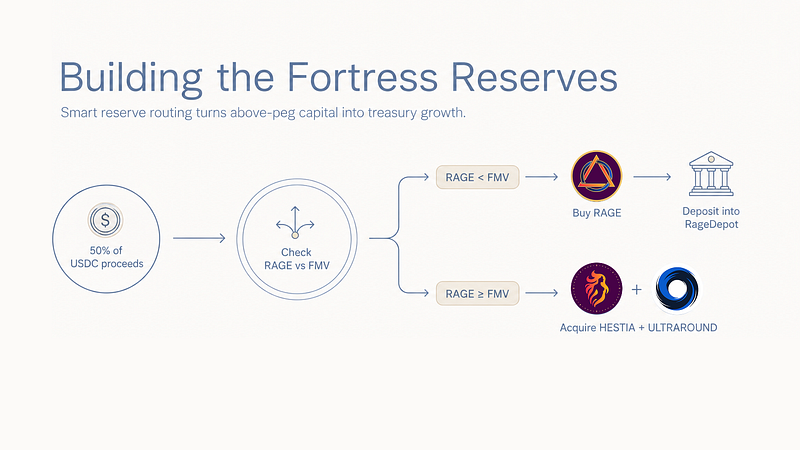
Building the Fortress reserves
The other half of the USDC is used to acquire reserve assets.
The Fortress follows smart-routing logic based on the relationship between RAGE’s market price and its fair market value, or FMV.
When RAGE trades below its FMV, the Fortress can use this capital to acquire RAGE and deposit it into the RageDepot.
When RAGE trades at or above its FMV, the Fortress can acquire HESTIA and ULTRAROUND.
This gives the treasury a value-based approach to capital allocation. Market conditions help determine where new reserve capital goes, while each eligible action can expand the assets held within the system.
How this connects URM to RAGE
This mechanism creates an important connection between URM demand and the wider ecosystem.
RAGE is backed by a treasury of HESTIA and ULTRAROUND. Its Backing Per Share, or BPS, represents the quantity of underlying assets backing each RAGE token.
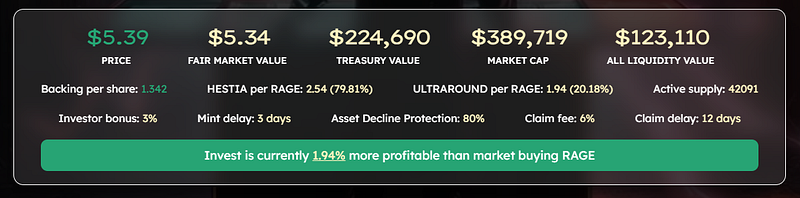
When above-peg activity directs capital toward RAGE, HESTIA, or ULTRAROUND, that activity becomes part of a broader treasury system built around productive assets.
For someone holding RAGE, this relationship matters because protocol activity can contribute to the assets supporting the ecosystem over time.
URM demand therefore reaches beyond trading activity around the stablecoin. It can become a source of capital for liquidity and reserve growth across the wider system.
A flywheel built around real activity
The broader idea is straightforward.
When demand pushes URM above its target, the Fortress can convert that market activity into USDC. The protocol then directs that capital toward liquidity and reserve assets.
More above-peg activity can contribute to deeper protocol-owned liquidity. A deeper liquidity position can handle more trading activity around the target. Reserve accumulation can also expand the resources available to the Fortress.
Each part comes from activity happening within the protocol.
That is what makes the above-peg mechanism an important part of the URM ecosystem. Demand can become productive capital that continues working inside the system.
Conclusion
URM’s above-peg mechanism connects stablecoin demand with protocol growth.
When URM trades above its target and the configured conditions are met, the Fortress can supply URM to the market, receive USDC, and direct that capital toward two areas: protocol-owned liquidity and reserve assets.
The result is a system where periods of strong demand can help deepen liquidity, grow treasury resources, and strengthen the infrastructure supporting the wider URM ecosystem.
Learn more | Whitepaper | X | Telegram