Key Takeaways Shares of IBM have declined 19% since July 14 following disappointing second-quarter results that fell short of revenue projections. Susquehanna’s James Friedman lifted his pric
Key Takeaways
- Shares of IBM have declined 19% since July 14 following disappointing second-quarter results that fell short of revenue projections.
- Susquehanna’s James Friedman lifted his price target from $225 to $235 while maintaining a Neutral stance on the stock.
- The company’s quantum computing operations are drawing increased interest, though they contribute minimal revenue at present.
- An IBM senior executive offloaded $5.75 million in company shares on August 26.
- The upcoming Quantum World Congress in September could serve as an important catalyst for investor sentiment.
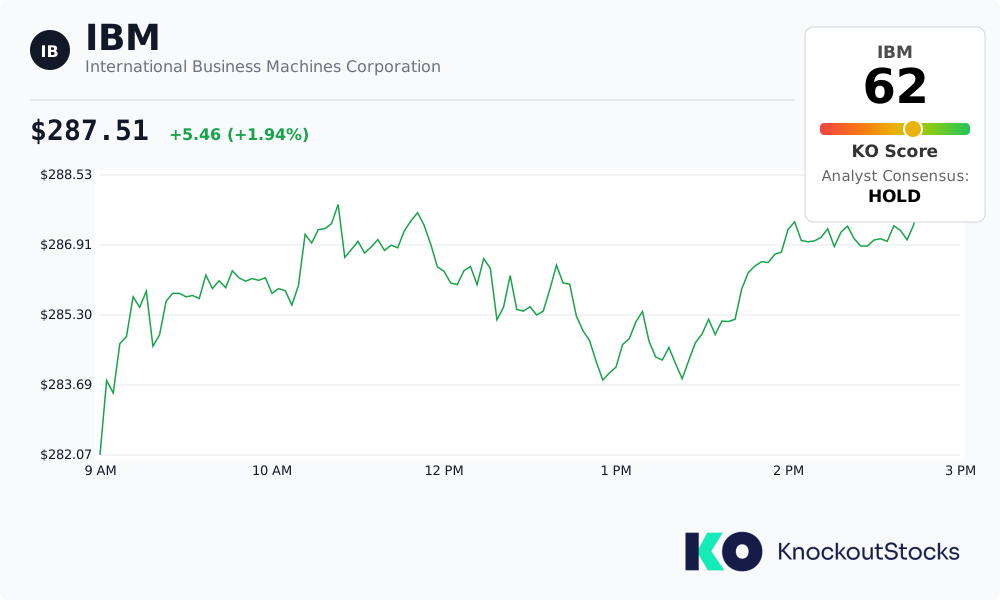
Trading commenced Monday with IBM shares at $235.78, hovering near the 52-week floor of $199.19 and significantly beneath the 52-week peak of $332.46. The stock has shed 19% of its value since July 14, a period during which the S&P 500 climbed 2.1%.
 International Business Machines Corporation, IBM
The decline began with a historic single-session drop following IBM’s pre-announcement of second-quarter results. While the company delivered earnings of $2.93 per share that aligned with expectations, revenue came in at $17.16 billion—missing the $17.46 billion Wall Street consensus. Year-over-year revenue growth registered a modest 1.1%.
A contributing pressure point has been clients reallocating capital toward artificial intelligence infrastructure, diverting funds from IBM’s conventional product portfolio.
Quantum Computing Takes Center Stage
As legacy business segments encounter headwinds, IBM’s quantum computing arm has emerged as a focal point for investors. Susquehanna’s James Friedman drew attention to IBM’s purchase of HRL Laboratories and its collaboration with the Commerce Department to establish Anderon, an independent quantum chip manufacturing facility.
The tech giant has invested in quantum computing research for more than two decades and has played a role in significant scientific achievements. However, the unit remains revenue-light, and widespread commercial adoption hinges on technological breakthroughs anticipated within this decade.
Friedman elevated his IBM price objective to $235 from $225 while retaining his Neutral outlook. He identified the annual Quantum World Congress scheduled for late September as a potential near-term catalyst for heightened technology sector interest.
Additional factors he noted include a revitalized software strategy within IBM’s consulting division under new leadership, constrained Red Hat expansion due to easing server supply bottlenecks, and a mainframe revenue timing issue—where 40% of delayed Q2 transactions closed early in the third quarter.
Executive Stock Sale and Institutional Activity
Senior Vice President Robert David Thomas divested 25,000 IBM shares on August 26 at an average price of $230.32, generating proceeds of $5.76 million. This transaction reduced his stake by 34.34%, leaving him with 47,800 shares remaining.
Meanwhile, multiple institutional investors expanded their positions throughout the second quarter. New Republic Capital boosted its holdings by 144%, and Daiwa Securities Group grew its position to 251,572 shares valued at $70.7 million.
Institutional investors and hedge funds collectively control 58.96% of IBM’s outstanding shares.
Analyst consensus on IBM stands at “Moderate Buy” with a mean price target of $265.40. The stock has garnered sixteen Buy recommendations, eleven Hold ratings, and one Sell rating. Barclays maintains an Overweight rating with a $262 price objective, while JPMorgan also carries an Overweight designation with a $250 target.
IBM’s upcoming quarterly dividend payment of $1.69 per share is slated for September 10.
The post IBM (IBM) Stock Falls 19%: Will Quantum Computing Spark a Recovery? appeared first on Blockonomi.