Is SpaceX the Palm IPO of the AI Era? Understanding the Comparison Everyone Is Talking About
As SpaceX reaches a historic valuation and investors rush to gain exposure before the next phase of growth, comparisons to the dot-com bubble are spreading across social media. But are these comparisons based on evidence, or simply a recurring feature of every bull market?
A
AnonymousCryptoCompass newsroom
June 14, 2026
5 min read
OPINION
CryptoCompass editorial visual for markets coverage.
Is SpaceX the Palm IPO of the AI Era? Understanding the Comparison Everyone Is Talking About
Every Bubble Has a Symbol
History rarely repeats perfectly.
But it often rhymes.
When investors look back at major market cycles, they tend to remember a single company that became the symbol of excessive optimism.
In the late 1990s, many point to Palm.
In the housing boom, people remember subprime mortgages.
In the crypto mania of 2021, many remember NFTs and speculative tokens.
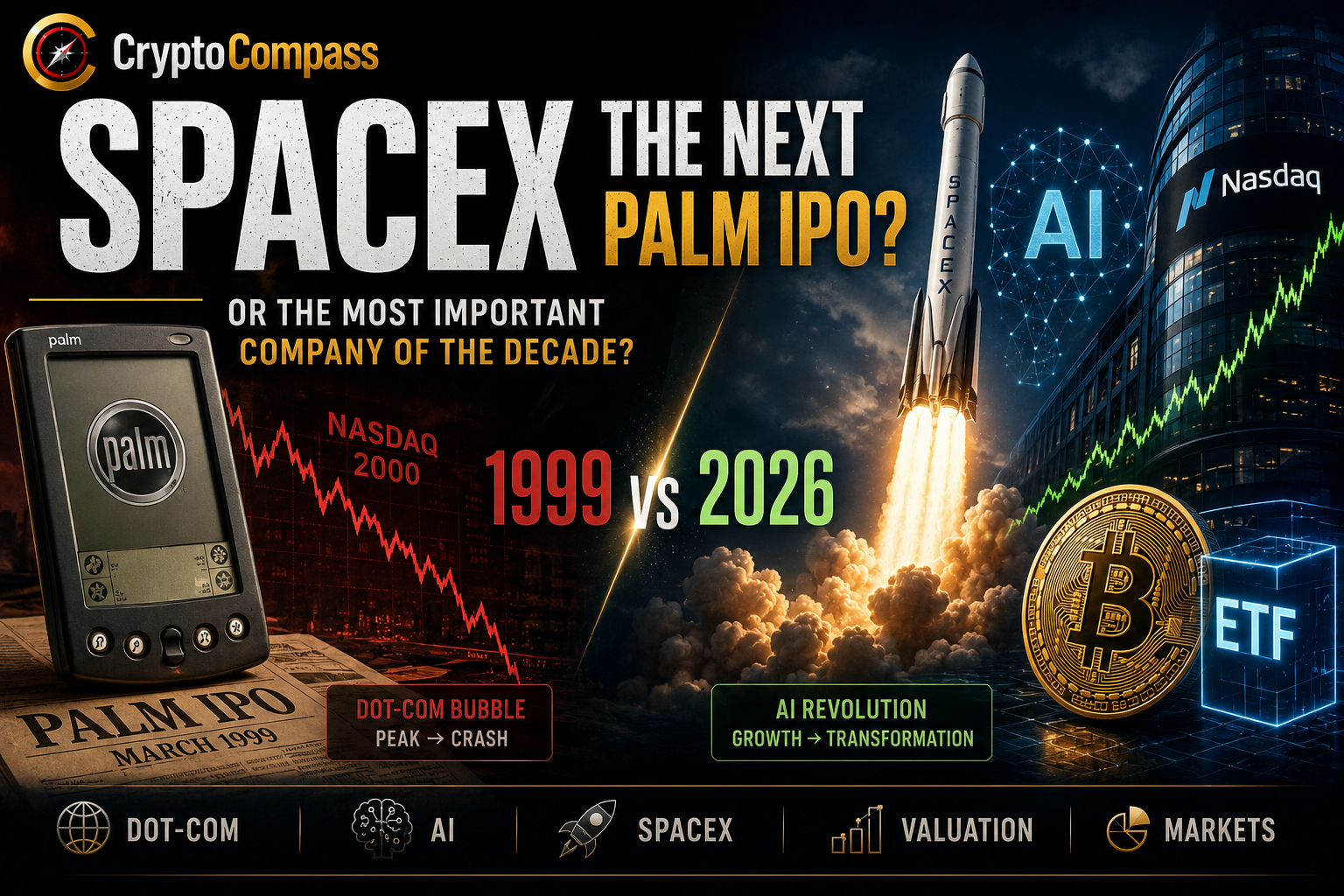
Today, some investors believe SpaceX could become that symbol for the AI era.
The argument has gained traction across financial social media.
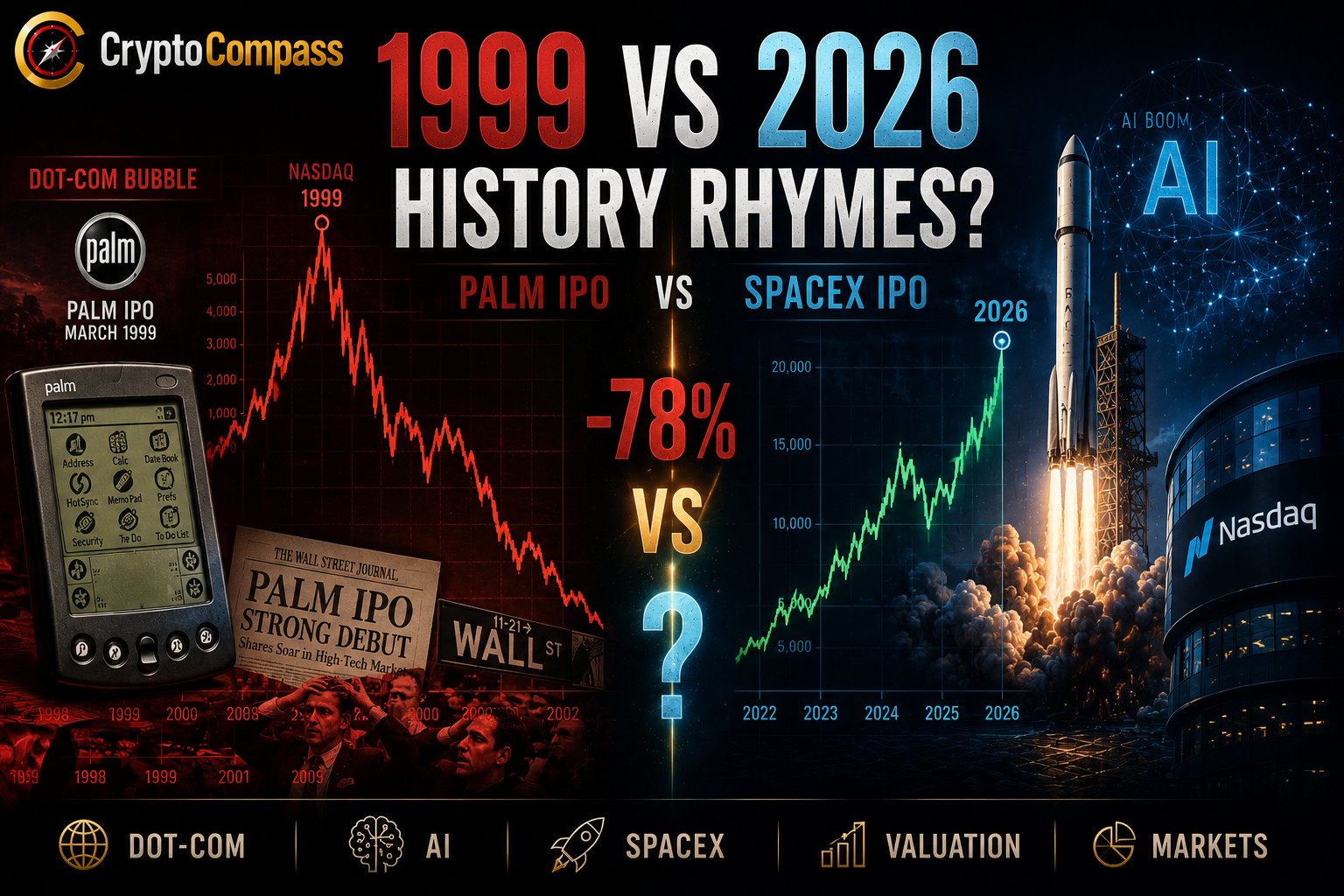
The chart being shared is simple.
Palm IPO marked the final phase of the dot-com bubble.
SpaceX IPO may mark the final phase of the AI bubble.
The implication is obvious.
If history rhymes, a major correction could follow.
But reality is more complicated.
Why Palm Became a Market Legend
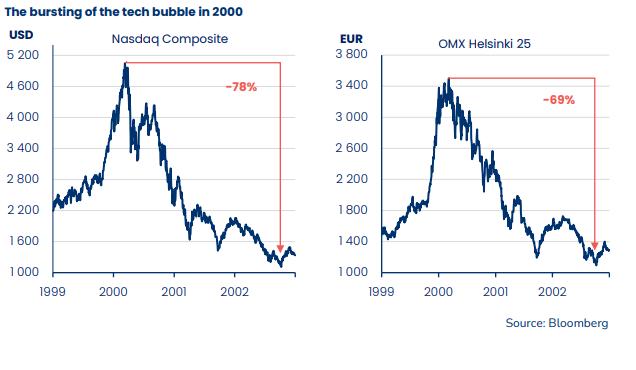
The dot-com boom of the late 1990s became one of the most significant speculative episodes in modern financial history, ending with a historic Nasdaq collapse.
To understand the comparison, investors first need to understand Palm.
Palm was one of the hottest technology companies of the late 1990s.
At the peak of the internet boom, investors believed mobile computing would change the world.
They were correct.
But they dramatically overestimated how quickly profits would arrive.
Palm's IPO became one of the most celebrated public offerings of the era.
Its valuation exploded.
Media coverage became relentless.
Retail investors rushed to participate.
Institutional investors increased exposure.
Within months, the dot-com bubble reached its peak.
Then the Nasdaq collapsed.
Between 2000 and 2002:
Nasdaq lost roughly 78%
Hundreds of internet companies disappeared
Trillions of dollars in market value evaporated
This sequence created a lasting psychological association.
Palm became remembered as a warning sign.
Why People Are Comparing SpaceX
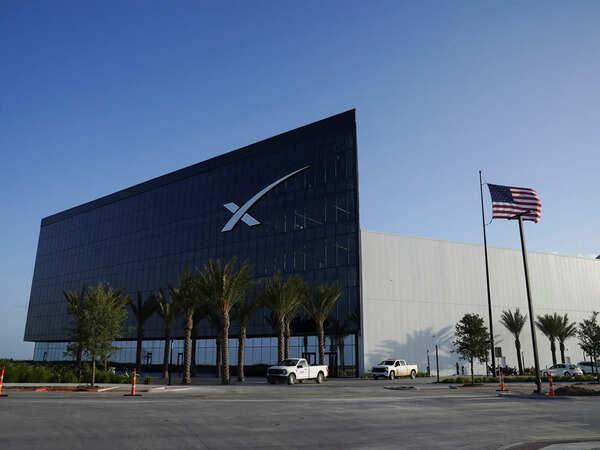
SpaceX has become one of the most closely watched companies in global markets, with investors debating whether its valuation reflects future potential or excessive optimism. The comparison is not really about rockets.
It is about market psychology.
Today's environment contains several familiar ingredients.
Artificial Intelligence Euphoria
AI dominates investment conversations.
Every earnings call mentions AI.
Every startup includes AI.
Every venture fund wants AI exposure.
Capital is flowing aggressively toward anything connected to the theme.
This resembles previous technology booms.
Record Valuations
SpaceX has achieved a valuation that would place it among the most valuable companies on Earth.
Supporters argue the valuation is justified.
Critics argue expectations have become detached from reality.
Regardless of which side is correct, the scale itself attracts attention.
Large numbers create headlines.
Headlines attract speculation.
Speculation attracts more capital.
Retail Participation
The fear of missing out remains powerful.
Investors who missed:
Amazon
Tesla
Nvidia
do not want to miss the next transformational company.
This creates enormous demand.
Often independent of valuation.
The Similarities
There are legitimate similarities between the two eras.
Narrative Dominance
In both cases, a single story captured investor imagination.
1999:
The Internet Will Change Everything
2026:
Artificial Intelligence Will Change Everything
Both statements are probably true.
The problem is that true stories can still produce bubbles.
Capital Concentration
Large amounts of capital have become concentrated around a small number of themes.
Today those themes include:
AI
Semiconductors
Space Infrastructure
Robotics
This resembles previous periods where capital became heavily concentrated around transformative technologies.
Valuation Expansion
Many assets have appreciated faster than underlying fundamentals.
This does not automatically imply a bubble.
But it does increase sensitivity to disappointment.
The Differences Nobody Talks About
This is where the comparison begins to weaken.
Palm and SpaceX are fundamentally different businesses.
Palm Was Mostly A Product Company
Palm sold devices.
Its future depended heavily on consumer adoption.
Competition was intense.
Margins were uncertain.
Technology changed rapidly.
SpaceX Owns Infrastructure
SpaceX operates launch systems.
Satellite networks.
Defense relationships.
Communications infrastructure.
Government contracts.
Recurring revenue streams.
These businesses tend to be more durable.
The AI Revolution Already Generates Revenue
The internet boom was largely based on future expectations.
Today's AI boom is already generating massive cash flows.
NVIDIA alone produces more profit than many countries.
Microsoft, Amazon, Google and others are investing hundreds of billions because demand already exists.
That distinction matters.
Could SpaceX Still Mark a Market Top?
Absolutely.
But not necessarily because it is overvalued.
Major market peaks often require a catalyst.
Sometimes that catalyst is an IPO.
Sometimes it is a policy change.
Sometimes it is simply exhaustion.
The most dangerous assumption investors can make is believing:
Great company = impossible to overpay for.
History repeatedly proves otherwise.
What This Means For Bitcoin
Bitcoin investors should pay close attention to this debate.
Not because Bitcoin depends on SpaceX.
But because both compete for capital.
Institutional investors allocate money across:
Bitcoin
AI
SpaceX
Semiconductors
Private Equity
When risk appetite is strong, all may benefit.
When liquidity contracts, all may suffer.
This is why macro conditions matter more than individual narratives.
The Bigger Question
The real question is not whether SpaceX resembles Palm.
The real question is whether investor expectations have once again moved ahead of reality.
Every generation believes its technology revolution is different.
Sometimes it is.
Sometimes it isn't.
The challenge is determining which situation we are living through before history delivers the answer.
CryptoCompass View
The comparison between Palm and SpaceX is not a prediction.
It is a warning.
Not a warning about SpaceX specifically.
A warning about human behavior.
Every bull market eventually creates a symbol.
A company.
A technology.
A narrative.
A belief that "this time is different."
Sometimes that belief changes the world.
Sometimes it changes portfolios.
The hardest part is figuring out which one comes first.
Questions Investors Should Ask
Is AI adoption generating real economic value?
Are valuations growing faster than revenues?
How dependent are markets on continued liquidity?
What happens if interest rates remain high?
Are investors buying fundamentals or buying stories?
Those questions matter far more than whether a chart on social media looks similar to 1999.
You can also read this news on BH NEWS: Dog-Themed Crypto Draws Fresh Attention as Trends Shift Dogecoin, the cryptocurrency initially seen as a playful entrant to the crypto world, has recen
Dogecoin, the meme-based cryptocurrency regularly spotlighted by Elon Musk, has returned to the market’s focus after stabilizing at the crucial $0.081 support zone following a steep decline.
TLDR: Dogecoin trades near $0.088 after rebounding from a recent sharp drop toward $0.078 level. Analysts cite a repeating triangle apex retest pattern seen in 2017 and 2020 cycles. Whale act