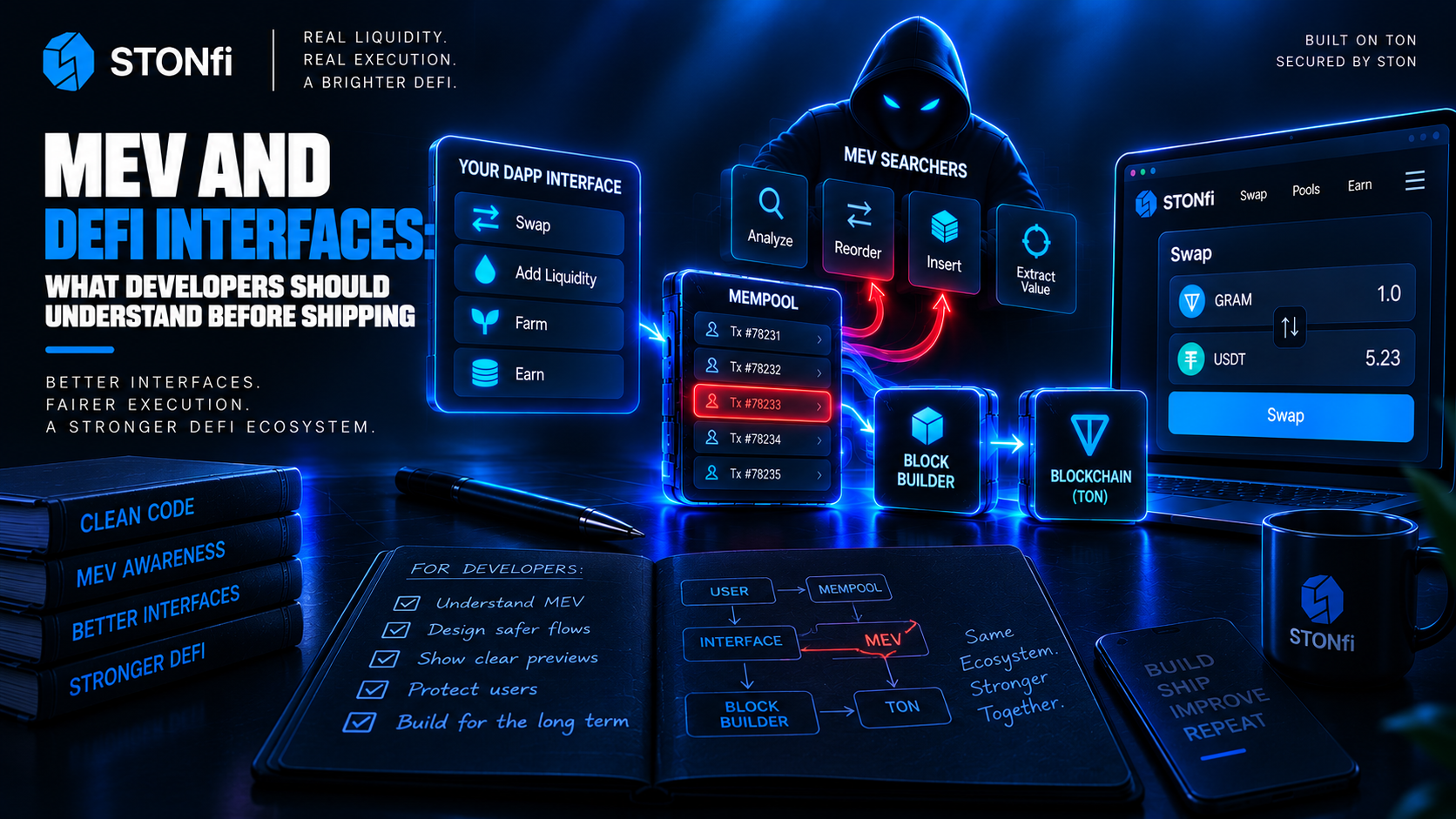
MEV and DeFi Interfaces: What Developers Should Understand Before Shipping MEV gets talked about as a validator-and-mempool problem, which is true but incomplete — a meaningful chunk of the e
MEV and DeFi Interfaces: What Developers Should Understand Before Shipping
MEV gets talked about as a validator-and-mempool problem, which is true but incomplete — a meaningful chunk of the exposure a user actually experiences is decided by decisions made in the interface layer, long before any transaction reaches a block producer.
I used to think of MEV as something that happened "underneath" an application — a mempool-level phenomenon that frontend developers couldn't really influence one way or the other, the same way a website builder doesn't influence TCP packet routing. That turned out to be wrong, and it took building alongside people who actually ship swap interfaces for a living to understand why. A meaningful share of the MEV a user actually experiences isn't decided by validators — it's decided by choices an interface makes well before a transaction ever reaches a mempool: what slippage default it suggests, how it displays a quote, whether it warns about an unusually large price movement, and how much time it leaves between a quote and a signature. None of that is validator behavior. All of it is product design.
My take: Most "how to protect users from MEV" advice is aimed at protocol designers and validator-level infrastructure. That's necessary but it's not sufficient — a huge amount of a user's actual MEV exposure is shaped by interface decisions that have nothing to do with consensus mechanics at all.
🧩 What MEV Actually Is, and Why a Public Mempool Makes It Possible
MEV — maximal extractable value — describes profit that can be extracted by controlling the order, inclusion, or exclusion of transactions within a block, beyond whatever a validator earns from ordinary fees. The mechanism that makes this possible is structural: on most chains, pending transactions sit visible in a public mempool before they're confirmed, which means anyone watching that mempool can see a profitable-looking transaction coming and react before it settles.
The most common pattern that grows out of this visibility is the sandwich attack, and it's easiest to see as a sequence rather than a single event:
- A searcher watching the mempool spots a pending swap large enough to move a pool's price meaningfully
- Before that swap confirms, the searcher submits their own trade in the same direction, executing first and pushing the price further that way
- The original user's trade executes against this now-worse price, exactly as submitted, with nothing technically broken
- The searcher immediately reverses their own position, capturing the price difference their first trade created — at the original user's direct expense

My take: What makes this pattern so quietly effective is that nothing in it looks like an attack from the user's side. Every transaction is valid, the swap goes through, and the only evidence is a number that came in worse than the quote implied — which most people just chalk up to normal market movement.
This same mempool visibility also enables plain front-running on its own, where a searcher simply copies a profitable-looking transaction outright and pays a higher fee to have their copy included first, capturing an opportunity the original transaction was reaching for without needing the three-step sandwich structure at all.
Whether any of this is technically possible on a given chain depends heavily on that chain's architecture — how transactions become visible before confirmation, how ordering within a block actually gets decided, and whether there's a meaningful window where a pending transaction can be observed and reacted to before it settles. That single architectural detail is the entire reason MEV exposure varies so much from one chain, and one execution model, to another — it's not a universal tax on all blockchain activity, it's a specific consequence of a specific kind of visibility.
🔍 Where This Actually Shows Up in a Swap Interface, and Why It's a Product Problem, Not Just a Chain Problem
Here's the part that took me longest to really internalize: even when the underlying chain and execution model meaningfully reduces the possibility of MEV extraction, the interface built on top can still expose users to real losses through choices that have nothing to do with the chain's own architecture — and can just as easily reduce that exposure through choices that have nothing to do with it either.

Three specific choices show this most clearly:
- Slippage defaults. An interface that defaults every user to a generous, one-size-fits-all slippage tolerance — set high specifically so trades "just work" without failing — hands every searcher watching for opportunities a wider window to extract value from, on every trade using that default, whether or not that particular trade needed it. The chain didn't ask for a high default; the app chose one, almost always to reduce failed-transaction support tickets.
- Quote presentation. A quote presented as if it's a fixed, guaranteed number, held open for an unnecessarily long window between confirmation and signature, gives more time for the market — and anyone specifically watching that trade — to move against the user before execution settles.
- Trade-size warnings. A well-designed interface flags when a proposed trade is large enough, relative to current pool depth, to represent an attractive sandwich target — not to scare users off, but so splitting a large trade into smaller pieces becomes an informed choice rather than something discovered only after a worse-than-expected execution.
None of these three examples touch consensus, block production, or validator incentives at all. They're entirely product-layer decisions, made by whoever built the interface, and they meaningfully change how much MEV exposure a user actually experiences on a chain whose underlying architecture might otherwise make that exposure structurally small.
⚙️ What Actually Reduces Exposure, Beyond Just "Be Careful"
Telling users to "be careful about slippage" is true and also close to useless as practical guidance, because it puts the entire burden of understanding an adversarial, largely invisible dynamic onto the person least equipped to reason about it in real time, mid-transaction, under time pressure. The more durable fixes live at the architecture and interface level, not in a warning label.
The most structurally significant one is removing the public visibility that makes front-running and sandwiching possible in the first place. A request-for-quote model, where a trade is resolved through private, competing offers rather than broadcast openly to a public mempool before execution, closes off the specific window a sandwich attack depends on — there's no publicly visible pending transaction for a searcher to react to, because the competitive process for finding the best price happens before anything is exposed for front-running to begin with. This is a genuinely different shape of protection than telling users to set tighter slippage; it removes the opportunity structurally rather than asking users to defend against it individually, transaction by transaction.

Below that architectural layer, a handful of interface-level choices compound meaningfully on top of it:
- Tighter default slippage tolerance, rather than a generous one-size-fits-all number chosen mainly to reduce failed-transaction complaints
- Quotes that are refreshed aggressively and communicated as time-bound, rather than displayed as fixed guarantees that hold indefinitely between confirmation and signature
- Minimum received treated as the number that actually matters, shown clearly rather than buried below an optimistic headline figure
- Proactive warnings when a trade size is large enough relative to pool depth to represent an attractive target for extraction
None of these eliminate MEV as a category. Together, they meaningfully shrink both the opportunity available to extract it and the size of the loss when extraction does happen, and they do it without requiring the user to understand mempool mechanics at all — which is the right place for that burden to sit, because most users never will, and shouldn't have to.
🧭 Where STONfi Actually Sits on Top of This
This isn't an abstract industry problem sitting somewhere outside STONfi's own architecture — the specific choices described above are exactly what shape how exposed a STONfi swap actually is in practice.
Omniston's RFQ-based execution model is the structural piece doing the heaviest lifting here. Instead of broadcasting a pending swap into a public mempool where it can be watched and reacted to before it settles, a STONfi swap through Omniston gets resolved through competing resolvers offering private, executable quotes — the exact visibility that a sandwich attack depends on to identify and react to a profitable target simply isn't present in the same form.

My take: That's not a slippage setting or a warning label doing the protecting here. It's the underlying execution shape itself being different from the one that makes classic sandwiching straightforward on a fully transparent public-mempool chain.
On top of that architectural choice, the interface-level decisions matter just as much as the general case above suggests. STONfi's swap flow surfaces minimum received as the figure that actually matters, not just an optimistic headline number, and treats quotes as time-bound rather than presenting them as fixed guarantees that hold indefinitely between confirmation and signature. Price impact is shown before you commit to a trade, specifically so an unusually large trade relative to pool depth is a visible, informed decision rather than something you discover only after execution comes back worse than expected. None of this is framed explicitly as "MEV protection" in STONfi's own marketing language, and it doesn't need to be — it's simply what a swap interface looks like when the people building it understood, at the design level, where extraction opportunities actually live and built the defaults to close them rather than leave them open in the name of fewer failed-transaction support tickets.
🧭 Conclusion
MEV is genuinely a chain-and-consensus-level phenomenon at its root, but treating it as purely a validator problem lets interface developers off the hook for decisions that measurably shape how much of it users actually experience in practice. A public mempool creates the underlying opportunity; slippage defaults, quote presentation, and trade-size warnings decide how large that opportunity actually gets for any individual user, on any individual trade. Chains and protocols that remove mempool-level visibility through mechanisms like RFQ close off the structural opportunity at its source. Interfaces that make quotes time-bound, minimum-received figures prominent, and large-trade risk visible shrink what's left on top of that. Neither replaces the other, and a developer shipping a swap interface who treats MEV as someone else's problem to solve is quietly leaving real value on the table for their own users to lose, one sandwich at a time.
❓ Frequently Asked Questions
Does using an RFQ-based system like Omniston eliminate MEV completely?It removes the specific mempool visibility that classic front-running and sandwiching depend on, which meaningfully reduces certain categories of extraction. It doesn't make every form of MEV theoretically impossible across all contexts, but it closes off the most common practical attack surface.
Is a high default slippage tolerance always a sign of bad interface design?Not necessarily bad, but it's a trade-off that should be visible and adjustable rather than hidden. A high default reduces failed transactions but widens the window available for value extraction on every trade using it.
Why does quote presentation matter if the underlying chain is already fast?Even fast finality doesn't eliminate the window between a quote being generated and a user signing it. How that window is communicated and how long it's allowed to stay open are separate, interface-level decisions.
Can a user personally do anything about MEV beyond trusting the interface?Setting tighter slippage tolerance for smaller, less time-sensitive trades and paying attention to price impact warnings before confirming large trades both help, though the more durable protection comes from the underlying execution architecture rather than individual vigilance alone.
Disclosure: Official STONfi Ambassador.