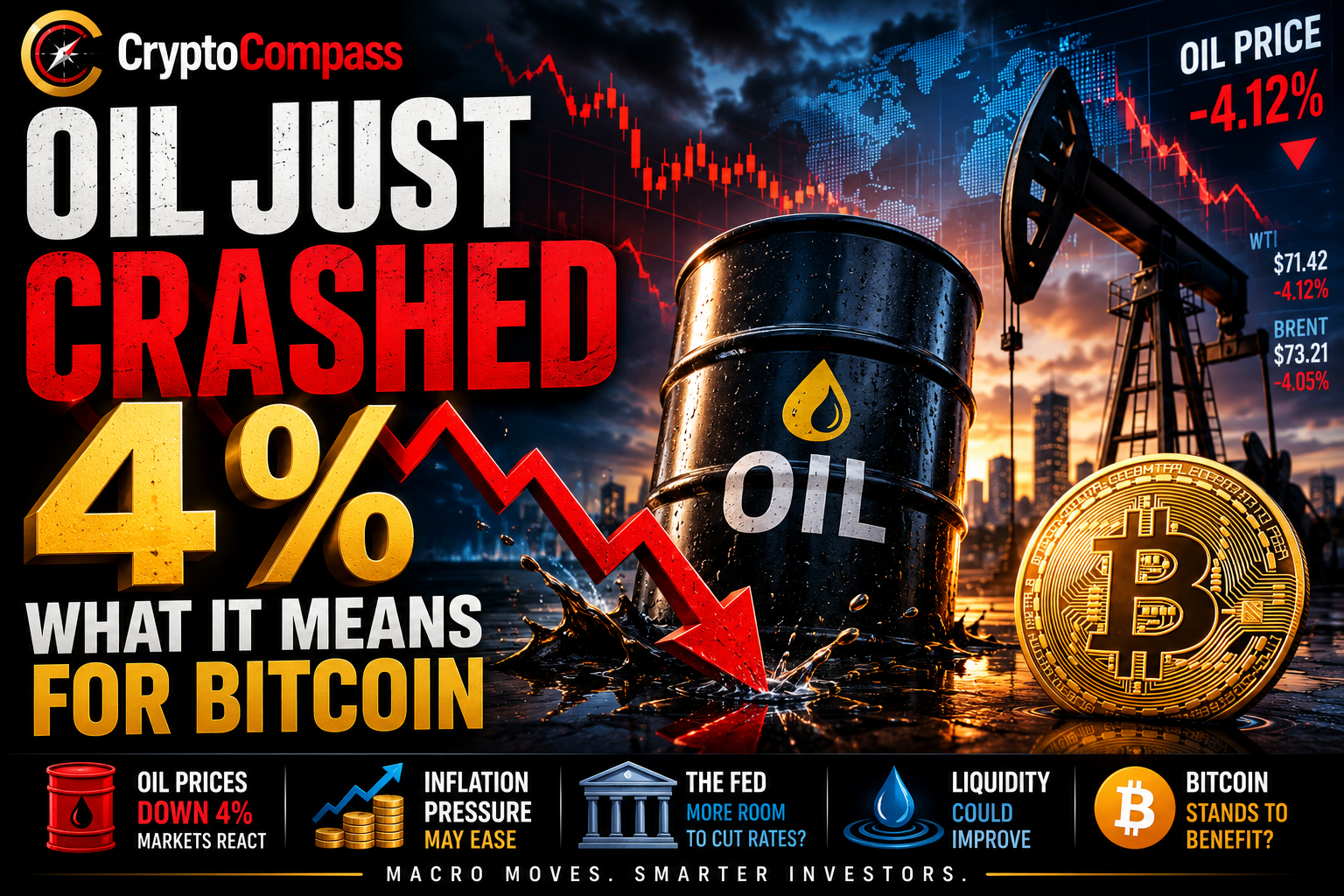
Oil prices just suffered one of their sharpest daily declines in weeks. While most crypto investors may ignore the move, energy markets often provide important clues about inflation, interest rates, and the future direction of Bitcoin.
A
AnonymousCryptoCompass newsroom
June 12, 2026
8 min read
ANALYSIS
CryptoCompass editorial visual for markets coverage.
Oil Just Crashed 4%. What It Means for Bitcoin.
The Market Move Most Crypto Investors Missed
While Crypto Twitter spent the day debating Bitcoin's next breakout, another market delivered one of the most important signals of the week.
Oil fell more than 4%.
For energy traders, that was a major move.
For macro investors, it immediately changed conversations around inflation, interest rates, and economic growth.
For crypto investors, however, the reaction was largely muted.
That may be a mistake.
Because oil remains one of the most important variables influencing the global economy.
And increasingly, the global economy influences Bitcoin.
Why Oil Matters More Than Most Investors Realize
Oil is not simply a commodity.
It is one of the foundations of modern economic activity.
Almost everything depends on energy somewhere in the supply chain.
Transportation.
Manufacturing.
Shipping.
Agriculture.
Construction.
When oil prices rise sharply, costs spread throughout the economy.
When oil prices fall, the opposite often occurs.
That is why central banks, governments, and institutional investors pay close attention to energy markets.
Oil influences inflation.
Inflation influences monetary policy.
Monetary policy influences liquidity.
And liquidity influences risk assets.
Including Bitcoin.
The Inflation Chain Reaction
The relationship is not always immediate.
But it is often powerful.
A sustained decline in oil prices can reduce pressure on transportation and production costs.
That can help slow inflation.
Lower inflation gives central banks greater flexibility.
Greater flexibility can create conditions for lower interest rates.
And lower interest rates often support risk-taking across financial markets.
This is why oil traders frequently influence markets far beyond energy itself.
What Markets Are Really Watching
Oil remains one of the most important commodities influencing inflation, transportation costs, and global economic activity. The 4% decline in oil is not important because of the number itself.
It is important because of what it might signal.
Investors are asking:
Is inflation cooling again?
Will the Federal Reserve face less pressure?
Could rate cuts become more likely?
Will liquidity improve?
These questions matter far more than the daily movement of oil futures.
Markets are constantly attempting to price the future.
Oil often provides one of the earliest clues.
Why Bitcoin Cares About Liquidity
Investors closely monitor Federal Reserve policy as inflation and energy prices continue shaping expectations for future interest rates.
Many investors still think Bitcoin trades independently.
That perception is increasingly outdated.
Bitcoin ETFs have brought institutional investors into the market.
Portfolio managers now evaluate Bitcoin alongside:
Equities
Bonds
Gold
Commodities
Private market investments
As a result, Bitcoin is becoming more sensitive to macroeconomic conditions.
Liquidity matters.
Capital availability matters.
Interest rates matter.
And all three are influenced by inflation expectations.
The Fed Remains the Biggest Variable
No institution has greater influence over global liquidity than the Federal Reserve.
If falling oil prices contribute to easing inflation pressures, markets may become more optimistic about future policy decisions.
That does not guarantee rate cuts.
Nor does it guarantee higher Bitcoin prices.
But it can influence expectations.
And expectations often move markets long before policy changes occur.
This is one reason professional investors spend as much time monitoring macro data as they do watching asset prices.
The Geopolitical Factor
Energy markets rarely move in isolation.
Oil prices remain sensitive to:
Middle East tensions
Shipping disruptions
Sanctions
OPEC production decisions
Global economic growth
A single geopolitical development can quickly change supply expectations.
That is why investors should avoid viewing one day's price movement as a complete trend.
The broader context matters.
What Smart Money Is Watching
Retail investors often focus on price.
Institutional investors often focus on cause.
Why did oil fall?
What does it mean for inflation?
How might central banks respond?
How could liquidity conditions change?
These are the questions driving large-scale capital allocation decisions.
Understanding them can provide a significant advantage.
Looking Ahead
Oil may not dominate crypto headlines.
But it remains one of the most important indicators in global markets.
If energy prices continue moving lower, inflation pressures could ease.
If inflation eases, central banks gain flexibility.
If central banks gain flexibility, liquidity conditions may improve.
And if liquidity improves, Bitcoin could benefit.
The relationship is not guaranteed.
But it is far too important to ignore.
CryptoCompass View
Most crypto investors watch Bitcoin.
Professional investors watch what moves Bitcoin.
Oil remains one of the most influential forces shaping inflation, monetary policy, and global liquidity.
And in today's market, liquidity still matters more than almost everything else.
Navigate Markets. Discover Opportunities.
Frequently Asked Questions
Why does oil affect Bitcoin?
Oil influences inflation expectations, which can affect central bank policy and liquidity conditions that impact risk assets.
Does a falling oil price automatically mean Bitcoin will rise?
No. The relationship is indirect and influenced by multiple macroeconomic variables.
Why do institutional investors monitor oil markets?
Oil provides insight into inflation, economic growth, consumer demand, and future monetary policy expectations.
What matters more: oil or crypto-specific news?
Both matter, but macroeconomic forces often influence the broader market environment in which crypto trades.
What should investors watch next?
Oil prices, inflation reports, Federal Reserve communications, Treasury yields, and Bitcoin ETF flows.
What to know: Binance XRP reserves dropped by 89 million tokens in one day. Negative funding rates reveal that traders increased bearish futures positions. Shrinking exchange supply contrasts
Bitcoin miners are once again in the spotlight as on-chain indicators suggest a capitulation phase, a dynamic that some traders and analysts view as a potential long-term entry point for BTC
What to Know SHIB defended critical support as oversold conditions attracted renewed buyers. Multiple resistance levels now stand between SHIB and recovery. Mercari and Kalshi developments ad