Ask ten people in your circle how they draft an email, debug a line of code, or summarise a long PDF today, and at least eight will mention ChatGPT, Grok, Claude, or Gemini. Spend enough time
Ask ten people in your circle how they draft an email, debug a line of code, or summarise a long PDF today, and at least eight will mention ChatGPT, Grok, Claude, or Gemini. Spend enough time around tech founders and enthusiasts, and it is easy to walk away believing that traditional search engines are already dead.
Yet when you step outside that bubble and look at how the wider internet actually behaves, a very different picture emerges. People have not abandoned the search bar. In fact, on web browsers, AI chatbots are still trailing traditional search by a massive margin.
That is the central takeaway from a June 2026 traffic study by digital market intelligence firm OneLittleWeb. As part of its Most Visited Websites in the World analysis, the firm tracked monthly web visits across 10,171 global websites using estimates from Semrush and Ahrefs. Their goal was to measure the real traffic gap between traditional search engines and the growing wave of AI chatbots.
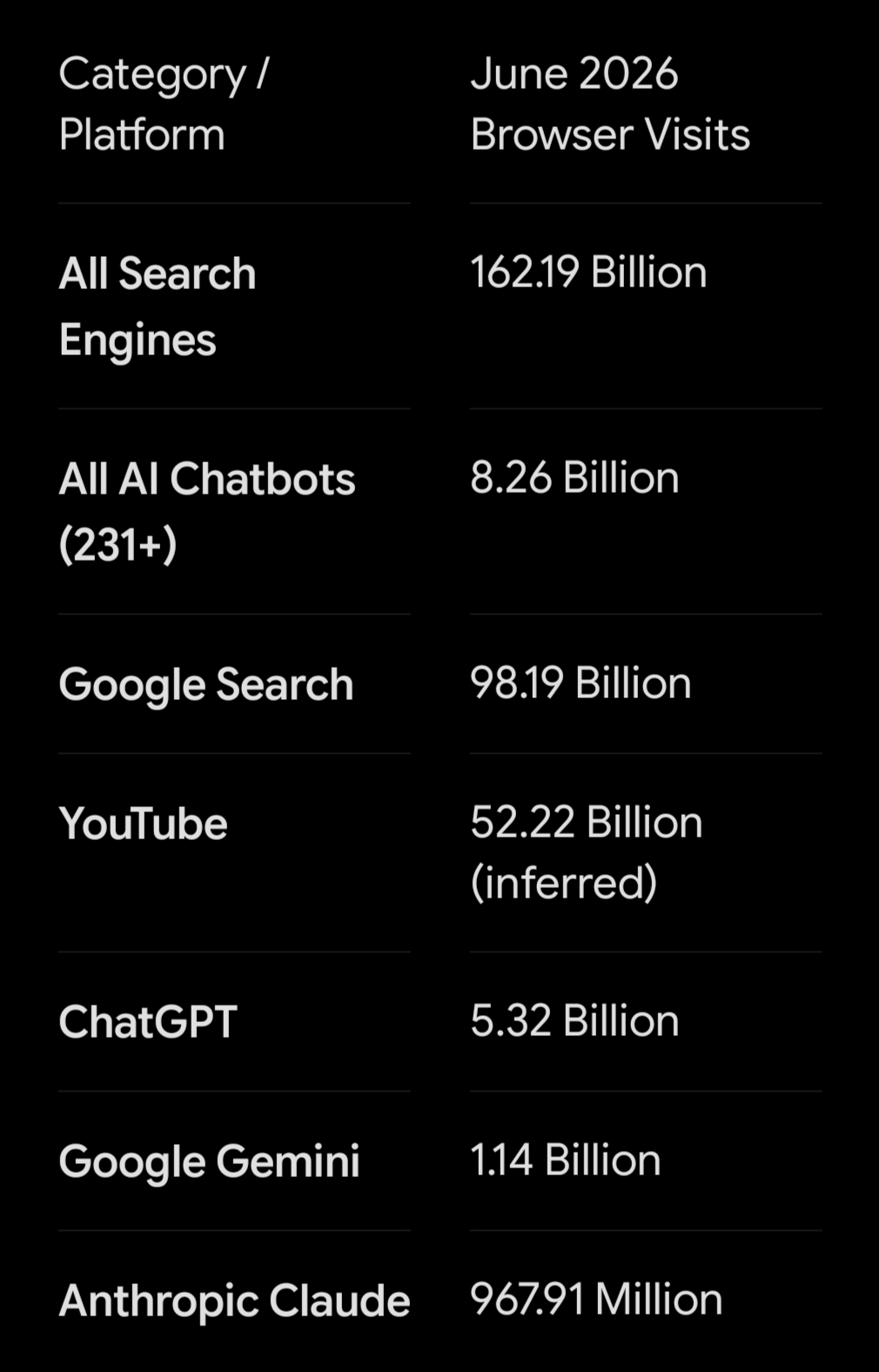
Pictorial representation of June 2026 web traffic. Data source: OneLittleWeb
The gap between the two categories remains huge. In June 2026, tracked global websites recorded a combined 283.65 billion browser visits. Search engines accounted for 162.19 billion of those visits, representing 57.2% of all tracked web traffic.
By comparison, the entire AI chatbot category, covering more than 231 distinct platforms in the dataset, pulled in 8.26 billion visits, or roughly 2.9% of total web traffic. Put simply, search engines received 19.6 times more browser visits than AI chatbots in June, leaving a gap of153.93 billion visits in a single month.
The head-to-head numbers between the market leaders are just as lopsided. Google alone generated 98.19 billion visits in June, nearly 11.9 times more traffic than all 231+ AI chatbots combined. OpenAI’s ChatGPT led the chatbot pack with 5.32 billion visits, meaning Google drew roughly18.5 times more browser visits than its biggest AI challenger.
Within the chatbot space, ChatGPT remains the clear default for most users, holding 64.4% of all chatbot browser traffic. Google’s Gemini came in a distant second with 1.14 billion visits, followed closely by Anthropic’s Claude at 967.91 million.
Reading between the lines: What the methodology leaves out
While OneLittleWeb’s numbers offer a clean baseline, anyone using this report to make product, SEO, or publishing decisions needs to pay close attention to how the data was gathered. Two methodological choices stand out.
First is what counts as a search engine. OneLittleWeb notes in its findings that Google and YouTube combined generated 150.41 billion web visits, representing 92.74% of all search engine traffic. Since Google accounted for 98.19 billion visits, simple subtraction tells us that YouTube contributed52.22 billion visits to the search engine total.
Google’s new AI search Ad tools
To be fair, millions of people use YouTube to search for how-to guides, lectures, and product reviews. Still, someone opening a browser tab to watch a music video or a comedy skit is not conducting a traditional web search. If you strip YouTube’s 52.22 billion visits out of the search category, traditional search traffic drops to roughly 109.97 billion visits. That is still massive, but it narrows the gap between search engines and AI chatbots from 19.6x down to about 13.3x.
Second, and more importantly, the report only measures browser-based website visits. As the methodology explicitly states, the figures do not capture unique users or mobile app usage.
Think about how you use these tools on your phone. When most people want to run a Google search, they open Chrome or Safari and type into the browser bar, which logs a web visit. When regular ChatGPT, Claude, or Gemini users need an answer on the go, they rarely open a mobile browser and type chatgpt.com. They tap the dedicated mobile app on their home screen. By relying purely on Semrush and Ahrefs browser estimates, the data naturally captures almost all of Google’s mobile reach while missing a massive chunk of daily AI chatbot sessions happening inside iOS and Android apps.
Even the month-on-month dip recorded in June hints at how differently people use these platforms. Search engine traffic dipped 2.53% in June, while AI chatbot visits fell by a steeper 5.78% (a loss of roughly 507.43 million visits). Because students, researchers, and white-collar workers make up the core base of desktop AI users, a nearly 6% drop in June makes complete sense: universities and schools across the Northern Hemisphere close for summer holidays, and academic prompting slows down.
The web traffic numbers reveal coexistence, not replacement
Does this mean the AI wave is overhyped? I wouldn’t dare say that. Pulling 8.26 billion browser visits in a single month for a category that barely existed four years ago is a serious scale.
As OneLittleWeb co-founder Sujan Sarkar explains in the report, these numbers do not tell us whether chatbots will eventually replace search; they simply show the scale of both habits today. People still rely on Google when they need to navigate to a specific website, check local store hours, buy a flight ticket, or verify live news. They turn to ChatGPT and Claude when they want synthesis, drafting, or direct answers without sifting through ten different blog posts.
Sarkar also points to the most important shift happening right now: traditional search is absorbing AI directly into its own interface. With Google rolling out AI summaries at the top of its search results, the line between a search engine and a chatbot is blurring every month.
For website owners, media houses, and businesses that rely on organic search traffic, OneLittleWeb’s report is both a relief and a warning. The relief is that 162 billion monthly search visits mean traditional SEO is still very much alive. The warning is that the battle is no longer just about whether users pick Google over ChatGPT. It is about where people choose to start looking for information and whether they ever need to click through to your website once they get their answer.
