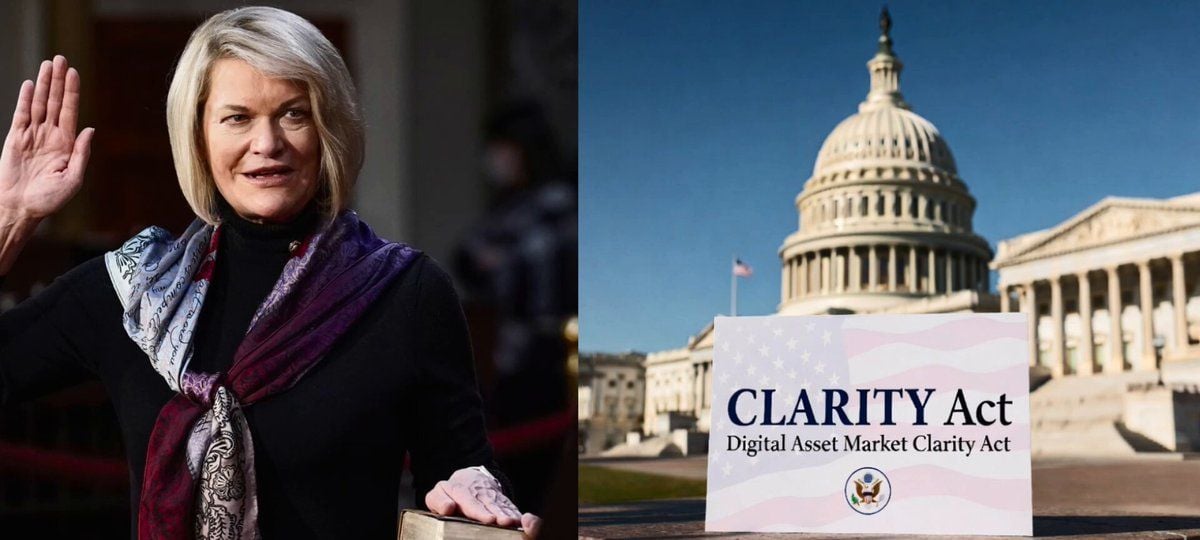
Lummis Raises the Stakes on Developer Liability Senator Cynthia Lummis (@SenLummis) is sounding the alarm: if Congress fails to pass the Digital Asset Market Clarity Act (CLARITY Act) in the
Lummis Raises the Stakes on Developer Liability
Senator Cynthia Lummis (@SenLummis) is sounding the alarm: if Congress fails to pass the Digital Asset Market Clarity Act (CLARITY Act) in the current session, American software developers who write and publish blockchain code could face criminal prosecution. Speaking publicly on the issue, Lummis argued that developers should not carry legal risk simply for publishing open-source blockchain software, a position she has championed throughout the long legislative fight over U.S. crypto market structure.
The concern centres on Section 1960 of federal law, which criminalises the operation of an unlicensed money-transmitting business. Section 1960 is a federal statute that prosecutes any person running an unlicensed money transmitting business, and the Blockchain Regulatory Certainty Act (BRCA), first introduced by Sen. Lummis, seeks to define the scope of Section 1960 to protect legal developers. Without that protection enshrined in law, developers who build open-source blockchain software, operate a node, or validate transactions without taking custody of customer funds remain in a gray area that regulators have occasionally used against developers.
The push for developer protections followed industry outcry over the prosecution of founders of privacy-focused decentralised platforms Samourai and Tornado Cash.
Where the CLARITY Act Stands
The Digital Asset Market Clarity Act is the most comprehensive piece of crypto regulation ever to pass one chamber of the United States Congress, clearing the House of Representatives on July 17, 2025, with a 294-134 vote. Despite that strong showing, the bill has faced repeated delays in the Senate. Since then, the bill has stalled through two cancelled markup sessions, extended negotiations over stablecoin regulation, and an intensifying lobbying fight between the crypto industry and the traditional banking sector.
The CLARITY Act cleared the Senate Banking Committee in May 2026, marking a critical step for the bill, which is the top legislative priority of the crypto industry. However, the committee vote was split largely along partisan lines, with all 13 Republican members supporting it and only two Democrats voting in favour, suggesting possible hurdles ahead.
The calendar pressure is acute. Senators Lummis and Bernie Moreno (R-OH) have both warned that failure before the Memorial Day recess could push the next viable legislative window to 2030 or beyond. Even with committee approval secured, lawmakers still need to resolve the conflict-of-interest provision before a final version is ready for a vote from the full Senate, where 60 yes votes will be needed, necessarily including a significant number of Democrats.
For DeFi builders, the stakes are concrete. Sections 309 and 409 of the bill would exempt DeFi software developers, wallet providers, and validator operators from SEC and CFTC registration requirements under certain conditions, giving the sector the legal cover it has sought for years. Without passage, Lummis and other crypto advocates argue that ambiguity in existing law leaves developers exposed.
Sources:CNBC: Crypto industry scores win as Clarity Act clears Senate hurdleCoinDesk: Clarity Act unveiled by U.S. Senate Banking CommitteeCrypto Briefing: CLARITY Act includes Blockchain Regulatory Certainty Act to protect developers