Banks are starting to put deposits on blockchain. Jamal Raees told TheStreet Roundtable why he thinks they will still need stablecoins to spend them at Money20/20. A deposit token is a digita
Banks are starting to put deposits on blockchain. Jamal Raees told TheStreet Roundtable why he thinks they will still need stablecoins to spend them at Money20/20.
A deposit token is a digital version of money held at a bank. It moves on a blockchain, but it stays a deposit, with the bank's balance sheet behind it.
JPMorgan made its JPMD deposit token available to institutional clients last November on Base, the public blockchain built by Coinbase. It was the first U.S. dollar deposit token issued by a bank on a public blockchain.
Raees joined the Solana Foundation as general manager of payments in September after roles at Polygon Labs, Bridge and Wyre. He said he also spent time with BitPay, Square and Cash App.
Bank tokens for the treasury
Bessent has pitched dollar stablecoins as a tool for dollar dominance, a sentiment with which Raees agrees, but he takes it even further.
“I think stablecoins and especially tokenized deposits are gonna further entrench that, which is great,” he said.
He expects tokenized deposits to become the main place institutions hold cash on-chain. He said they may even be FDIC insured, although this is not confirmed yet, and that they would offer the best yield. JPMorgan stresses that its JPM Coin is a deposit, not a stablecoin.
The yield pitch could give banks an edge. The GENIUS Act, signed into law in July 2025, bars stablecoin issuers like Circle from paying interest directly to holders, while bank deposits can still pay it.
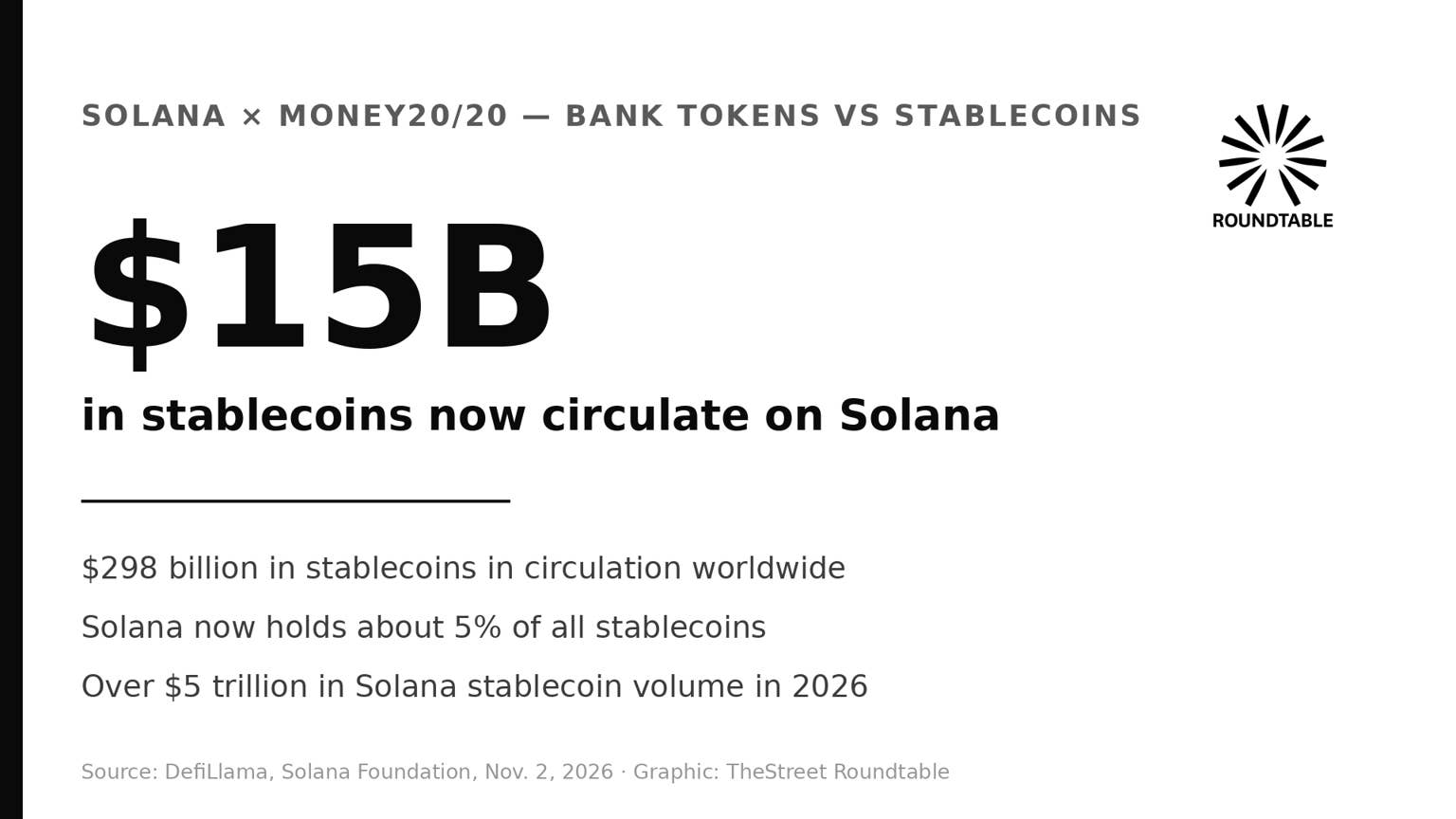
Stablecoin market size and Solana's share, as of Nov. 2. Source: DefiLlama
Why Circle and Tether keep the rails
What banks will not do, he said, is the decade of work needed to get liquid in every market. That gives Circle and Tether “a moat to a certain extent.”
Stablecoins in circulation total about $295 billion, and Solana holds about $15 billion of them. Visa launched stablecoin settlement for U.S. banks in December, starting with USDC over Solana.
Raees sees the two kinds of tokens working together.
“JPMorgan will hold the asset in JPMD, they'll swap programmatically into USDC, and then they will execute the transaction,” he said.
That fits a broader push by the foundation into payments and fintech, from Samsung wallets to emerging markets.
Agentic payments start with businesses
Asked what excites him most, Raees pointed to AI agents.
“I think agentic gets really exciting on the B2B side first, which is a hot take. I think retail comes later,” he said.
He said suppliers are already using agents to automate vendor and supply chain work. The Solana Foundation has said that AI agents will need new payment rails, and that stablecoins are a natural fit for machines paying machines.
He also wants on-chain FX to mature. He expects yield to be a big theme over the next 18 months.
“We think treasurers are just starting to discover that. It's gonna be massive,” Raees said.
Popular on TheStreet Roundtable
Disclaimer: This article is for informational purposes only and does not constitute financial advice. Cryptocurrency investments are highly volatile and risky. Always conduct your own research before making any investment decisions.