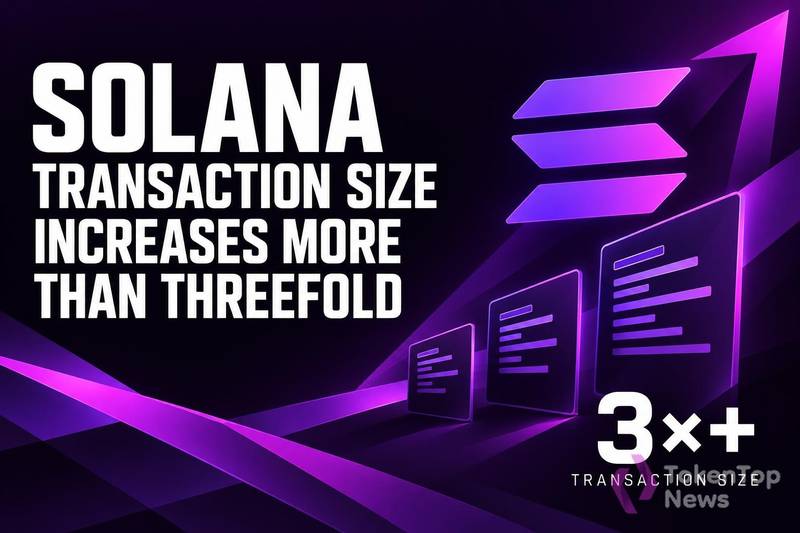
Two Solana governance proposals lay out a more-than-threefold increase in the maximum transaction size, from a baseline of 1,232 bytes to a proposed 4,096 bytes, but both documents are still
Two Solana governance proposals lay out a more-than-threefold increase in the maximum transaction size, from a baseline of 1,232 bytes to a proposed 4,096 bytes, but both documents are still marked Review and neither identifies a mainnet activation date. The change to Solana transaction size would apply only to a new v1 transaction format, leaving existing transactions untouched.
What the reported Solana transaction size increase means
The core claim traces to SIMD-0296, which identifies the existing maximum transaction payload at 1,232 bytes, a figure derived from a conservative 1,280-byte IPv6 MTU after networking overhead. The proposal would lift that ceiling to 4,096 bytes. For related coverage, see Missed Solana’s Early Surge and Cardano’s Penny-Priced Days? APEMARS Raises $515K as the Top Meme Coin Presale to Buy - Stage 23 Closes in 6 Hours.
Documented transaction-size baseline
1,232 bytes
SIMD-0296 identifies 1,232 bytes as the existing maximum transaction payload. The proposal leaves legacy and v0 transactions unaffected. Source: SIMD-0296.
How large is the reported increase?
Dividing the proposed cap by the baseline yields roughly 3.32 times, or about a 232% increase, which is where the "more than threefold" framing comes from. That ratio is a comparison of proposed byte limits, not a measurement of throughput. For related coverage, see USDC Treasury Mints 250 Million USDC on Solana.
Proposed v1 transaction-size limit
4,096 bytes
SIMD-0296 proposes 4,096 bytes for v1 transactions: approximately 3.32 times the 1,232-byte baseline (+232.5%). Applications must adopt v1. The fetched proposals are marked Review and do not establish mainnet activation; this comparison does not measure throughput. Source: SIMD-0296.
Transaction size is distinct from transaction count and from transactions per second. Larger individual transactions do not by themselves lift network throughput, which sits separately from this proposal even as Solana's network TPS has set fresh records. For related coverage, see Solana Network TPS Reaches Over 1600, Setting New Record.
What larger Solana transactions could mean for developers
SIMD-0296 names several use cases currently constrained by the size limit: ZK proofs for Confidential Balances, untruncated Winternitz signatures, nested Squads multisig, and BLS signature schemes without precompiles. More payload space could give these transaction types room they lack today. For related coverage, see Best Crypto Under $1? Apeing Raises Over $10K in the First 30 Minutes at $0.0001 as Solana and XRP Rally .
Constraints a larger size limit may not resolve
The extra headroom is bounded. The companion SIMD-0385 specifies maximums of 12 signatures, 64 accounts and 64 instructions per transaction, the same as its listed prior maximums, so the byte cap rises while those structural limits hold. SIMD-0385 also removes address lookup tables from the v1 format and moves compute-budget configuration into transaction fields.
Any benefit is also conditional on adoption. The larger size is restricted to the v1 format and requires applications to update, while legacy and v0 transactions are unaffected, meaning developers building the kind of high-volume flows behind moves like large USDC mints on Solana would need to migrate to see any change.
Rollout details that still need confirmation
Both SIMD-0296 and SIMD-0385 display a status of Review with placeholder activation-feature fields, and neither establishes a mainnet activation date. That places the change firmly in the proposal stage rather than as a released implementation or an activated network feature.
Solana's documentation notes that transaction instructions execute atomically: if any instruction fails, all state changes revert, though fees are still charged on failure. That execution model is unchanged by the size proposals and is worth keeping in mind for developers, including institutional players such as those behind recent Solana treasury financing, when weighing larger, more complex transactions. Until a validator release or feature-activation record appears, the higher cap should be read as proposed, not live.
Disclaimer: This article is for informational purposes only and does not constitute financial or investment advice. Cryptocurrency and digital asset markets carry significant risk. Always do your own research before making decisions.
Read original article on tokentopnews.com