Key Takeaways DZ Bank has launched coverage on SpaceX (SPCX) with a Sell recommendation and $100 price objective, suggesting approximately 25% potential decline. The majority of Wall Street—7
Key Takeaways
- DZ Bank has launched coverage on SpaceX (SPCX) with a Sell recommendation and $100 price objective, suggesting approximately 25% potential decline.
- The majority of Wall Street—75% of analysts—maintains Buy ratings on SPCX, with a consensus price objective of $220.20.
- The company delivered quarterly revenues of $7.81 billion, representing a 91.9% year-over-year surge that exceeded forecasts.
- An additional 319 million shares entered circulation following a second lockup period ending, driving shares beneath the $135 IPO level.
- CEO Elon Musk pushed back the timeline for attempting a Starship upper-stage recovery by multiple months, creating investor uncertainty.
Shares of SpaceX (SPCX) were changing hands near $131.82 during Friday’s session, declining 1.6% for the day, after experiencing a brief 1.5% uptick in early morning activity triggered by DZ Bank analyst Markus Leistner’s fresh Sell recommendation.
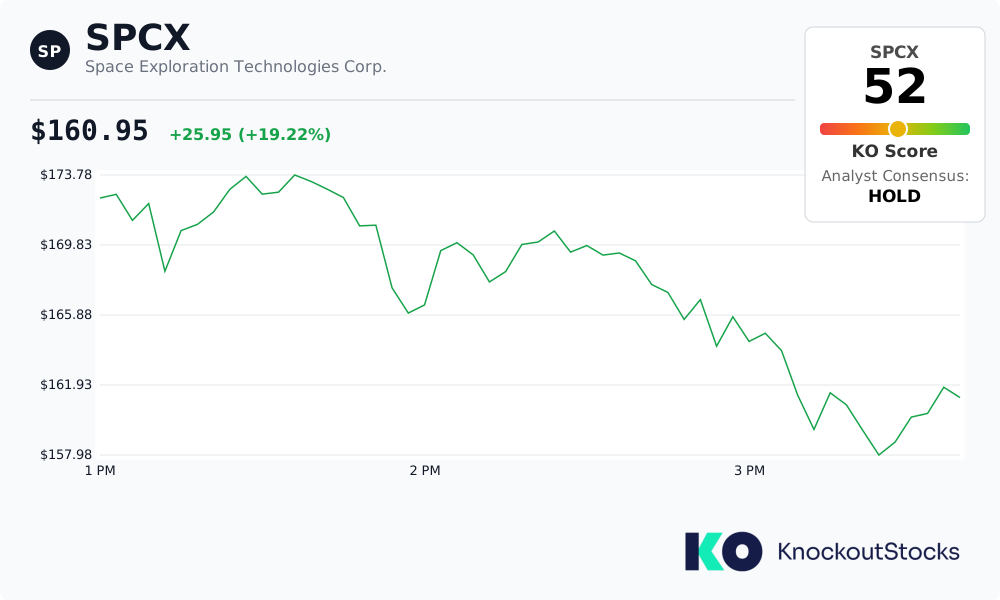 Space Exploration Technologies Corp., SPCX
Leistner established a $100 price objective, indicating potential downside of approximately 25% from the company’s present trading level. This assessment stands among the most pessimistic views on Wall Street, where three-quarters of equity analysts monitoring SPCX maintain Buy recommendations. The consensus price objective across the analyst community stands near $220.20.
The equity has experienced challenging trading conditions recently. Entering Friday’s session, SPCX had declined 4.3% across the previous five trading days, positioning it marginally beneath its $135 initial public offering price. The 52-week trading band extends from $104.83 through $225.64.
DZ Bank has chosen not to release the complete research analysis to the public, referencing U.S. regulatory constraints. However, the fundamental bearish thesis revolves around capital requirements. SpaceX faces projected aggregate capital expenditures approaching $800 billion through decade’s end, with substantial portions allocated toward artificial intelligence infrastructure development.
The organization presently operates approximately 1.4 gigawatts of computational capacity distributed across two facilities and aims to achieve 10 gigawatts before 2027 concludes. Extended-term objectives contemplate hundreds of gigawatts. Executing this expansion will necessitate SpaceX’s procurement of considerable debt and equity financing.
This investment strategy carries substantial upside possibilities. Industry data suggests a single gigawatt of AI computational power can generate annual rental income reaching $50 billion. Optimistic analysts reference this revenue potential as validation for the stock’s current market valuation.
SpaceX disclosed quarterly revenues totaling $7.81 billion in its latest financial disclosure, marking a 91.9% year-over-year expansion. The enterprise recorded a per-share loss of $0.09, surpassing analyst projections of a $0.26 deficit. Fiscal year 2026 revenues are anticipated to approach $44 billion, while 2027 forecasts exceed $100 billion.
Additional analysts maintain constructive positions. Argus recently elevated SPCX from Hold to Buy status with a $160 objective. William Blair confirmed its Buy rating, emphasizing SpaceX’s competitive advantage in reusability technology and artificial intelligence revenue prospects. Stifel Nicolaus maintains a $190 target. Piper Sandler holds a Neutral stance with a $140 objective following a reduction from its earlier projection.
Share Lockup Release and Launch Timeline Shift Create Headwinds
Thursday’s 4.1% decline followed the release of 319 million shares previously restricted from trading by insiders and initial investors. Additional lockup expirations remain scheduled throughout 2027, potentially applying continued downward pressure on valuation.
Musk additionally verified that SpaceX will postpone efforts to capture the descending Starship upper stage using the launch tower mechanism for an extended period. Market participants had anticipated this capture test during August. Achieving complete Starship reusability represents a critical factor in minimizing orbital access costs, which forms the foundation of the company’s extended-term financial model.
SpaceX achieved its 100th orbital mission of 2026 during the current week and extended the Starlink satellite network beyond 11,000 operational units.
The post SpaceX (SPCX) Stock Could Drop to $100, Warns DZ Bank Analyst appeared first on Blockonomi.
