Key Points SPCX shares decreased 1% in pre-market hours Friday, reaching $151.46 and marking a 24% decline across six sessions following its June 12 market debut The share price momentarily d
Key Points
- SPCX shares decreased 1% in pre-market hours Friday, reaching $151.46 and marking a 24% decline across six sessions following its June 12 market debut
- The share price momentarily dropped beneath $150, a threshold never breached at close since its opening price on launch day
- Russell 1000 index will welcome SpaceX after Friday’s closing bell, with a classification of 90.4% growth and 9.6% value
- Index-tracking funds following Russell benchmarks must purchase roughly $3 billion in SPCX shares, according to Jefferies analysis
- Nasdaq 100 entry scheduled for July will compel major funds like Invesco QQQ ETF to acquire positions
Shares of SpaceX (SPCX) declined 1% during Friday’s pre-market session to $151.46, momentarily touching below the $150 mark — a closing price the stock has avoided since its June 12 IPO launched at precisely that figure.
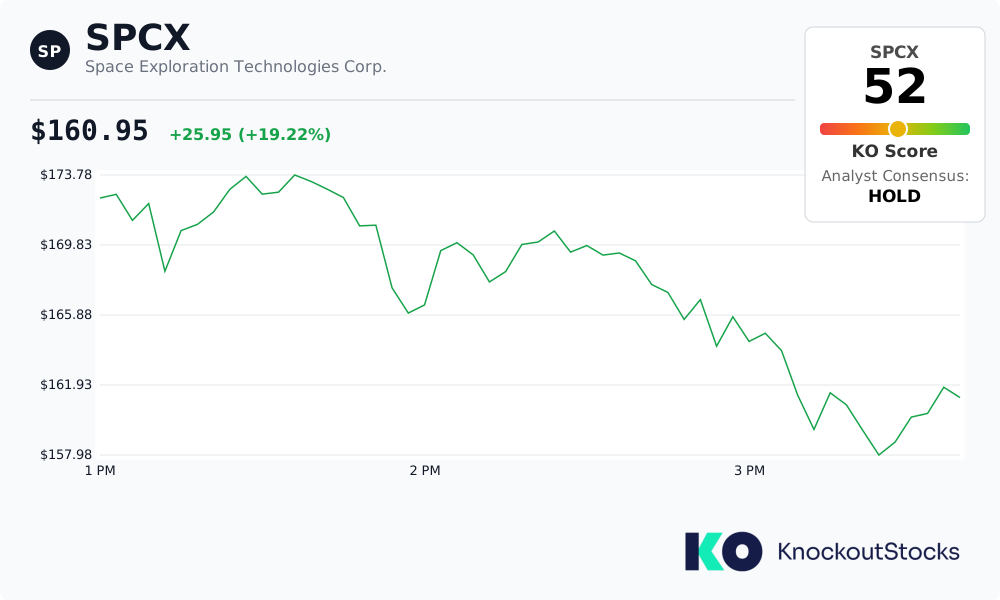 Space Exploration Technologies Corp, SPCX
This downward movement continues a challenging period for the aerospace company’s publicly traded shares. From its intraday peak of $225.64 reached on June 16, SPCX has tumbled approximately 24% throughout six trading days, closing Thursday at $153.
The decline coincides with broader market rotation away from elevated-valuation technology and artificial intelligence stocks. Space Exploration Technologies posted a $4.9 billion loss in the previous fiscal year, while shares currently command a multiple of 107 times projected 2025 revenue. By contrast, Nvidia maintains a valuation near 21 times sales.
This valuation disparity has attracted significant attention from market observers. The magnitude of SPCX’s retreat was substantial enough to eliminate CEO Elon Musk’s trillionaire designation.
According to The New York Times, citing sources with knowledge of internal discussions, OpenAI is now reconsidering its IPO timeline after observing SpaceX’s volatile market introduction.
Index Inclusion May Boost Buying Pressure
Notwithstanding recent price weakness, Friday presents a potentially supportive development. SpaceX will officially enter the Russell 1000 index following today’s closing bell, part of FTSE Russell’s twice-yearly reconstitution process.
FTSE Russell modified its eligibility requirements this year to accelerate large IPO inclusions into its benchmark indexes. The company will join with a 90.4% growth and 9.6% value designation, subject to reassessment in December.
This inclusion carries significance because passive investment vehicles tracking Russell indexes — such as the iShares Russell 1000 ETF (IWB) — must maintain SpaceX positions after entry. Jefferies projects these funds will acquire close to $3 billion in SPCX shares to align with benchmark weights.
This purchasing activity typically occurs during a compressed timeframe near market close on reconstitution day, as portfolio managers work to minimize tracking deviation. Options pricing suggests market participants anticipate approximately 3.6% volatility in either direction by session end.
Upcoming Nasdaq 100 Entry and S&P 500 Status
Additional index inclusion awaits SpaceX in July, when the company joins the Nasdaq 100. This will necessitate purchases by substantial funds including the Invesco QQQ ETF, creating another wave of index-mandated buying.
S&P 500 membership remains unavailable currently. S&P Global rejected SpaceX’s candidacy after refusing to adjust its profitability requirements for megacap market entrants. Companies must demonstrate profitability both in the latest quarter and throughout the preceding four quarters — standards SpaceX presently fails to meet.
Space Exploration Technologies maintains a market capitalization near $2 trillion, positioning it alongside Amazon’s valuation. However, merely $100 billion represents publicly available shares, with remaining equity controlled by Musk, company insiders, and employees.
When Tesla gained S&P 500 admission in 2020, the resulting closing-hour demand pushed shares up 6% that session.
The post SpaceX (SPCX) Stock Plummets 24% Since IPO — Will Russell 1000 Entry Provide Relief? appeared first on Blockonomi.