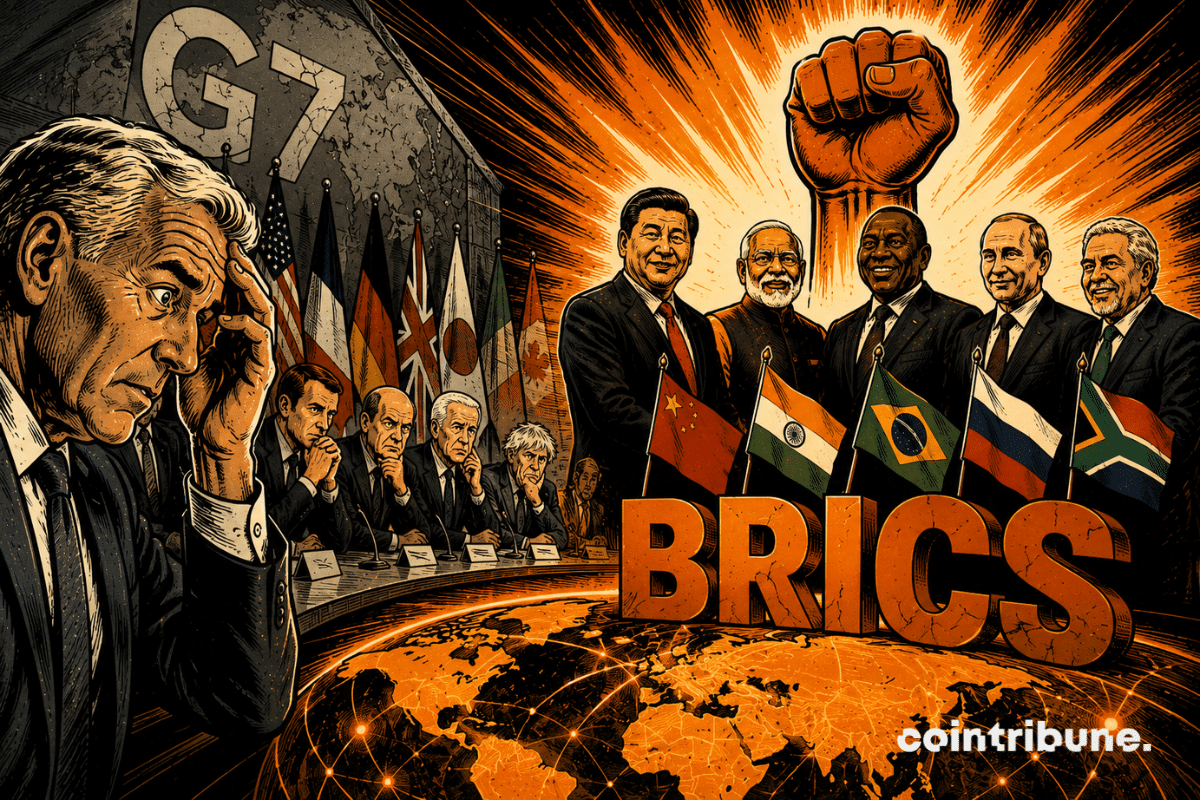
The economic monopoly of the West now hangs by a thread, and it is no longer marginal theorists who say this, but the very architects of global finance. Twenty-five years after theorizing the
The economic monopoly of the West now hangs by a thread, and it is no longer marginal theorists who say this, but the very architects of global finance. Twenty-five years after theorizing the emergence of the economic powers of the South, Lord Jim O’Neill presents an uncompromising assessment of the G7’s inability to adapt to the new global landscape. As the international financial network fragments under the weight of sanctions and geopolitical tensions, this reassessment sounds like a major warning for the supremacy of the US dollar.
In brief
- The creator of the BRIC term warns that the G7 can no longer pretend to ignore a bloc whose combined GDP now surpasses theirs.
- The integration of new powers such as Iran or the United Arab Emirates transforms a marketing slogan into a concrete geopolitical alliance.
- The refusal to reform the IMF and the World Bank has driven emerging countries to build their own financial architecture.
- This historic monetary fragmentation pushes toward the adoption of decentralized networks and neutral reserve assets.
The rise of the BRICS amid the inertia of the G7
The historical assessment made by Lord O’Neill reveals the vast gap between early 2000s projections and the current economic reality. Thus, the British economist bluntly reminds that Western nations made a major strategic mistake by underestimating the cohesion and growth potential of this emerging bloc.
Several factual data points illustrate today this shift in economic power :
- Dominance of global GDP : the combined share of the BRICS in the world gross domestic product, measured by purchasing power parity (PPP), has now officially surpassed that of all G7 countries ;
- Strategic geopolitical expansion : the historic enlargement of the bloc, which includes major players such as Iran, Egypt, Ethiopia, and the United Arab Emirates, is redefining trade routes and control over global energy resources ;
- Historical warning from the founder : Twenty-five years after inventing the concept, Lord O’Neill firmly warns that “the West cannot ignore the BRICS for another 25 years”.
To explain this trajectory, it is important to emphasize that the strength of the BRICS lies in their growing appeal to other major economies of the global South. The recent enlargement of the bloc demonstrates that the alliance has surpassed the mere marketing concept stage to become a true political and commercial coalition.
By failing to take the formation of this coalition seriously from the outset, Western powers missed the opportunity to smoothly integrate these emerging economies into the existing financial order. This historical misjudgment now forces the G7 to urgently react to a dynamic it no longer controls.
The impasse of the Bretton Woods institutions and the search for alternatives
Beyond merely noting GDP growth, the current deadlock stems directly from the blockage of international financial institutions by Western powers. Lord O’Neill strongly highlights that the persistent refusal of the United States and their allies to reform the International Monetary Fund (IMF) and the World Bank has pushed the BRICS to build their own architecture.
Unable to obtain representation and voting rights proportional to their real economic weight within the Bretton Woods institutions, these countries have developed the New Development Bank (NDB) and multiplied bilateral agreements. The maintenance of an outdated Western governance has thus acted as the main catalyst for the creation of a parallel financial system.
This pursuit of financial autonomy accelerates under the effect of the dollar’s militarization through unilateral economic sanctions, a mechanism that drives many states to seek alternatives for settlement outside the SWIFT network. Initiatives multiply to use national currencies in cross-border trade, as exemplified by exchange systems developed between China, Russia, and India, or advanced experiments with central bank digital currencies (CBDCs).
By seeking to safeguard their transactions against the risk of asset freezing, the member countries of the BRICS do not necessarily aim to destroy the dollar, but to protect their economies from judicial and political decisions from Washington.
Secure your cryptos with LedgerThis link uses an affiliate program.The emergence of decentralized networks as the ultimate financial shield
This global monetary fragmentation creates an unprecedented testing ground for the integration of decentralized technologies and alternative neutral reserve assets. As confidence erodes in traditional fiat currencies subject to Western central banks’ policies, the need for uncensorable cross-border exchange tools becomes a strategic priority for many actors of the global South.
The increasing use of blockchain technology to secure commercial settlements illustrates this transition toward depoliticized financial architectures. These tools offer a choice alternative to nations eager to trade smoothly without depending on a single jurisdiction or partisan financial intermediaries.
The adoption of cryptographic protocols and the search for tangible guarantees such as physical gold are gradually transforming sovereign reserve management internationally. Unlike currencies backed by massive sovereign debts, decentralized assets act as immutable stores of value, immune to quantitative easing policies and asset seizures.
Thus, this dynamic reinforces the thesis that the financial infrastructure of the future will not be dictated by a single hegemon but will rely on open and distributed networks. The BRICS, by seeking to break the dollar-euro duopoly, inadvertently accelerate the global transition to this new technological paradigm.
These upheavals outline a deeply fragmented international monetary system, where the coexistence of competing financial blocs is likely to increase currency market volatility in the short term.
In the long term, the erosion of the greenback’s hegemony opens a royal path for distributed ledger technologies, perceived by a growing number of actors as indispensable sovereignty tools. The West now faces a historic choice: engage in genuine multilateral cooperation on equal footing or accept seeing control of global financial flows definitively slip away to new autonomous networks.