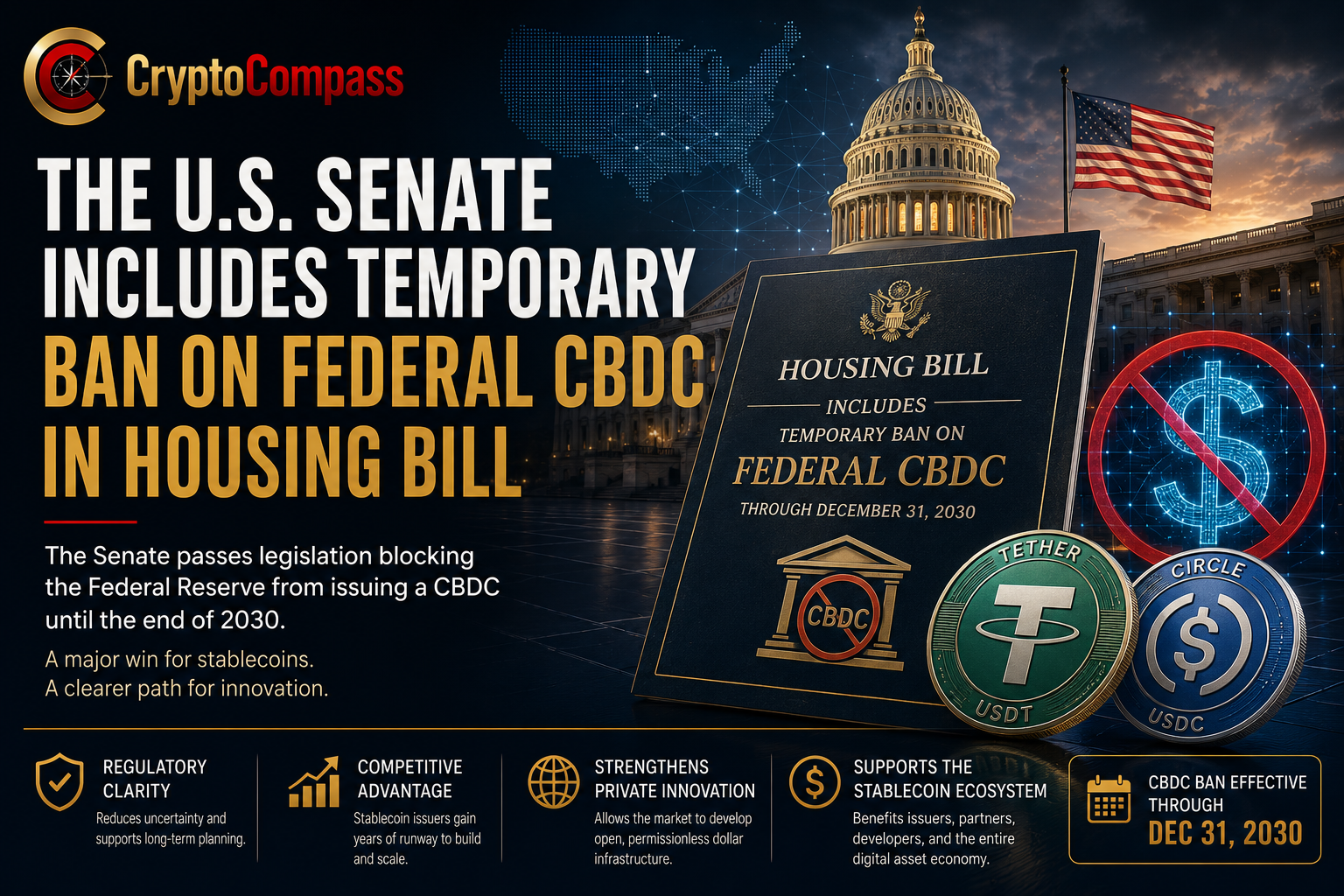
While much of the crypto industry remains focused on ETFs, tokenization, and institutional adoption, a major regulatory development in Washington could have long-term implications for the future of digital money. By temporarily blocking the Federal Reserve from issuing a retail C
One of the biggest competitive threats facing stablecoins has never been another crypto company.
It has been the U.S. government.
For years, investors, policymakers, and financial institutions have debated what would happen if the Federal Reserve launched a digital dollar.
Would consumers migrate to a government-backed alternative?
Would banks lose deposits?
Would stablecoins become redundant?
Those questions may now be postponed for years.
The U.S. Senate has approved a housing-related bill that includes a provision preventing the Federal Reserve from issuing a central bank digital currency (CBDC) until at least the end of 2030.
The vote passed with overwhelming bipartisan support.
The significance extends far beyond Washington.
A Rare Moment Of Regulatory Clarity
One of the biggest challenges facing digital asset markets has been uncertainty.
Not technological uncertainty.
Regulatory uncertainty.
Businesses can adapt to regulations.
What they struggle with is not knowing what the rules will be.
The Senate vote provides something the stablecoin sector has rarely enjoyed:
Visibility.
At least for the foreseeable future, the threat of direct competition from a federally issued retail digital dollar appears significantly reduced.
That matters because markets often respond more strongly to certainty than to policy itself.
The Battle Between Public Money And Private Money
The debate around CBDCs has never been purely technological.
It is fundamentally a question about who should issue digital money.
On one side sits the state.
On the other sits the private sector.
A CBDC would represent government-issued programmable digital cash.
Stablecoins represent privately issued digital dollars operating on public blockchain networks.
Both seek to solve similar problems.
Fast settlement.
Digital payments.
Global accessibility.
Programmability.
The difference is who controls the infrastructure.
The Senate's decision effectively gives the private sector additional time to build before facing a direct federal competitor.
Why Stablecoin Issuers Benefit
For companies such as Circle and Tether, the implications are substantial.
The absence of a near-term U.S. CBDC removes a major source of strategic uncertainty.
Instead of preparing for competition from the world's largest central bank, stablecoin issuers can focus on expanding adoption, improving infrastructure, and strengthening relationships with financial institutions.
This comes at a time when stablecoins are already becoming increasingly embedded within the global financial system.
Payment providers are integrating stablecoin rails.
Banks are exploring settlement solutions.
Tokenized financial products continue to grow.
Cross-border payments increasingly rely on blockchain infrastructure.
The ecosystem is gaining momentum.
The Senate's decision gives that momentum more room to develop.
Stablecoins Are Becoming Infrastructure
One of the most important trends in digital finance is that stablecoins are gradually evolving beyond crypto trading.
They are becoming financial infrastructure.
Today, stablecoins facilitate billions of dollars in daily settlement activity.
They move capital across borders.
They support tokenized assets.
They provide dollar access in emerging markets.
Increasingly, they function as a bridge between traditional finance and blockchain networks.
This is precisely why the CBDC debate matters.
The winner may ultimately control the rails through which digital dollars move.
A Strategic Shift In Washington
The vote may also signal something broader.
For years, policymakers approached stablecoins and CBDCs as competing visions of digital money.
That distinction may be softening.
Rather than building a government-controlled retail digital dollar, lawmakers may be signaling a preference for regulating and supervising private-sector innovation instead.
If that interpretation proves correct, it would represent a significant shift in U.S. digital asset policy.
The government would oversee the system.
The private sector would build it.
The Global Race Continues
The United States is not the only country exploring digital currencies.
China continues advancing its digital yuan.
Europe remains actively engaged in discussions surrounding a digital euro.
Central banks across Asia, the Middle East, and Latin America continue experimenting with CBDC frameworks.
The global race has not ended.
But the U.S. may be choosing a different path.
Rather than issuing a digital dollar directly, it may be allowing private stablecoin issuers to become the dominant providers of blockchain-based dollar liquidity.
CryptoCompass View
For years, many investors viewed CBDCs as an existential threat to stablecoins.
The logic was simple.
Why use a private digital dollar if a government-backed alternative exists?
The Senate's decision does not permanently resolve that debate.
But it does change the timeline.
And in technology markets, time matters.
Five years is enough time to build networks.
Five years is enough time to establish market dominance.
Five years is enough time to become infrastructure.
If the Federal Reserve remains on the sidelines until 2030, Circle, Tether, and the broader stablecoin ecosystem may receive something more valuable than regulatory approval.
They may receive a head start.
And in platform markets, head starts often become moats.
—
By Suttermill
CryptoCompass Editorial Desk