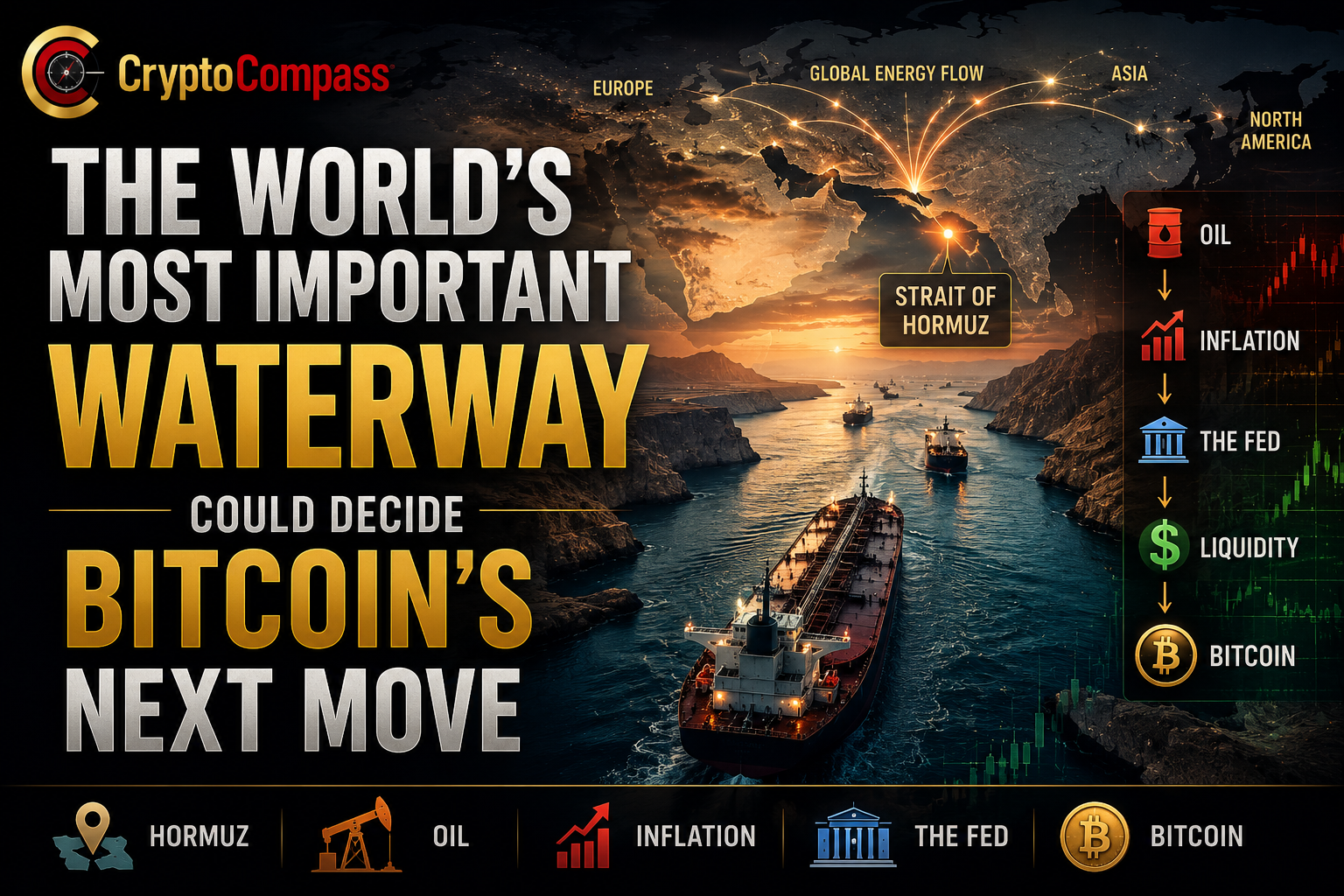
Most Bitcoin investors are watching ETF flows and price charts. They may be looking in the wrong place. One narrow waterway in the Middle East could have a bigger impact on Bitcoin's future than any on-chain metric.
Bitcoin Investors Are Watching The Wrong Charts
Every day, crypto traders monitor:
ETF flows
Funding rates
Open interest
Exchange balances
These metrics matter.
But they may not be the most important indicators right now.
Thousands of miles away from Wall Street and Silicon Valley lies a shipping route responsible for moving a significant share of the world's energy supply.
The Strait of Hormuz.
A narrow corridor between the Persian Gulf and the Gulf of Oman.
On a map, it appears insignificant.
In global markets, it is one of the most important locations on Earth.
And it may have more influence over Bitcoin than most investors realize.
Why Hormuz Matters
Nearly every major economy depends on energy.
And a large percentage of globally traded oil passes through Hormuz.
Every tanker moving through the region influences:
Oil prices
Energy markets
Inflation expectations
Central bank policy
When the market fears disruption, oil prices rise.
When tensions ease, oil prices often fall.
That movement creates ripple effects throughout the financial system.
Oil Is Still The World's Most Important Commodity
Technology dominates headlines.
AI captures investor attention.
Bitcoin attracts speculation.
Yet oil remains the fuel powering the global economy.
Transportation.
Manufacturing.
Agriculture.
Logistics.
Everything ultimately depends on energy.
When oil rises sharply, inflation often follows.
When oil falls, inflation pressure can ease.
This relationship has shaped markets for decades.
The Inflation Connection
Inflation is the bridge connecting Hormuz to Bitcoin.
Many investors assume Bitcoin trades independently.
Increasingly, that is not true.
Bitcoin now operates within a broader macroeconomic framework.
The sequence looks like this:
Hormuz
↓
Oil
↓
Inflation
↓
Federal Reserve
↓
Liquidity
↓
Bitcoin
This chain reaction explains why geopolitical events can eventually influence digital assets.
The Federal Reserve Is Watching Too
The Federal Reserve does not directly control oil prices.
But it must react to the consequences.
If energy costs rise significantly:
Markets immediately begin repricing risk.
The result often affects:
This is why professional investors monitor geopolitics closely.
Why Bitcoin Is Now A Macro Asset
The ETF era changed Bitcoin.
Institutional investors now treat Bitcoin as part of a broader portfolio.
They compare it against:
Stocks
Gold
Treasury bonds
Private markets
Alternative assets
That means Bitcoin increasingly responds to macroeconomic forces.
Liquidity conditions matter.
Interest rates matter.
Inflation matters.
And all three are influenced by energy markets.
A Lesson From Previous Crises
History repeatedly demonstrates the relationship between energy shocks and financial markets.
Major geopolitical disruptions often trigger:
Higher oil prices
Higher inflation
Increased volatility
Sometimes Bitcoin benefits as investors seek alternative assets.
Other times liquidity tightens and risk assets struggle.
The outcome depends on how policymakers respond.
Markets Care About Probabilities
The key issue is not whether Hormuz closes.
The key issue is whether markets believe disruption is possible.
Financial markets constantly price probability.
Even a small increase in perceived risk can influence:
Energy futures
Treasury yields
Currency markets
Crypto assets
Investors are not trading certainty.
They are trading expectations.
What Smart Money Is Watching
Institutional investors currently monitor:
These indicators often provide earlier signals than crypto-specific data.
By the time a trend becomes obvious on Bitcoin charts, macro markets may have already moved.
Looking Ahead
Most crypto narratives focus on blockchain technology.
The next major market move may have nothing to do with technology.
It may originate from geopolitics.
A shipping route.
An energy market.
An inflation report.
A central bank decision.
The lesson is simple.
Bitcoin no longer trades in isolation.
Understanding global markets has become increasingly important for understanding crypto markets.
CryptoCompass View
The Strait of Hormuz is not a crypto story.
That is precisely why crypto investors should pay attention.
Markets are connected.
Oil influences inflation.
Inflation influences liquidity.
Liquidity influences Bitcoin.
Sometimes the most important Bitcoin chart isn't a Bitcoin chart at all.
Navigate Markets. Discover Opportunities.