TRD Network Tokenomics: Understanding Supply, Unlocks and Distribution Before you put money into any crypto project, check its tokenomics first. Tokenomics tells you how many tokens exist, wh
TRD Network Tokenomics: Understanding Supply, Unlocks and Distribution
Before you put money into any crypto project, check its tokenomics first. Tokenomics tells you how many tokens exist, who owns them, and when those tokens actually enter the market. In this article, we look closely at TRD network tokenomics: the token allocation, total supply, and vesting schedule so you know exactly how the TRD token works over time.
What Is Tokenomics and Why Does It Matter?
Tokenomics is the economic design behind a coin. It covers three things: how many tokens will ever exist, how they get split among different groups, and the rules for when those tokens unlock. A project can have strong tech behind it, but weak tokenomics can still hurt it. If insiders or early holders get to sell large amounts too soon, the price can crash for everyone else.
This is why TRD network token supply and its spread matter so much. A clear allocation plan, spread out over several years with set vesting periods, shows a team thinking long term instead of chasing a quick payout. Here's how TRD Network presale has built this out.
TRD Token: Basic Details
Here are the core facts about the token:
Detail
Information
Name
TRD Network
Decimal
18
Contract Address
0xEa059F3f1106aA0Ddd1550b1cc37Fc195a559Ef9
Total Supply
3.30 Billion TRD
You can check the contract yourself on-chain to confirm these details. That's a simple but useful step before you trust any token.
TRD Network Token Allocation Breakdown
Now, the main part of this article: TRD network token allocation. The full 3.30 billion supply is split across ten groups. Each group has its own job in the ecosystem. Here is the full list: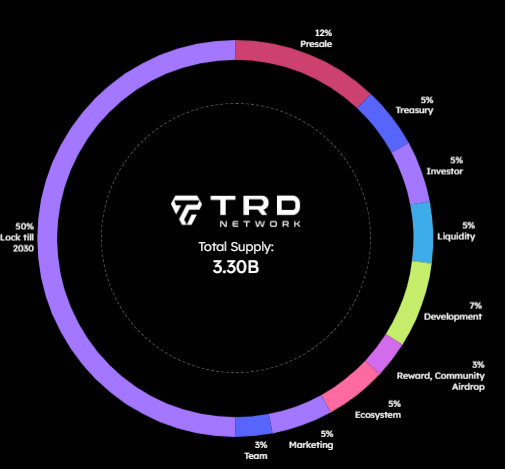
Category
Percentage
Token Amount
Purpose
Presale
12%
396M
Allocated to early investors & supporters with structured vesting
Treasury
5%
165M
Diversify holdings, hedge against inflation, and seek reserve
Investor
5%
165M
Long-term asset appreciation; allocation for early investors with vesting over 12 to 24 months
Liquidity
5%
165M
Designed to support exchange activity and market stability
Development
7%
231M
Unlock starts from July 2026, vesting till January 2031
Reward, Community / Airdrop
3%
99M
Distributed within 12 months, starting 1st August 2025
Ecosystem
5%
165M
Unlock starts from October 2026, vesting till April 2031
Marketing
5%
165M
10% unlocked initially, 90% vesting from September 2026 till August 2029
Team
3%
99M
Unlock starts from January 2027, vesting till August 2031
Lock till 2030
50%
1.65B
From 2031 to 2036, 10% of the supply unlocks every six months, with a planned 25% token burn after 2031 to increase value
A clear token allocation table like this tells you who gets what, and when. That's the kind of detail any careful investor should check before putting money in.
Breaking Down the Vesting Schedule
One thing stands out in this tokenomics plan. Half the total supply: 1.65 billion TRD tokens stays locked until 2030. After that, it unlocks in small steps through 2036. A burn plan is also built in to cut supply and support value over time.
Here is a simple view of the unlock timeline for each main group:
Category
Unlock Start
Vesting End
Development
July 2026
January 2031
Ecosystem
October 2026
April 2031
Marketing
September 2026 (10% initial unlock)
August 2029
Team
January 2027
August 2031
Reward/Community/Airdrop
August 1, 2025
Within 12 months
Lock till 2030
2031
2036 (10% every 6 months)
Spreading unlocks over many years, instead of all at once, is a safer setup. It cuts the risk of a big sell-off right after listing.
Why This Structure Matters for Investors
A few points stand out when you study this token allocation plan:
Long vesting cuts dump risk. Team, Development, and Ecosystem tokens all unlock in steps over years, not all in one go.
Half the allocation stays locked. With 50% locked until 2030, far fewer tokens are in the market early on than the full allocation suggests.
A burn plan is built in. A planned 25% burn after 2031 aims to manage allocation and support value, instead of just flooding the market as tokens unlock.
Liquidity and Treasury add stability. With 5% set aside for each, the project has a buffer to support exchange activity and guard against market swings.
Even so, good tokenomics can't promise price growth. A solid TRD network token supply plan still depends on the team's execution, real adoption, and the wider market.
Final Thoughts
Studying TRD network tokenomics gives you a clear picture of how the project works behind the scenes, from the 3.30 billion total supply down to each group's unlock date. The strong focus on long vesting, a large locked reserve till 2030, and a built-in burn plan all point to one goal: avoid sudden supply shocks. Still, tokenomics is only one piece of the puzzle. Check the team, the roadmap, and the real-world use case too before you decide anything.
Disclaimer
This article is for informational purposes only and should not be treated as financial or investment advice. Cryptocurrency investments carry significant risk, including high volatility and potential loss of capital. Always conduct your own independent research and consult a qualified financial advisor before making any investment decisions.