TRON processed $2.1 trillion in USDT transfers during the second quarter of 2026 as its stablecoin market reached a record $89.2 billion, according to Messari’s Aug. 10 report. Summary TRON p
TRON processed $2.1 trillion in USDT transfers during the second quarter of 2026 as its stablecoin market reached a record $89.2 billion, according to Messari’s Aug. 10 report.
Summary
- TRON processed $2.1 trillion in USDT transfers during Q2 as stablecoin supply reached record levels.
- USDT supply ended Q2 at $87.9 billion, giving TRON the largest circulating balance among blockchains.
- Network fees rose 15.9% quarterly to $699.4 million, reversing declines after the 2025 fee cut.
- Bitnomial launched regulated U.S. TRX futures in July after introducing spot trading during the quarter.
- Canary amended its staked TRX ETF filing in July, targeting Cboe BZX under ticker TRXS.
USDT accounted for $87.9 billion, or 98.5% of stablecoins on the network, putting TRON ahead of Ethereum’s $78.7 billion USDT balance at quarter end.
The quarter also brought a broader U.S. route into TRX. Binance.US restored spot trading, Bitnomial added TRX to its regulated U.S. markets and Canary Capital continued work on a proposed staked TRX exchange traded product. After the quarter, Bitnomial added TRX futures and Anchorage Digital opened institutional staking access.
You might also like: TRON crosses 15B transactions as TRX eyes breakout
TRON USDT supply moved above $90 billion after Q2
Average daily USDT transfer volume rose 4.3% from the previous quarter to $22.8 billion, reversing the decline recorded in Q1. Total stablecoin capitalization increased 4.1%, while TRON accounted for 47.6% of tracked USDT supply at the end of June, Messari found.
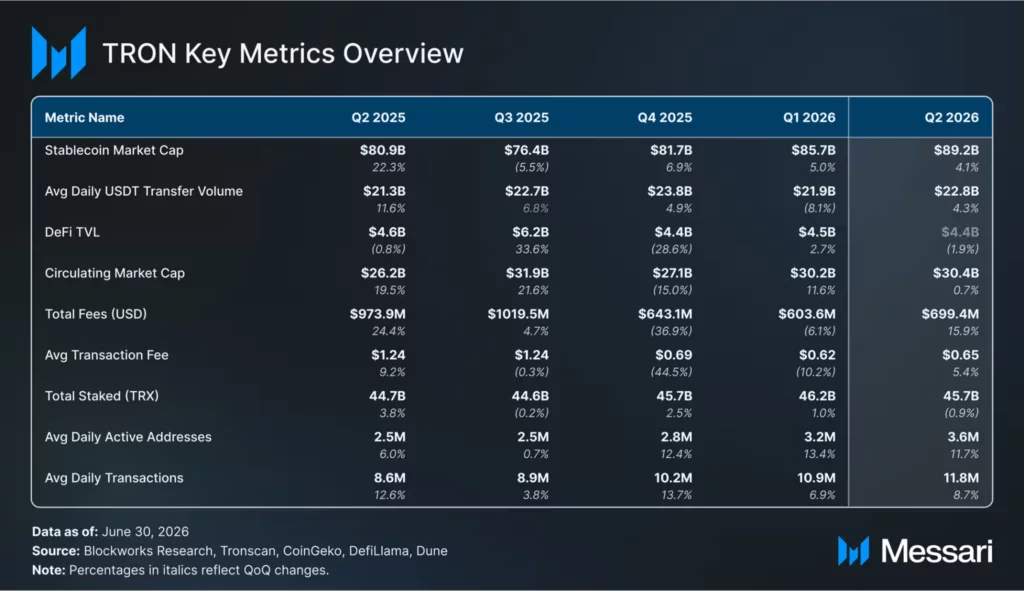
TRON key metrics overview, source: Messari
Growth continued after the quarter closed. TRON’s official milestone page records USDT circulation on the network surpassing $90 billion on July 9. That extends the trend discussed inearlier stablecoin coverage, when TRON was already widening its USDT lead over Ethereum.
Network usage has also remained elevated. TRONSCAN currently reports an average of about 12.07 million daily transactions over the latest 30 days. As crypto.news reported in arecent network milestone, lifetime transactions crossed 15 billion in early August while circulating USDT remained above $90 billion.
Higher activity lifted fees while TRX supply kept growing
TRON generated $699.4 million in network fees during Q2, up 15.9% in dollar terms. Fees measured in TRX increased 2.1% to 2.10 billion TRX. Messari said it was the first quarterly fee increase since an August 2025 governance change cut the network’s energy unit price. Average transaction cost increased 5.4% to $0.65.
Higher fees did not return TRX to net deflation during the quarter. Circulating supply increased by about 87 million TRX to 94.85 billion as token creation continued to exceed burns. Total staked TRX also fell 0.9% to 45.7 billion, while the staking rate declined to 48.2%.
The inflationary pattern has continued into August. TRONSCAN data shows total supply at roughly 94.898 billion TRX on Aug. 10. About 3.92 million TRX were generated that day against 3.32 million burned, producing a net increase of roughly 598,000 TRX. Daily figures can vary, but supply remains above its Q2 closing level.
U.S. access widens for TRX through exchanges and staking
Binance.US restored TRX on April 16 with TRX/USD and TRX/USDT trading pairs and native deposits and withdrawals, according to its notice. The listing reversed the exchange’s 2023 removal of the asset, covered in past Binance.US coverage.
Bitnomial then added spot TRX during Q2 before launching exchange traded TRX futures on July 27. Its release says eligible U.S. traders and institutions can use the CFTC regulated contracts to hedge or take exposure to TRX. Bitnomial president Michael Dunn said six months of regulated futures history “meets a key milestone” for potential spot ETF eligibility, although that statement does not amount to SEC approval of any TRX product.
Institutional custody access expanded as well. Anchorage Digital said in a July 14 announcement that clients can now stake TRX while keeping assets within its regulated custody framework.
Canary ETF filing and U.S. compliance remain next tests
Canary Capital’s proposed staked TRX product provides another U.S. development to watch. A July 24 amended SEC filing identifies Cboe BZX as the planned exchange and TRXS as the ticker. Canary anticipates staking at least 90% of the trust’s TRX under normal circumstances. However, the prospectus remains preliminary and says the shares are “expected to be listed” subject to the required conditions. The registration statement must become effective before securities can be sold under the offering.
The network’s growing stablecoin footprint also keeps U.S. compliance scrutiny in view. On July 1, the Treasury Department’s Office of Foreign Assets Control added 131 TRON addresses to its ISIS K designation in an official update.
Chainalysis separately said in its analysis that Tether froze balances across all 131 addresses. The wallets had received more than $1.4 million since 2023, according to the blockchain analytics firm. The episode was detailed in earlier sanctions coverage.
TRON has also continued upgrading its infrastructure. The mandatory GreatVoyage v4.8.2 Pyrrho release arrived July 15, followed by the nonmandatory v4.8.2.1 Heraclitus update on July 31. For the second half of 2026, the main measurable developments are whether USDT circulation and transaction activity hold their recent levels, whether TRX supply returns to net deflation, and how the proposed U.S. ETF process develops.
Read more: Trump Media holds 14,139 BTC as Q2 loss hits $238M
