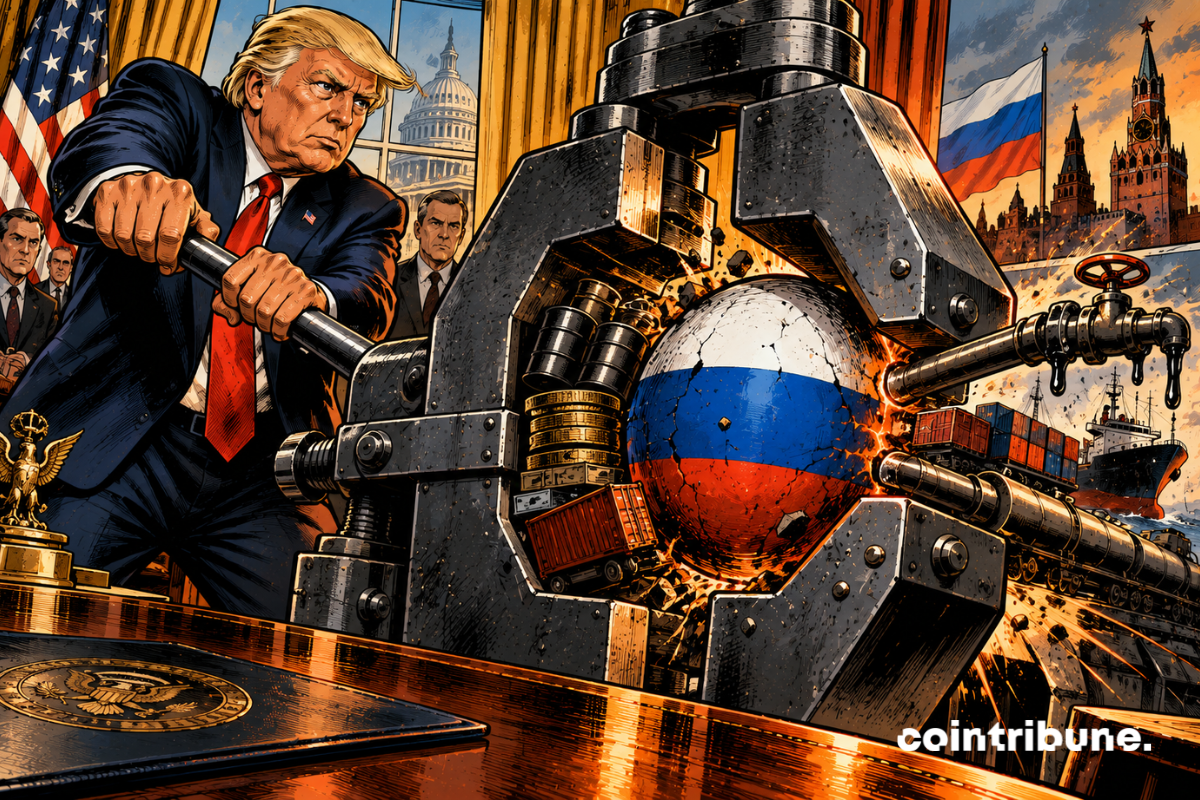
The Graham law now offers Donald Trump a new economic arsenal against Russia and other countries that finance its energy sector. Enacted on September 18, this legal standard authorizes tariff
The Graham law now offers Donald Trump a new economic arsenal against Russia and other countries that finance its energy sector. Enacted on September 18, this legal standard authorizes tariffs that can reach 100% against the main buyers of Russian oil and gas.
In brief
- Donald Trump enacts the Graham law, which strengthens US sanctions against Russia.
- Tariffs reaching 100% can target major buyers of Russian energy.
- China and India are among the most exposed countries due to their Russian oil purchases.
- The US president retains broad discretion to apply, suspend, or adjust these sanctions.
- The text divides part of Congress, with some lawmakers fearing impact on consumers and diplomatic relations.
The Graham law expands sanctions against Moscow
Following its adoption by both chambers of Congress, Donald Trump signed the “Lindsey O. Graham Sanctioning Russia and Iran Act of 2026”, while the latter is considering taking control of Iranian oil. One month after a favorable Senate vote by 86-11, the House of Representatives approved the text by 262 votes to 159 on September 16.
Since Trump’s return to the White House, this law represents the most important Ukraine-related text adopted by Congress. It aims to drastically reduce the revenues the Kremlin uses to finance the war in Ukraine.
€20 bonus for registering on BitvavoThis link uses an affiliate program.
Many provisions are intended to strengthen economic pressure on Moscow :
- Sanctions target Russian officials, oligarchs, and certain family members ;
- Banks and financial institutions linked to the Russian government may be targeted ;
- Ships of the “ghost fleet” used to circumvent restrictions become sanctionable ;
- Tariffs of up to 100% may hit certain Russian energy partners.
Crude oil, natural gas, liquefied natural gas, petroleum products, uranium, and Russian coal are covered by this measure. It also targets foreign actors who facilitate the circumvention of existing sanctions.
The Graham law puts China and India under pressure
This law limits new tariffs to the five largest importers of Russian oil or gas by volume. It may also target the five nations that contribute most to circumventing restrictions on Russia’s energy sector.
The text specifies no country. It also does not indicate the procedure Washington will use to establish these two rankings. Thus, China and India nevertheless rank first among exposed states given their significant purchases of Russian crude.
The 100% surcharge will not immediately apply to all Chinese or Indian goods. Indeed, the US president has broad discretion to select the countries concerned and set the exact tariff levels.
Therefore, an exception may also protect a nation whose gas purchases represent less than 15% of Russian gas exports, provided it has taken significant measures to reduce them. Finally, the US president may suspend certain sanctions if he believes a waiver serves US national interests.
Broad support despite criticisms in Congress
This law bears the name of Republican Senator Lindsey Graham, who died on July 11, 2026. Associated with several dozen lawmakers from both major parties, he presented a first version of the text in April 2025.
Democratic Senator Jeanne Shaheen believes this measure will target “Russian leaders, financial institutions, the energy sector, and the ghost fleet”. Moreover, she considers that countries continuing to finance Russia through energy acquisitions, especially those in the BRICS alliance, now face severe consequences.
However, the law divided Democratic lawmakers. Fifty-eight voted with the Republican majority, while their House leader, Hakeem Jeffries, opposed it. He fears the text grants Trump nearly unlimited authority to impose tariffs that could later burden American consumers.
Some lawmakers also fear tensions with Washington’s strategic partners. Sanctions against India would weaken a key relationship in facing China. Furthermore, high tariffs risk raising the cost of imported products in the US.
Its effectiveness will depend on Donald Trump”s choices
This enactment does not guarantee automatic and uniform application of sanctions. Their scope will depend on countries selected by the administration, tariff levels, and granted exceptions. Beijing has already denounced extraterritorial jurisdiction lacking international law basis.
Rapid reductions in Chinese or Indian purchases could deprive Russia of part of its outlets. It would also cause redistribution of oil flows and exert upward pressure on global prices if Russian supply declined.
Moreover, this text extends US provisions against Iran’s energy and military sectors. However, its real first test will come from Russia. Upcoming White House decisions will show whether Donald Trump uses this new tool or favors waivers to limit price and diplomatic effects.