The United Kingdom just placed a significant bet on the future of finance, and the numbers attached to it are hard to ignore. A newly released government roadmap lays out plans for the countr
The United Kingdom just placed a significant bet on the future of finance, and the numbers attached to it are hard to ignore. A newly released government roadmap lays out plans for the country to become a serious hub for tokenized assets, with the first government bond issuance on a blockchain expected in the first quarter of 2027.
Officials behind the plan believe the effort could generate 44.15 billion dollars in yearly economic output by 2035, a figure that would place the UK among the leading players in a market still finding its footing.
What the UK Tokenization Push Actually Involves
At its core, the UK tokenization roadmap is about moving traditional financial instruments, things like bonds, funds, and other assets, onto blockchain rails. The idea is simple enough on paper.
Tokenized assets can settle faster, trade around the clock, and reach investors who previously faced barriers to entry. In practice, pulling this off at national scale is a different story altogether, which is why the roadmap leans so heavily on collaboration rather than a single government agency working alone.
Not everyone is convinced the numbers will land exactly where officials expect. Barclays and PwC ran their own projections and came back with a more modest 29.45 billion dollars annually by the same year. That estimate only holds up, though, if the UK actually becomes the top hub for tokenized finance while the United States and the rest of Europe adopt the technology at a similar pace. Competition, in other words, could easily shrink the UK’s slice of the pie.
Big Financial Names Are Already on Board
What gives the UK tokenization roadmap real weight is the guest list. Around 54 firms have joined the government’s task force to build out live use cases, and this is not a lineup of small startups testing the waters.
BlackRock, Goldman Sachs, JP Morgan, and Morgan Stanley are working alongside Coinbase, Ripple, and Circle, a mix of old-guard banking and crypto-native firms that rarely share a table this openly. That kind of participation tends to signal something beyond a passing trend.
Airbnb’s Chesky Adds a Note of Caution
Interest in tokenization is not limited to banks and blockchain companies anymore. Airbnb CEO Brian Chesky recently admitted he has been watching the space quietly for a while, noting that most of the chatter is noise but something real seems to be happening beneath it.
He compared the shift to how the internet made information liquid, suggesting tokenization could do something similar for ownership itself. Still, Chesky was not fully sold. He pointed to trust as the real hurdle, arguing that the token or platform that eventually wins will not be the most technically advanced one but the one people actually trust with their assets.
Where the Tokenization Market Stands Right Now
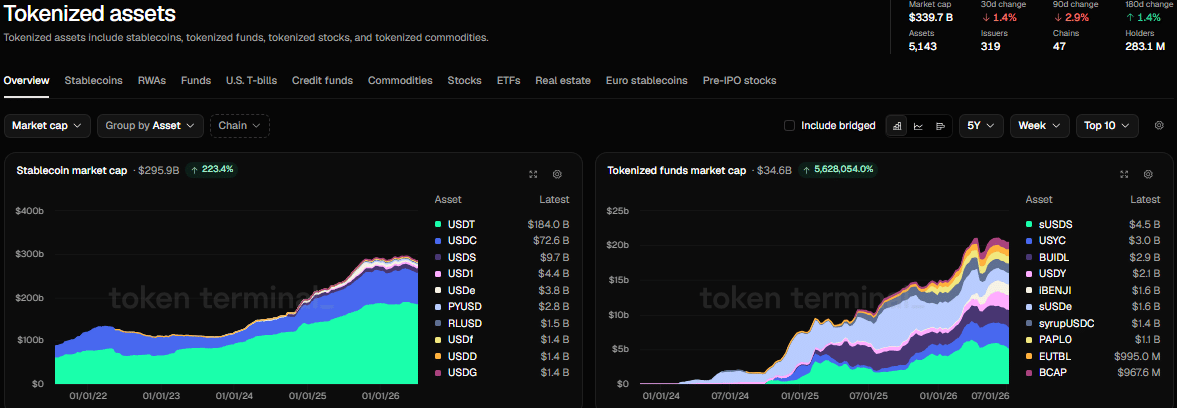
Data from Token Terminal shows the total tokenized asset market has already climbed to roughly 340 billion dollars, with stablecoins accounting for 295.9 billion of that and tokenized funds contributing another 34.6 billion.
Holders of tokenized assets now number around 283 million people spread across 47 blockchains, covering more than 5,100 assets from 319 separate issuers. Securitize currently sits at the top of that list, becoming the first platform to push past 5 billion dollars in real-world asset value.
Conclusion
Taken together, the UK tokenization roadmap arrives at a moment when institutional interest and real market activity are finally lining up. Government backing paired with support from major banks, crypto firms, and even consumer brands like Airbnb gives these projections a foundation that feels sturdier than the usual industry hype. Whether the UK actually hits 44.15 billion dollars by 2035 remains to be seen, but the groundwork being laid right now suggests the country is not treating this as a side project.
Frequently Asked Questions
What is the UK tokenization roadmap?
It is a government plan to move financial assets like bonds onto blockchain platforms, with a bond issuance targeted for early 2027.
How much money could UK tokenization generate by 2035?
Government projections point to 44.15 billion dollars a year, while Barclays and PwC estimate a more cautious 29.45 billion dollars.
Which companies are involved in the tokenization task force?
About 54 firms joined, including BlackRock, Goldman Sachs, JP Morgan, Morgan Stanley, Coinbase, Ripple, and Circle.
Is Airbnb entering the tokenization space?
Airbnb has not launched a tokenization product, but CEO Brian Chesky has expressed cautious interest in the concept.
Glossary of Key Terms
Tokenization; The process of converting rights to a real-world or financial asset into a digital token on a blockchain.
Real-World Assets (RWAs); Physical or traditional financial assets, such as bonds or real estate, represented digitally through tokenization.
Stablecoin; A type of digital token designed to hold a steady value, usually pegged to a currency like the US dollar.
Task Force; A group formed by the UK government bringing together banks and crypto firms to develop tokenization use cases.
Issuer; A company or platform responsible for creating and distributing tokenized assets to investors.