Most token founders sign one market making contract in their working life, usually a few weeks before TGE, usually on terms the market maker drafted. That is why the same mistakes keep repeat
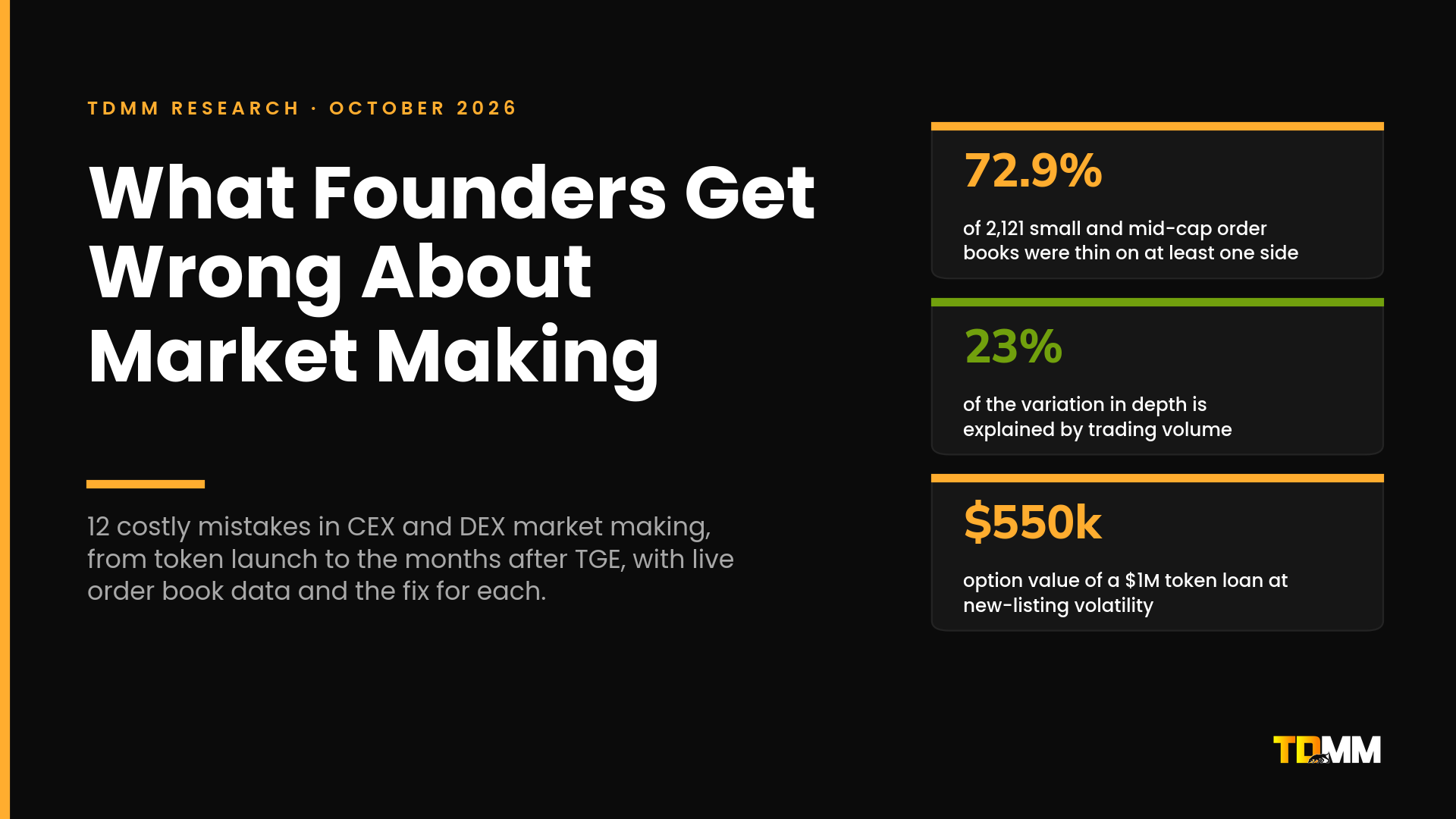
Most token founders sign one market making contract in their working life, usually a few weeks before TGE, usually on terms the market maker drafted. That is why the same mistakes keep repeating. We took a live snapshot of 2,121 order books and modelled the most common deal structure to show what those mistakes cost, and how to avoid them.

Nine numbers behind the mistakes. Sources as dated in the panel.
A crypto market maker keeps buy and sell orders live on both sides of a token’s market so people can trade at a fair price. It cannot create buyers. If more holders want to sell than buy, a market maker can keep the move orderly but cannot reverse it. Any firm that promises a price target or a volume number is offering something it cannot deliver without trading in ways exchanges treat as manipulation.
What liquidity does buy is a calmer market. Arrakis Finance analysed 2025 token launches and found tokens with under $20,000 of depth within 2% on their main exchange averaged 237% annualised volatility, against 171% for tokens with $165,000 or more.
The most common mistake is paying for volume. On 5 October 2026 we measured 2,121 USDT order books on Gate (881) and MEXC (1,240), every pair trading more than $5,000 a day, with stablecoins, leveraged tokens and tokenised stocks removed. Trading volume explained only 23% of the variation in depth within 2% of the price.

Volume explains only 23% of depth. Source: TDMM snapshot, 5 October 2026.
Among tokens trading $1 million to $10 million a day, 2% depth ran from $5,300 at the 10th percentile to $608,000 at the 90th, a 116x gap. And 238 books (11.2%) traded more than 100 times their own 2% depth in a day. That is not proof of wash trading, but volume that does not match the liquidity behind it is one of the red flags Binance now lists.
CoinMarketCap and CoinGecko display depth within 2% of the price. Kaiko stopped using that level in its research because it is the easiest to game. Our data shows why it matters: in the median book only 14.8% of the 2% depth sat within 0.5% of the price, where most trades execute.

Where the depth in the 2% figure really sits. Source: TDMM snapshot, 5 October 2026.
The fix is to set depth targets at 0.5%, 1% and 2%, on both sides, on every venue.
Many projects pay their market maker by lending tokens, often 1% to 5% of supply for 12 to 24 months according to Arrakis, with call options in place of a fee. We priced a typical deal with Black-Scholes: a $1 million loan with strikes at 1.0x, 1.25x and 1.5x for 12 months. The options are worth about $275,000 at 88% volatility and $550,000 at 166%, the median we measured for new listings. A retainer of $5,000 a month on three exchanges costs $180,000 a year.

What “free” costs. Source: TDMM model.
Option value is a ceiling, not a bill, but a founder who calls a loan free is comparing a known cost with an unpriced one. The reverse error also exists: squeeze the terms too hard and the good firms walk away.
On the largest exchanges the venue does not impose a service level on a token’s market maker, so spread, depth and uptime must be written into the project’s own contract. Here is where books sat on 5 October by volume tier.

Spread and depth benchmarks by volume tier. Source: TDMM snapshot, 5 October 2026.
24h volume
Median spread
Top-quartile spread
Median 2% depth
Top-quartile 2% depth
Thin on one side
$5k to $100k
30.8 bps
14.9 bps
$3.1k
$14.3k
82%
$100k to $1M
15.3 bps
8.1 bps
$16.3k
$66.3k
58%
$1M to $10M
5.8 bps
3.2 bps
$117.0k
$298.1k
24%
Over $10M
1.5 bps
0.8 bps
$844.2k
$3.56M
0%
Ask for top-quartile figures for your tier, and keep exchange accounts, API keys and loaned inventory under your own controls: project-owned sub-accounts, trade-only keys with withdrawals disabled, and tokens released in tranches.
DEX spot volume hit a record 24.2% of CEX volume in July 2026, according to CoinDesk Data. When order books and pools are run by different providers, or pools by nobody, prices drift and arbitrage traders take the difference. A full-range pool also needs about $2.01 million to hold $10,000 of depth each side within 2%, against about $20,000 of resting orders on an order book.

Same depth, three ways to deliver it. Source: TDMM model.
The median new listing in our study of 753 tokens moved 41.2% in its first hour, so a market maker hired two weeks before TGE is too late. Start 60 to 90 days ahead. Binance’s March 2026 guidance asks issuers to disclose their market maker and contract terms and lists six trading red flags, and profit-share clauses like the one in the MOVE contract, where a market maker sold 66 million tokens after listing, are exactly what exchanges look for. Market making after TGE matters too: Keyrock found about 90% of more than 16,000 unlocks put downward pressure on price.
Before signing, get written answers to seven questions: what you deliver per venue; how you are paid, in dollars; whose accounts and keys; whether CEX and DEX run on one book; whether the contract can be disclosed to exchanges; what you report and how we verify it; and what happens after TGE and at the end.
TDMM runs CEX and DEX market making for token projects on one book, from pre-TGE planning to unlocks and exits, with every mandate written in spread, depth and uptime per venue. The full guide, with all twelve mistakes, is at tdmm.io.
Sources
TDMM order book snapshot of Gate and MEXC, 5 October 2026; TDMM Black-Scholes model; TDMM post-listing study, 25 September 2026; Arrakis Finance, “Crypto Market Makers 101”, 17 March 2026; LO:TECH, “The State of Crypto Market Making 2025”; Binance market maker guidance, 25 March 2026; Decrypt and The Block on the MOVE case; Kaiko Research; CoinDesk Data, July 2026; Keyrock unlock research. Charts: CC BY 4.0, credit TDMM (tdmm.io).
Disclaimer: Published by TDMM, a market maker with an interest in this subject, for information only. Not investment, legal or tax advice, and not a promise about any token’s price, volume or liquidity. Order book figures are a point-in-time measurement; model figures rest on stated assumptions. Digital assets are volatile and you may lose the entire value of a position.