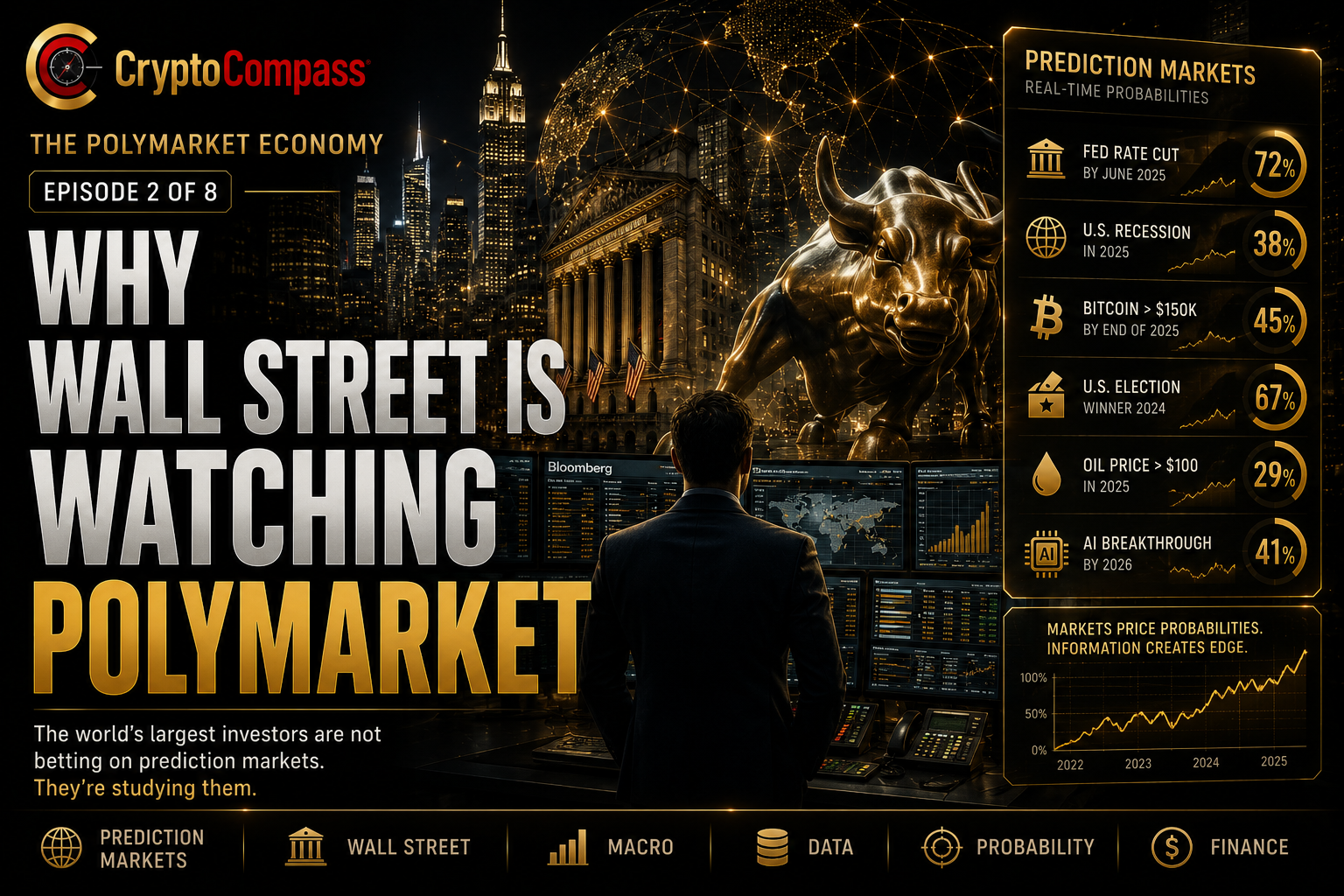
Wall Street does not care about predictions. It cares about information. And increasingly, some investors are beginning to view prediction markets as a new source of information—one that may reveal what people truly believe rather than what they publicly say.
Wall Street has spent decades searching for an edge.
Investors analyze earnings reports, economic indicators, central bank speeches, satellite imagery, shipping data, credit card transactions, and social media trends.
The goal is always the same.
Find information before everyone else.
Understand what is happening before it becomes obvious.
Predict what markets will do next.
This is why prediction markets are attracting attention.
Not because Wall Street suddenly became interested in gambling.
But because information has always been one of the most valuable assets in finance.
And prediction markets may represent an entirely new category of information.
Every financial market serves a purpose beyond trading.
Stock markets aggregate expectations about companies.
Bond markets aggregate expectations about interest rates.
Currency markets aggregate expectations about economies.
In each case, prices become signals.
Investors study those signals because they contain information about what millions of participants collectively believe.
Prediction markets operate under the same principle.
The difference is that they focus directly on future events.
Instead of interpreting a stock price to infer expectations, participants can observe expectations themselves.
The probability becomes visible.
The Value Of Seeing Expectations Directly
Consider a traditional economic forecast.
An economist might publish a report stating there is a 60% chance of a Federal Reserve rate cut within six months.
Now imagine a prediction market where thousands of participants are trading that exact outcome.
The market might imply a probability of 75%.
That gap becomes meaningful.
Who is correct?
Why are expectations different?
What information is the market incorporating?
For professional investors, these questions are valuable.
The answer may reveal opportunities before they appear elsewhere.
The Rise Of Alternative Data
Modern finance increasingly relies on alternative data.
Hedge funds purchase satellite imagery to estimate retail traffic.
They analyze cargo shipments to track supply chains.
They monitor social sentiment to identify shifts in consumer behavior.
Prediction markets fit naturally into this trend.
They are not replacing traditional analysis.
They are becoming another layer of intelligence.
A continuously updated source of market expectations generated by participants with financial incentives.
That combination is difficult to ignore.
Why Conviction Matters
One reason prediction markets are attracting attention is because they measure conviction.
Polls measure opinions.
Prediction markets measure positions.
The distinction matters.
A survey participant can answer a question without consequence.
A trader must decide whether to risk capital.
The two actions are not equivalent.
Financial markets have long understood this principle.
What people say often differs from what they do.
Prediction markets create an environment where belief has a price.
The Election That Changed Perceptions
The 2024 U.S. presidential election marked a turning point.
For months, prediction markets and traditional polling often told different stories.
Journalists began referencing Polymarket probabilities alongside polling averages.
Investors monitored political markets for clues about policy outcomes.
Macro funds followed election probabilities because political outcomes influence taxes, regulation, trade policy, government spending, and monetary expectations.
Prediction markets suddenly became relevant far beyond crypto.
They became part of the broader information ecosystem.
Wall Street Doesn't Need To Trade It
An important misconception is that institutions must actively participate in prediction markets for them to matter.
They do not.
Wall Street already consumes information from countless external sources.
Economic reports.
Research firms.
Government data.
News organizations.
Alternative datasets.
Prediction markets can simply become another input.
A signal rather than an investment.
The value lies in the information generated by the market, not necessarily the contracts themselves.
The deeper story may not be about trading.
It may be about forecasting infrastructure.
Imagine a future where prediction markets exist for:
Economic growth.
Inflation.
Corporate earnings.
Regulatory approvals.
Scientific breakthroughs.
Geopolitical risks.
Energy markets.
Technology adoption.
Such a system would create a continuously updating map of global expectations.
A real-time dashboard of uncertainty.
That possibility is what attracts attention from investors, economists, researchers, and policymakers alike.
The Limits Of Prediction Markets
None of this means prediction markets are perfect.
Liquidity can distort probabilities.
Participants can be biased.
Markets can overreact.
Smaller markets may be unreliable.
Regulatory uncertainty remains a major challenge.
Prediction markets should not be viewed as oracles.
They are tools.
Like every market, they are only as effective as the participants who contribute information to them.
CryptoCompass View
Wall Street's interest in Polymarket is not really about crypto.
It is about information.
Financial markets reward those who understand reality faster than everyone else.
Prediction markets offer a new mechanism for discovering what large groups collectively believe about the future.
Whether that mechanism ultimately proves superior to traditional forecasting remains uncertain.
But the direction of travel is becoming clearer.
For decades, investors relied on analysts, surveys, and economic models to understand expectations.
Prediction markets introduce a fourth source of intelligence: market-priced probabilities.
That may explain why some of the world's most sophisticated investors are paying attention.
Because in finance, information is power.
And prediction markets are rapidly becoming information markets.
NEXT IN THE SERIES
THE POLYMARKET ECONOMY
Episode 3 of 8
Prediction Markets vs Traditional Polls:
Which Is More Accurate?
Coming This Week.
By CryptoCompass