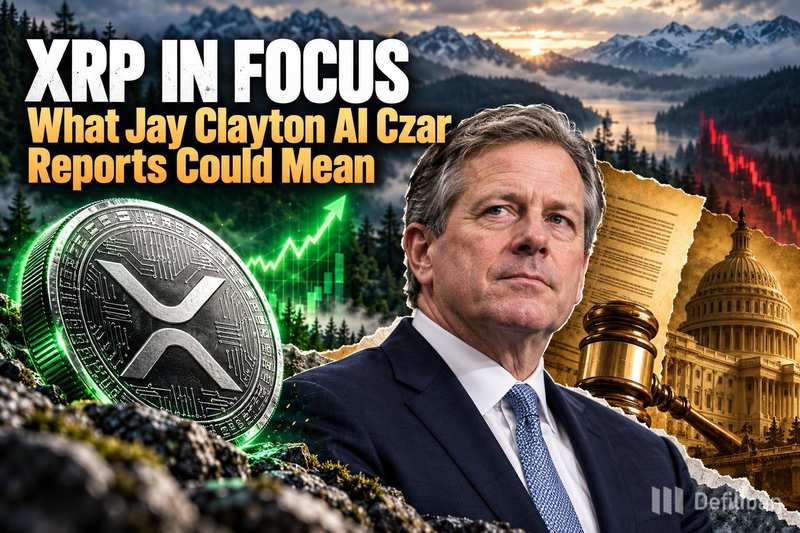
Reports circulating in regulatory and crypto policy circles suggest that former SEC Chair Jay Clayton could be tapped for a prominent AI-focused government role, drawing renewed attention to
Reports circulating in regulatory and crypto policy circles suggest that former SEC Chair Jay Clayton could be tapped for a prominent AI-focused government role, drawing renewed attention to XRP given Clayton's tenure overseeing the agency that brought the landmark enforcement action against Ripple. The appointment has not been confirmed, and no official mandate or remit has been published.
Jay Clayton served as SEC Chair from 2017 to 2020, a period that included the agency's initial scrutiny of initial coin offerings and the groundwork for later digital-asset enforcement. He subsequently served as U.S. Attorney for the Southern District of New York, the office that handles a significant share of federal financial prosecutions. His regulatory record makes any reported move into a senior policy seat a data point that XRP market participants track closely, even when the report is unconfirmed. For related coverage, see Cyber Revolution Summit Morocco 2026.
The reported role is framed as an AI czar position, which would be structurally distinct from the SEC chairmanship. For context, the White House in December 2024 announced David Sacks as its AI and crypto policy coordinator, a role that carries advisory authority rather than direct enforcement power. A similar AI-focused appointment for Clayton, if it materialized, would not automatically extend to securities law interpretation or XRP-specific policy. For related coverage, see CRYPTOCON SYDNEY RETURNS TO ICC SYDNEY WITH FREE GENERAL ADMISSION FOR 2026.
That distinction matters for protocol-level analysis. An AI advisory mandate does not restore or alter SEC enforcement posture, does not reopen or close civil proceedings, and does not bind the commission's current leadership. Readers assessing XRP governance risk should treat the reported appointment as a personnel development to monitor, not a confirmed shift in the regulatory stack governing digital assets. For related coverage, see 21Shares Turns Staking Rewards Into ETF Payouts.
Ripple's legal situation with the SEC has its own separate procedural trajectory. The SEC's commissioner history shows that personnel transitions at the agency or in adjacent government roles do not automatically alter ongoing or concluded litigation. Any inference that Clayton entering a non-SEC role changes XRP's regulatory exposure requires a causal chain that current evidence does not support. Coverage of Ripple's stablecoin expansion, including the Ripple USD stablecoin reaching a new all-time high, reflects Ripple's own product development pace, which continues independently of personnel speculation.
What would change the signal
Three developments would convert this from a reported personnel item into a story with direct XRP protocol implications. First, an official White House or agency announcement confirming the appointment and describing the role's scope. Second, any public statement from Clayton touching on digital-asset regulation or Ripple-related proceedings in his new capacity. Third, a subsequent regulatory action or policy guidance that can be traced to the new role's authority.
Until any of those materialize, the current evidence supports only this: a former SEC Chair with a documented financial-enforcement background is reportedly under consideration for a senior AI policy position. The connection to XRP is circumstantial, grounded in Clayton's prior institutional role rather than any confirmed action. Protocol participants and liquidity providers watching the XRP regulatory overhang should track official confirmation channels rather than the report itself.
Broader shifts in Washington's approach to crypto-adjacent policy roles, including how AI coordination and digital-asset oversight intersect at the executive level, remain an open governance question. Developments in that space, such as institutional positioning in crypto ETFs, suggest that policy-adjacent personnel moves continue to carry asymmetric weight for token valuations even when the direct regulatory link is tenuous.
Disclaimer: This article is for informational purposes only and does not constitute financial or investment advice. Cryptocurrency and digital asset markets carry significant risk. Always do your own research before making decisions.
Read original article on defiliban.io