XRP price has climbed roughly 2% over the past 24 hours, bringing the token back to around $1.42 as buyers attempt to extend its recent recovery. Current market data puts the 24-hour range be
XRP price has climbed roughly 2% over the past 24 hours, bringing the token back to around $1.42 as buyers attempt to extend its recent recovery. Current market data puts the 24-hour range between approximately $1.38 and $1.45, while the XRP price is also up more than 5% over the past week.
The latest move comes as Celal Küçüker, an analyst we regularly cover at CaptainAltcoin, published an ambitious new XRP outlook. Küçüker believes XRP could become “the star of this bull run,” laying out a progression of targets at $2.30, $3.30, $4.90, $7.50 and eventually $11.60.
Those numbers are aggressive considering XRP remains near $1.42. However, Küçüker’s three-day chart shows that he isn’t calling for a straight-line rally. Instead, it maps several major resistance areas XRP would have to overcome before the higher targets become relevant.
Celal Küçüker Maps XRP Price Targets Up to $11.60
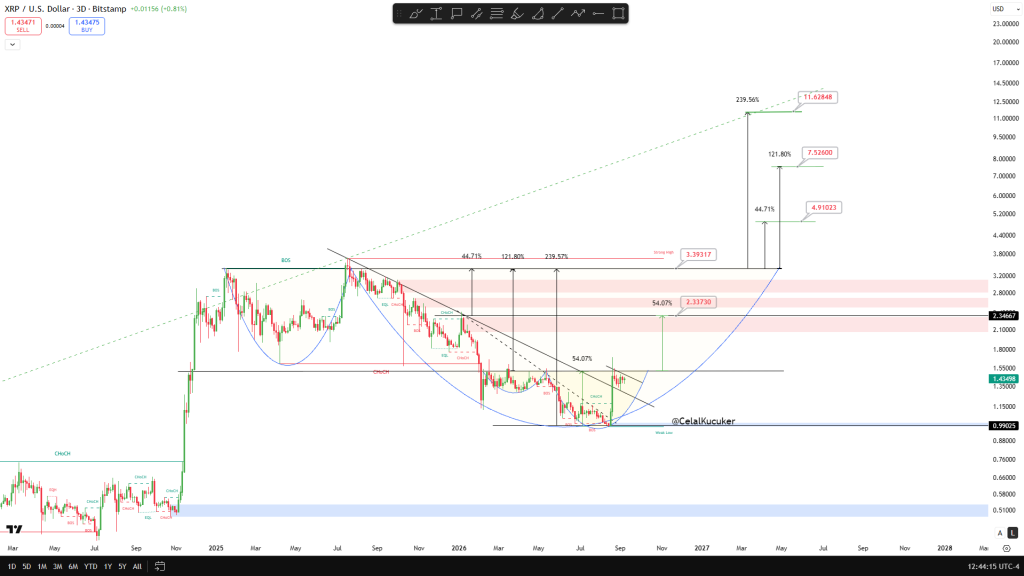
Küçüker’s chart starts with an important long-term base around $0.99.
XRP tested this region during the summer before producing a strong recovery. The chart labels the area as a “weak low,” and the subsequent rebound has carried XRP back above $1.40.
More importantly, XRP appears to have broken the descending trendline that had capped price since the 2025 peak. The latest candles are now consolidating above that breakout area, although XRP hasn’t yet cleared the horizontal resistance around $1.50–$1.55.
That is the first major test.
Küçüker’s blue projection shows XRP eventually breaking above $1.50 and beginning a much larger rounded recovery. His first major upside objective is approximately $2.3373.
The chart places several supply zones between roughly $2.10 and $3.10, meaning a move toward $2.30 wouldn’t necessarily give XRP a clear path toward its old highs. Buyers would still have to work through substantial historical resistance.
 Source: X/@CelalKucuker
The next critical level is approximately $3.39.
This is particularly important because it sits close to the major highs shown on Küçüker’s chart. A sustained break through this region would represent a much more significant technical development than simply recovering $2.
From there, his targets become considerably more ambitious.
How XRP Gets From $3.30 to $11.60
Küçüker uses measured percentage expansions to build the upper portion of his roadmap.
The first extension above the major $3.39 resistance produces a target near $4.91, which means roughly a 45% advance from that breakout area.
The next projected expansion takes XRP toward $7.526.
That would represent roughly a 122% advance from the same major breakout region and would put XRP comfortably into price discovery under the framework shown on the chart.
His most aggressive objective is $11.628.
The chart labels that move at approximately 240% above the $3.39 area.
From today’s $1.42 price, reaching $11.60 would require an increase of more than 700%. That makes $11.60 a long-range bull-market scenario rather than an immediate target.
There is also a logical progression to watch before entertaining those numbers:
$1.50–$1.55 → $2.33 → $3.39 → $4.91 → $7.53 → $11.63.
That progression is arguably more useful than the final target itself. XRP hasn’t cleared the first resistance yet, so each stage would need confirmation before the next becomes technically relevant.
The bearish invalidation area is equally clear. A return toward $0.99 would put XRP back at the base from which Küçüker’s projected recovery begins and would seriously weaken the bullish roadmap.
Read also: XRP Price Could Be Ready for a Big Move With or Without the CLARITY Act
Native Lending Could Become XRP Ledger’s Next Major Catalyst
The technical picture is developing alongside a potentially important fundamental change for the XRP Ledger.
Two proposed amendments (XLS-65 and XLS-66) would introduce infrastructure for native asset vaults and lending directly at the ledger level.
XLS-65 introduces Single Asset Vaults, allowing assets to be pooled on XRPL. XLS-66 builds on that infrastructure with a native lending protocol designed for fixed-term credit.
But there is an important qualification: the amendments are not live yet.
XRPL amendments require more than 80% support from trusted validators for two consecutive weeks before activation. With 35 validators being tracked, that effectively means reaching at least 29 votes if the requirement is strictly “more than 80%,” rather than merely 28. Recent reporting has XLS-65 and XLS-66 well below that threshold, at roughly 13 and 12 supporting validators respectively.
That distinction matters because institutional products are already being prepared around the functionality.
Clearpool and Cicada Partners are working on an institutional credit product using RLUSD, with Ripple participating as an investor. Clearpool is building the lending infrastructure while Cicada handles borrower sourcing, underwriting and credit management. The system is being tested on Devnet and remains dependent on XLS-65 and XLS-66 becoming active on mainnet.
If activated, native lending would give XRPL another DeFi primitive beyond its existing payments, DEX and tokenization capabilities.
That doesn’t mean lending automatically creates proportional demand for XRP. The planned institutional product uses RLUSD as the lending asset, while XRP’s direct role includes transaction fees and ledger reserve requirements. Still, increased XRPL activity could broaden the network’s economic use and create another reason for institutions and developers to interact with the ledger.
21Shares Takes Aim at One of XRP’s Biggest Misconceptions
XRP is also receiving attention from institutional asset manager 21Shares, which published a detailed guide describing XRP as one of crypto’s veteran assets.
One of the main issues addressed was the widespread belief that Ripple controls the XRP Ledger.
According to 21Shares, Ripple currently operates just one of the 35 validators on the ledger’s default trust list. The remaining validators include independent companies, developers, universities and other ecosystem participants.
That’s an important distinction between Ripple, the company; XRPL, the network; and XRP, its native asset.
Ripple has played an enormous role in XRP’s history and continues to build businesses and products connected with the ecosystem. But that isn’t the same thing as having unilateral control over XRPL consensus.
21Shares also points to the evolution of XRPL beyond its original cross-border payments use case. The network now supports a native decentralized exchange, stablecoins and tokenized real-world assets, while every ledger transaction requires an XRP-denominated fee that is subsequently burned.
XRP Price Outlook: How Realistic Is $11.60?
Küçüker’s chart gives bulls plenty to think about, but the most useful levels are considerably closer to the current XRP price.
At roughly $1.42, $1.50–$1.55 is the first battle.
Breaking that region would strengthen the recovery and turn attention toward approximately $2.33. That is where the first major target on Küçüker’s roadmap sits and where XRP would begin moving into heavier historical supply.
The bigger technical event would come around $3.30–$3.40. If XRP eventually breaks that area convincingly, the $4.90 target becomes much easier to discuss from a chart perspective.
Only after XRP establishes itself beyond its previous major highs would $7.50 and $11.60 become credible bull-market targets within Küçüker’s framework.
Fundamentals could help the broader story. Native lending would expand XRPL’s functionality if XLS-65 and XLS-66 receive enough validator support, while institutional firms continue building products around the network.
But neither those developments nor Küçüker’s chart guarantee an eightfold XRP rally.
Subscribe to our YouTube channel for daily crypto updates, market insights, and expert analysis.
The post XRP Price Could Be the Star of the Next Bull Run, Analyst Says appeared first on CaptainAltcoin.