Ericsson is a 150 year old telecom company that traces its roots back to April 1, 1876, when Lars Magnus Ericsson opened a telegraph repair shop in a Stockholm kitchen. Pavan Bachwal, who lea
Ericsson is a 150 year old telecom company that traces its roots back to April 1, 1876, when Lars Magnus Ericsson opened a telegraph repair shop in a Stockholm kitchen.
Pavan Bachwal, who leads Ericsson Mobile Financial Services, told TheStreet Roundtable at Money20/20 in Las Vegas that the fintech side of the business is where the next growth story lives.
“Telecommunication is still 99% plus of the business,” Bachwal said. “But me and my team are looking to create a new growth story.”
Related: Top analyst calls Nasdaq AI firm’s SEC filing 'one of the ugliest' ever
How a phone company ended up in payments
Bachwal says the push started in 2009, when his team was asked to explore financial inclusion and innovation. The result is a B2B platform that lets carriers, banks, and enterprises launch compliant financial products.
A wallet-led service is, in plain terms, an app that holds money and lets people pay, send and receive it from a phone. Ericsson does not run most of those apps. It sells the software underneath them.
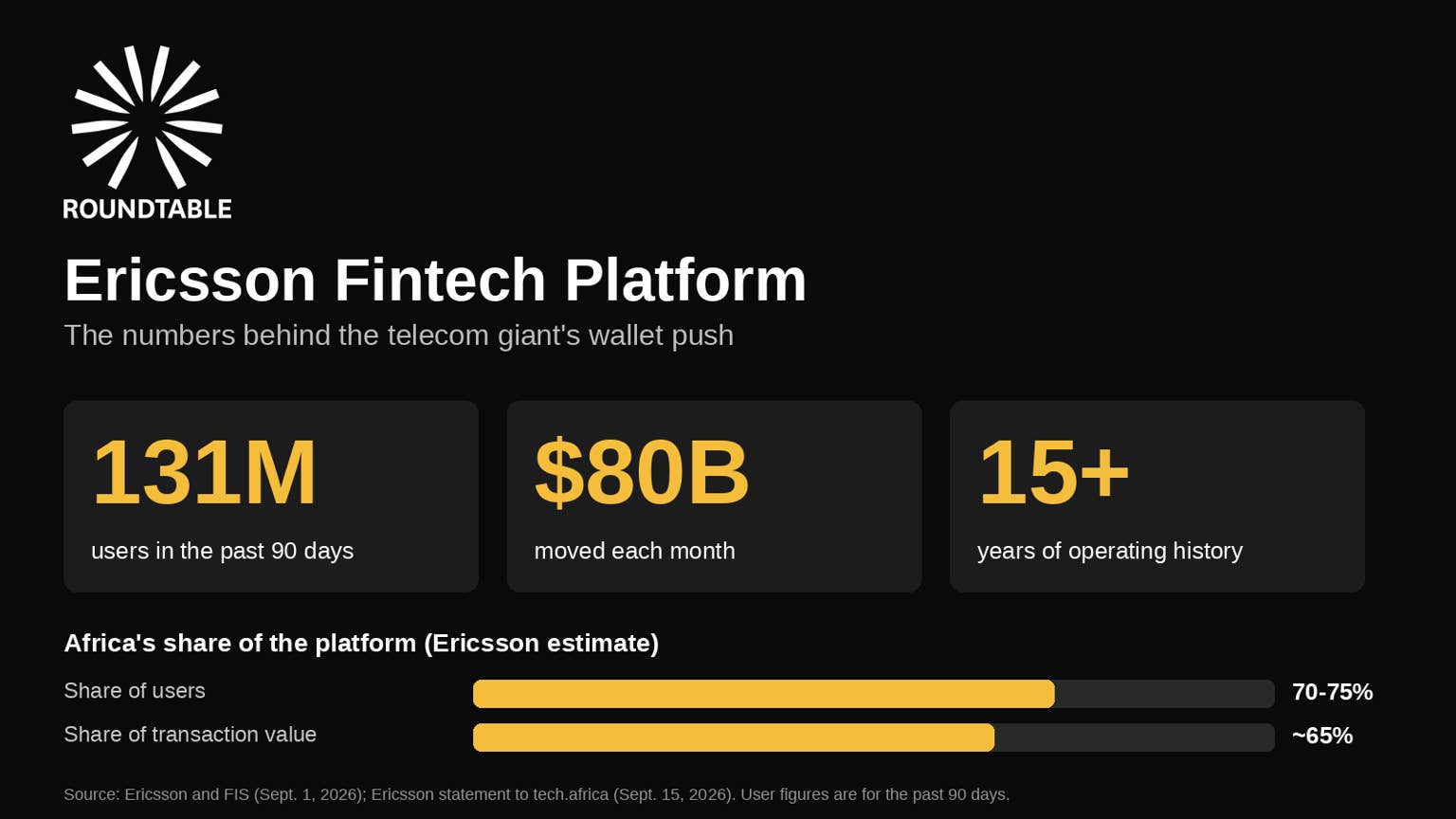
The scale is impressive. Ericsson says its fintech platform has more than 15 years of operating history, at least 131 million users who transacted in the past 90 days, and roughly $80 billion in monthly volume.
Most of that activity is in Africa and the Middle East. Ericsson told tech.africa that Africa accounts for about 70% to 75% of the 131 million users and about 65% of transaction value. The site described the platform as white-label infrastructure: operators run it under their own brands, so users rarely see Ericsson's name. Ericsson has named customers including MTN Group, e& Money in the UAE, Mobily Pay in Saudi Arabia and Easypaisa Digital Bank in Pakistan.
Ericsson has been adding partners. In February it announced a collaboration with Mastercard to connect the platform to Mastercard Move, Mastercard's money-movement products. Ericsson as a whole reported third-quarter sales of SEK 59.5 billion (about $6 billion at the ECB rate that day) on Oct. 15, up 7% from a year earlier on an organic basis.
Bachwal argues that the telecom and financial services worlds have already merged. Voice, data, and texting all run on mobile, and so do most financial transactions.
“We have also seen that transition from cash to card to bank to cardless to mobile,” he said. “Now the two worlds are converging.”
According to Bachwal, half of global internet traffic runs through Ericsson systems.
His team built the platform mobile-first, then stacked security, financial services, and digital wallet layers on top.
More news:
Not a bank
Ericsson has partnered with FIS, which announced a collaboration to pre-integrate FIS capabilities into the Ericsson Fintech Platform. Initial availability begins in the third quarter of 2026, with retail, healthcare, and government uses to follow. Ericsson CEO Börje Ekholm called fintech a clear growth area as connectivity and finance converge.
FIS would add its payments and card-issuing products, so a bank, retailer or carrier could launch a wallet without wiring the pieces together itself. FIS said the biggest challenge in launching wallet-led services “is not demand, but the complexity of connecting the systems needed to move, store, secure and manage money at scale.”
The third quarter, when FIS said availability would begin, has now ended. As of tech.africa’s Sept. 15 update, Ericsson had named no launch market and said a commercial launch would be announced “in due course.”
Bachwal said Ericsson’s edge in an increasingly crowded payments market comes down to four things: scale, trust, security, and stability. Those are the same qualities a century and a half of running phone networks was built on.
FIS’s release also cites a track record of “zero security incidents” on the platform. That is a company claim, not an independent audit.