The ruble-backed stablecoin A7A5 has continued to expand despite Western sanctions, processing more than $110 billion in cumulative on-chain transactions, according to CertiK. Issued by Old V
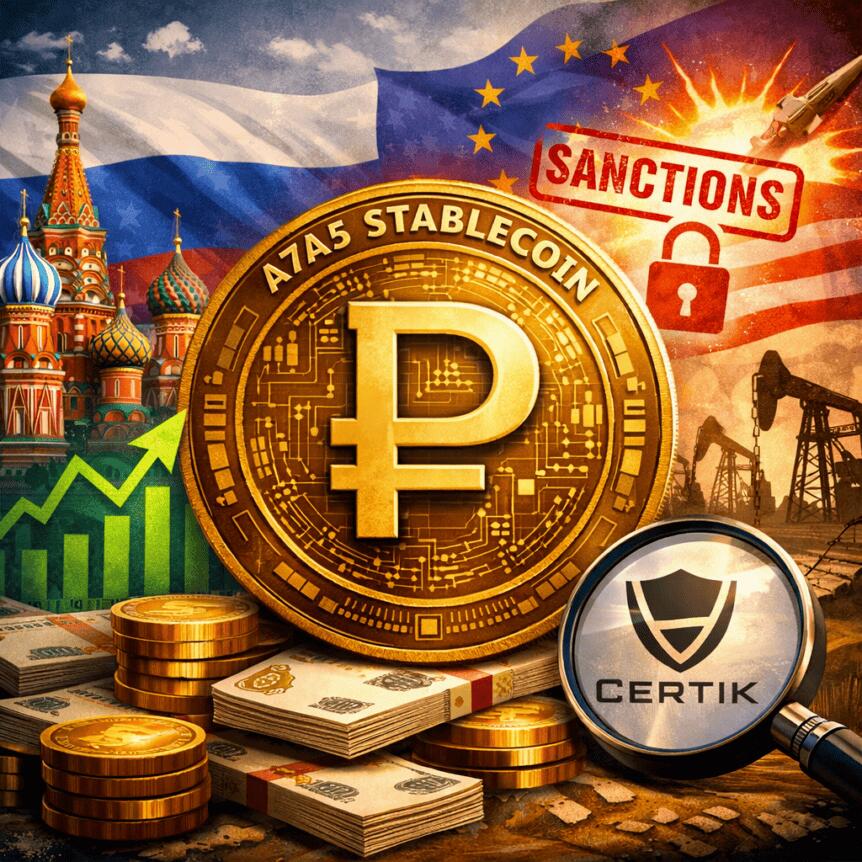
The ruble-backed stablecoin A7A5 has continued to expand despite Western sanctions, processing more than $110 billion in cumulative on-chain transactions, according to CertiK. Issued by Old Vector LLC in Kyrgyzstan on behalf of Russia’s cross-border settlement firm A7 LLC, the token now accounts for roughly 43% of the global non-dollar stablecoin market, with its holder base growing from about 13,000 wallets in February 2025 to 29,000 by May 2026.
CertiK describes A7A5 as a leading example of a sanctions-evasion stablecoin ecosystem, linking its activity to Russian cross-border settlement channels. The European Union’s 19th sanctions package, adopted on October 23, 2025, forbids A7A5 transactions from November 12, 2025. Yet, CertiK notes that the reserve and issuance architecture places key assets outside direct Western enforcement reach.
Key takeaways
- A7A5 has surpassed $110 billion in cumulative on-chain activity and commands about 43% of the global non-dollar stablecoin market, with wallets swelling to roughly 29,000 by May 2026.
- The project’s reserves sit in banking networks outside Western jurisdictions, and its design minimizes centralized control to resist direct enforcement.
- Liquid supply is distributed through DeFi pools (Curve, Uniswap) to avoid centralized exchange freezes, and the system deliberately lacks a centralized kill switch.
- Regulators have begun to squeeze onramps and execution points via the EU’s sanctions package and parallel actions, even as the blockchain itself cannot be “erased” by regulators from the outside; enforcement targets choke points.
Sanctions-era architecture and growth
The A7A5 project, launched in January 2025 by Old Vector LLC—a Kyrgyz entity acting for the Russian cross-border-settlement group A7 LLC, co-owned by Moldovan-Russian oligarch Ilan Shor and Russian state-owned lender Promsvyazbank—has intentionally built its framework to endure outside Western financial rails. CertiK notes that the reserves backing A7A5 sit largely in Central Asian banking networks and in the Russian banking system, reducing exposure to Western sanction enforcement.
A7A5’s design also emphasizes a distributed issuance and freezing model. Rather than anchoring control to a single centralized infrastructure, the project relies on decentralized finance liquidity layers, including Curve and Uniswap, to disperse liquidity and prevent unilateral freezing by centralized venues. Jonathan Riss, OSINT and blockchain intelligence analyst at CertiK, explained that this structure makes direct blockchain “rewrites” by regulators ineffective, while opening multiple points for enforcement actions to target residual choke points.
“While Western regulators cannot directly rewrite the Ethereum or Tron blockchain to erase A7A5, the EU’s 19th package and parallel US/UK actions target the physical and digital choke points.”
Riss emphasized that the three immunities crafted into A7A5—reserves outside Western reach, a non-centralized kill-switch, and DeFi-based liquidity—create practical resilience against sanctions that crippled other stablecoins in the past. CertiK characterizes A7A5 as one of the clearest examples of sanctions-evasion in a stablecoin ecosystem, closely tied to Russia’s cross-border settlement architecture.
The stablecoin’s path to prominence has not been accidental. A7A5’s on-chain activity and user base point to meaningful demand for ruble-based settlement and payments that can operate across borders even when traditional financial rails are constrained. The use of DeFi pools helps preserve liquidity in a way that reduces single points of failure, a feature that distinguishes A7A5 from more tightly centralized stablecoins.
Regulatory response and market dynamics
Washington and Brussels have moved to curb sanctioned assets by targeting the on- and off-ramp infrastructure that supports their circulation. The EU’s 19th sanctions package, in force for A7A5 from November 12, 2025, marks a meaningful escalation in the legal framework surrounding such tokens. However, the legal reach of sanctions—particularly when assets are held in jurisdictions outside Western control—remains a point of contention. As CertiK’s assessment suggests, regulators can strip access at centralized gateways and choke points, but they cannot “rewrite” the blockchain itself.
Beyond the paper trail of sanctions, A7A5 has demonstrated tangible market activity. The token recorded about $11.2 billion in trading volume for A7A5/RUB and roughly $6.1 billion for A7A5/USDT pairs, with Grinex (the successor to Garantex) serving as a primary conduit. This is notable given Garantex’s history as a laundering venue linked to illicit flows and later enforcement actions. In 2025, the U.S. Secret Service seized the Garantex domain, and Tether froze approximately $28 million in USDT held in wallets tied to Garantex, underscoring how on- and off-ramps still attract regulatory scrutiny even as new rails proliferate.
Owners and governance structures also weigh into the risk profile. The Ruble vault’s control framework was designed to retain issuance and reserves outside Western control, but the project’s governance is not centralized in a single public-facing entity. The leadership and ownership history surrounding A7A5’s parent entities suggest potential regulatory and compliance risk as authorities escalate enforcement against sanction-busting financial instruments.
Ownership, governance, and regulatory exposure
At the core of A7A5’s governance is Ilan Shor, who holds 51% of A7 LLC, the parent company behind the stablecoin’s issuance. Shor’s legal history adds a layer of geopolitical and regulatory sensitivity to the project. A Moldovan court convicted him in 2014 for theft from Moldovan banks, and he fled Moldova in 2019 to obtain Russian citizenship. He was sentenced in absentia in 2023 and currently resides in Moscow. This ownership backdrop has intensified attention on the project as Western authorities seek to constrict sanctioned digital assets from multiple angles.
The combination of Shor’s ownership, the token’s opaque reserve geography, and the reliance on DeFi rails creates a unique governance and risk profile for A7A5. Observers will be watching how regulators pursue enforcement actions that can disrupt liquidity or compel exchanges and liquidity providers to comply with sanctions, even as the asset circulates across borderless, permissionless networks.
As the regulatory landscape evolves, market participants should monitor how additional sanctions packages or enhanced enforcement actions affect onramps, liquidity provisioning, and cross-border settlement flows tied to ruble-denominated stablecoins. While the blockchain itself remains outside direct regulatory rewriting, the surrounding infrastructure—exchanges, custodians, and banks—continues to be a focal point for policymakers aiming to constrain sanctioned financial activity.
Readers should keep an eye on how this ecosystem adapts to shifting compliance requirements, potential liquidity pressures on DeFi pools, and any new oversight that targets the facilities that make sanctions-busting stablecoins viable—while hoping for clearer international norms on what constitutes legitimate cross-border settlement in a digitized world.
This article was originally published as A7A5 ruble stablecoin grows amid Western sanctions, CertiK finds on Crypto Breaking News – your trusted source for crypto news, Bitcoin news, and blockchain updates.