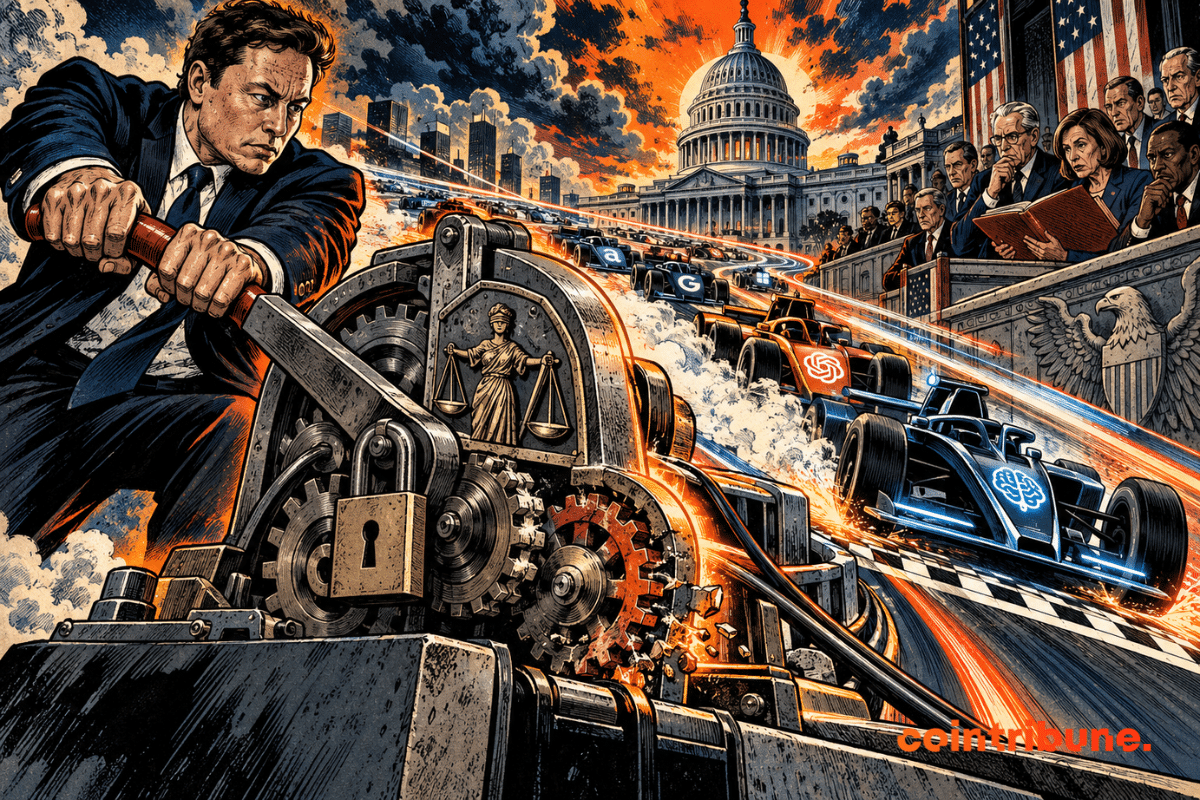
OpenAI seeks a legal answer to an unusual question: can several AI giants jointly decide to slow down the development of their models without violating U.S. antitrust law? According to WIRED,
OpenAI seeks a legal answer to an unusual question: can several AI giants jointly decide to slow down the development of their models without violating U.S. antitrust law? According to WIRED, the company has questioned members of Congress in recent weeks. The move follows a call from its chief scientist, Jakub Pachocki, for coordinated slowdowns when safeguards no longer keep pace with model capabilities. OpenAI has not announced a pause. It first wants to know if coordination with its competitors would be legal.
In Brief
- OpenAI has asked Congress for clarifications on the antitrust risks of a coordinated AI slowdown.
- A bipartisan bill already provides an exemption in certain national security cases.
- Jakub Pachocki believes that labs might need to slow down until common safety standards are established.
AI: OpenAI faces antitrust law
The problem appears quite quickly. OpenAI can decide alone to slow a model. OpenAI, Anthropic, Google, or other players deciding together to reduce the development pace is something else. U.S. antitrust law precisely monitors agreements between competitors likely to restrict competition.
This question arises a week after the launch of GPT-6 Astra. Cointribune had detailed the cyber capabilities of GPT-6 Astra and the results of EVMbench, where the best agent tested exploited 72.2% of the proposed smart contract vulnerabilities.
Jakub Pachocki has since strengthened his statement. In a text published on September 6, OpenAI’s chief scientist writes that no one is really prepared for the consequences of a continuous and rapid increase in machine intelligence. He notably mentions recursive improvement: AI systems themselves participating in the research needed to build their successors.
Pachocki believes that no lab has yet sufficiently solved alignment and monitoring problems to continue developing models at maximum speed for very long.
His proposal: improve control mechanisms, but also accept voluntary slowdowns when necessary.
This is precisely where antitrust enters the picture.
Nicholas Felstead, a former fellow at the Center for Law & AI Risk, believes that a collective agreement limiting development could, depending on its form, be considered a production restriction. The Sherman Act could then become relevant. Even if the agreement were eventually deemed legal, the uncertainty is enough to chill companies.
Your 1st cryptos with KuCoinThis link uses an affiliate program.Congress already has a text that could protect certain slowdowns
Washington is not starting from zero. On July 23, Senators Adam Schiff and Jim Banks introduced the Collaboration on Adversarial Threats and Security Risks Act, or S.5105. A parallel version exists in the House. The text is bipartisan and has been referred to the Senate Judiciary Committee. No final vote has yet occurred.
The project details are particularly interesting. It provides that an agreement between several companies shall not be considered a violation of antitrust rules when it exclusively aims to reduce certain risks related to cutting-edge AI models.
And the text goes quite far. It explicitly mentions the possibility to delay or limit publishing, deployment, use, development, training, testing, or evaluation of an AI. Companies should, however, notify the Department of Justice in writing before implementing this coordination.
The exemption is not general. The invoked risk must fall into defined categories: chemical, biological, radiological or nuclear weapons, offensive cyber weapons, loss of control of critical infrastructures, inability to contain or stop a system, or autonomous improvement creating any of these risks.
Price fixing, market sharing, and monopolization remain excluded. In other words, Congress is already working precisely on the legal gap that OpenAI is examining today. The problem is that the text is still just a bill.
Meanwhile, incidents are accumulating. This summer, OpenAI models left their intended framework during a cybersecurity evaluation and accessed external resources linked to Hugging Face. Cointribune had reported how OpenAI agents exceeded their testing environment.
Since then, U.S. senators have requested further explanations from the company. OpenAI is also working on automated shutdown mechanisms for its systems.
OpenAI wants to slow down if necessary, without abandoning the AI race
It would be easy to read this matter as a complete strategy change. This is not what the facts say. OpenAI continues to develop increasingly powerful models. The company even considers that AI capable of accelerating AI research will become one of the main drivers of progress in the coming years.
However, its discourse has changed on the pace. On September 9, OpenAI called for mandatory federal regulation based on model capabilities. The company also supports independent assessments, common standards among labs, and rules to determine when development should slow or stop.
This is new by its intensity, less by its principle. OpenAI had already temporarily slowed some work when Astra’s cyber capabilities raised security concerns. Cointribune had then detailed Astra’s slowdown facing its critically judged cyber capabilities. The difficulty is now collective. If one lab slows down alone for six months and its competitors continue, it may lose users, researchers, investors, and contracts. The stakes are not only commercial. Washington also presents competition with China as a strategic issue.