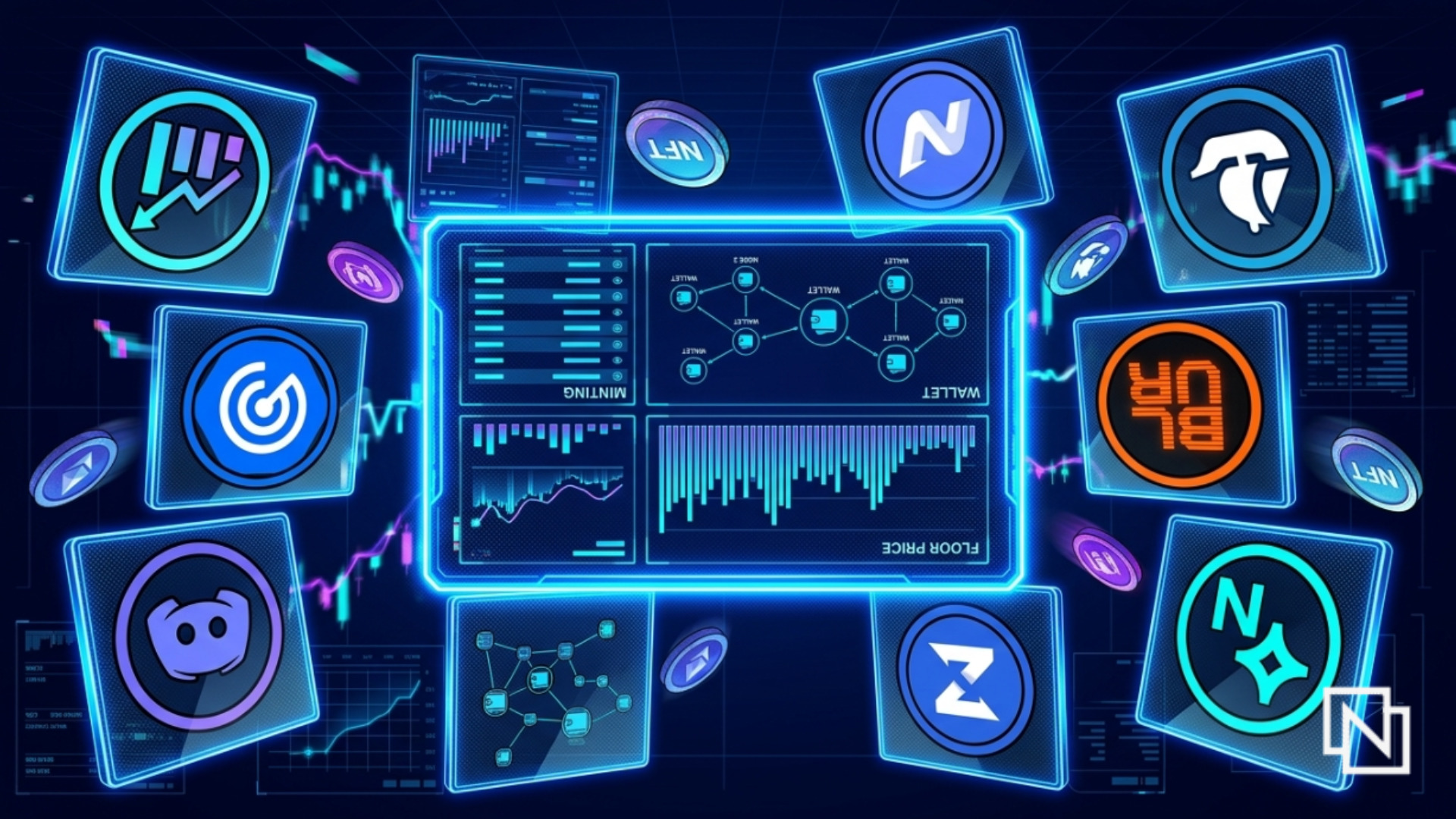
Most people do not need more NFT data. They need better triggers. The best NFT tracking tools in 2026 are the ones that help you notice meaningful movement early without turning every small f
Most people do not need more NFT data. They need better triggers. The best NFT tracking tools in 2026 are the ones that help you notice meaningful movement early without turning every small floor-price twitch into a false alarm.
That makes tracking different from analytics. Analytics helps you understand a market. Tracking helps you stay on top of one. If you are building a fuller workflow, this page should connect naturally to your guide on NFT analytics tools, your comparison of NFT marketplaces, and your broader coverage of NFT market shifts.
Reviewed by NFTEnex Editorial TeamLast reviewed: 2026-07-13Review type: No-budget editorial comparisonEditorial policy: NFTEnex Editorial Policy
Why you can trust this guide
This guide is based on live public product surfaces and official references reviewed on 2026-07-13. We directly checked the public positioning, visible workflow framing, and documentation shown in this article. We do not present unverified logged-in behavior, live checkout results, or completed onchain actions as first-hand use unless they were actually completed and documented.
Methodology
We compared each option using live public product surfaces, official documentation, and visible workflow cues captured at review time. In this version, the ranking prioritizes clarity, workflow posture, and fit for different user types over private dashboard claims we could not verify directly.
Limitations
This is a no-budget editorial review, not a fully funded end-to-end product test. Where a conclusion would require a live transaction, paid plan, logged-in dashboard, or wallet-funded workflow, we treat that as a limitation and avoid overstating direct experience.
For most users, DappRadar and NFTGo are the cleanest starting points because they make it easy to watch category movement and specific collections. Nansen is stronger when the signal you care about is wallet-driven. Zerion works well when you want NFT movement inside a broader portfolio view. OpenSea watchlists still matter because listing-level marketplace behavior can be useful even when deeper research happens elsewhere. Blur-native monitoring remains relevant for faster market participants. Discord alert bots and custom dashboards matter because the best tracking setup is often modular, not monolithic.
Quick picks:
- Best simple tracker: DappRadar
- Best collection watch setup: NFTGo
- Best wallet tracker: Nansen
- Best portfolio-linked tracking: Zerion
- Best for custom alerts: Discord bots and dashboard workflows
For this article, we reviewed the live public surfaces of DappRadar, OpenSea, Blur, and Zerion on 2026-07-10 so the comparison would not rely only on feature summaries and product claims.
That direct review does not replace a full alert test across logged-in watchlists, wallet tracking, or real notification workflows. What it does show very clearly is which products are built for broad orientation, which ones are shaped by marketplace behavior, and which ones are better understood as part of a bigger portfolio workflow.
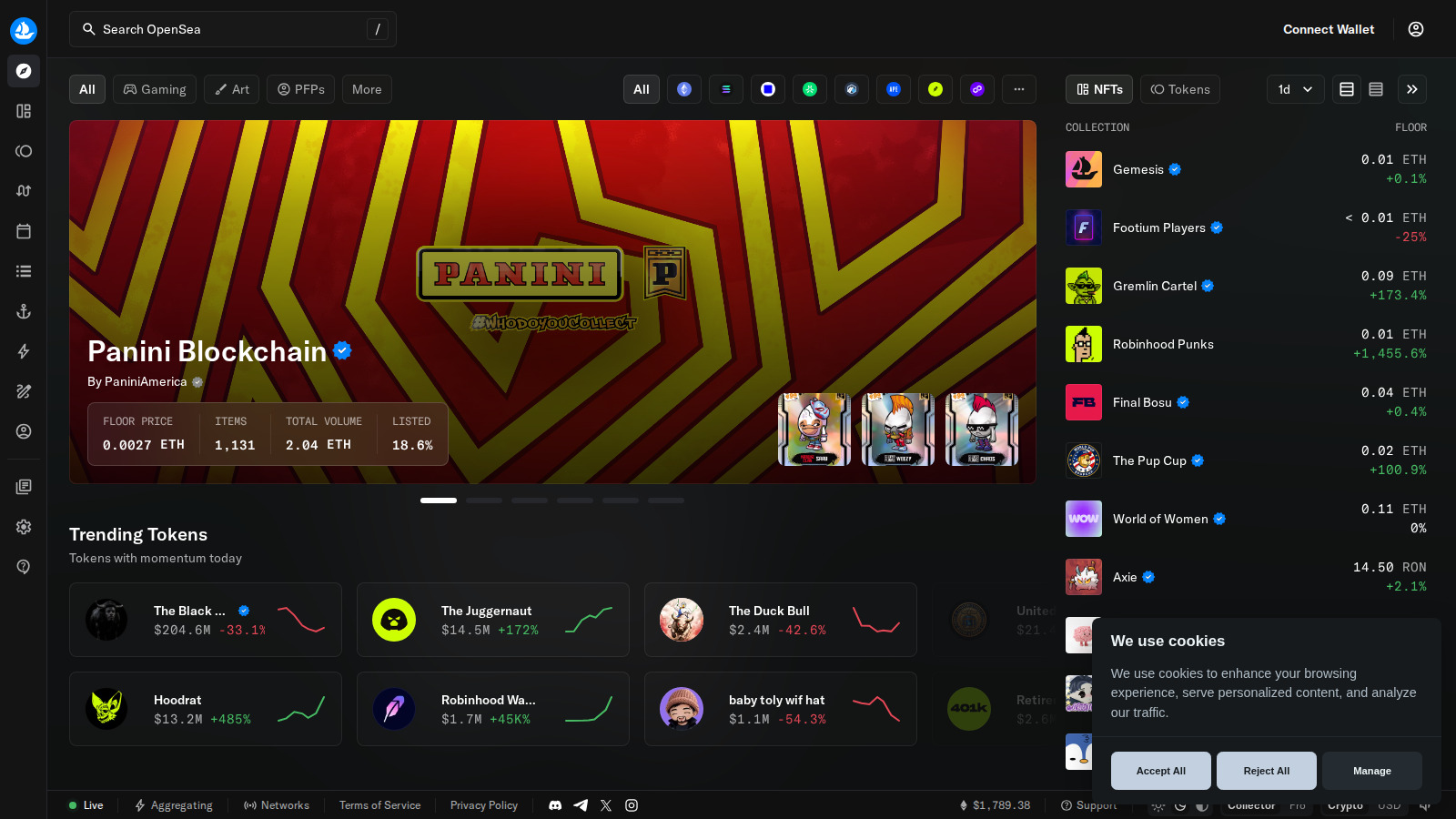
OpenSea homepage captured during our July 2026 review of NFT tracking and marketplace tools.
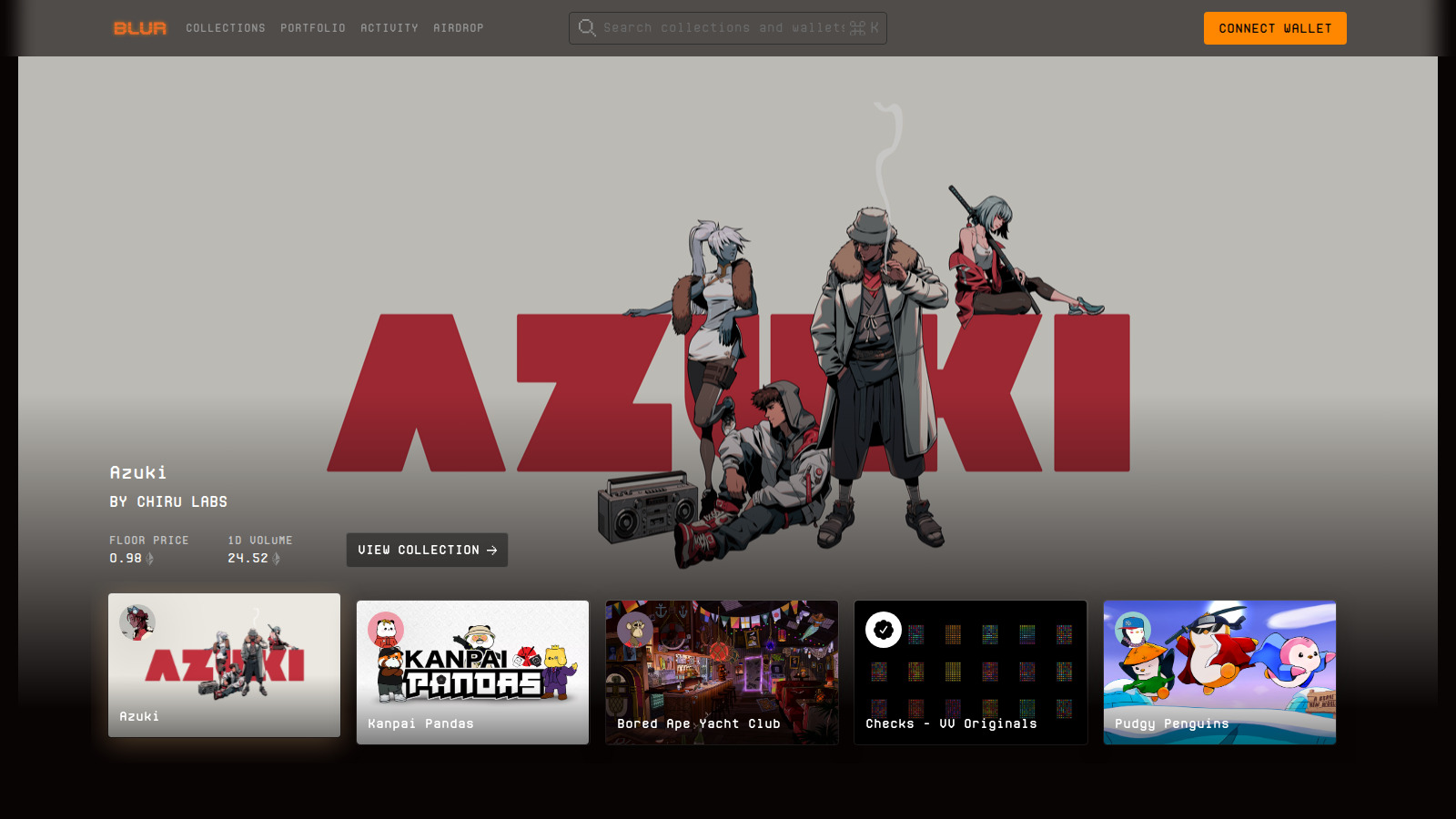
Blur homepage captured during our July 2026 review of trader-focused NFT monitoring tools.
What stood out immediately was that tracking products do not all define "signal" the same way. DappRadar treats signal more like category-level orientation. OpenSea treats it through listing and marketplace visibility. Blur frames it through fast market behavior for active traders. Zerion, in contrast, fits better when NFT tracking sits inside a broader wallet or portfolio view.
The screenshots above make that difference easier to see. The interfaces are not just visually different. They reveal whether the product expects a general researcher, a marketplace watcher, or an active trader.
What to track if you want an edge in NFTs
The most useful tracking signals are usually:
- floor-price change with liquidity context
- unusual wallet accumulation or distribution
- listing surges and bid behavior
- sales bursts that are real, not isolated
- sustained social or marketplace attention
- movement across related collections, not just one
Tracking only floor price is weak because floors can move on thin activity. Tracking only wallets is also weak because big holders can act early without creating durable demand. Good tracking combines price, flow, and participation.
Our direct editorial read after reviewing the live tracking surfaces
After opening these public surfaces side by side, the clearest difference was not just depth. It was where each product expects the user to start.
DappRadar looked strongest as a clean orientation layer. OpenSea looked useful when marketplace discovery itself is part of the signal. Blur looked much more like an execution-minded environment, which is useful for active traders but less ideal for a beginner trying to understand what is happening. Zerion still made more sense as a broader ownership tracker than as a pure NFT alert workstation.
That is why the best NFT tracking setup in practice is usually a combination. Most users do not need one perfect dashboard. They need one surface for orientation, one surface for collection-specific checks, and one place where signals can be reviewed without noise taking over.
If your main goal is floor-price awareness, DappRadar, NFTGo, and marketplace-native watchlists are enough for many users.
If your main goal is wallet behavior, Nansen is stronger because the wallet is the unit of analysis, not just the collection page.
If your main goal is discovery, collection watchlists plus category-level dashboards work better than any single trader tool.
If your main goal is reporting, you want a setup that helps you see movement early and verify it quickly. That usually means DappRadar or NFTGo plus OpenSea or Blur context, not just a single alert feed.
DappRadar
DappRadar is useful because it gives enough visibility for routine monitoring without demanding a complex setup. It helps users keep tabs on collection activity, marketplace patterns, and broad NFT vertical movement.
From the live public surface we reviewed, DappRadar looked like the easiest daily starting point in this list. That is a real strength for editors, casual users, and general researchers. It is also a limit if your edge depends on deep wallet behavior rather than high-level visibility.
Best for:
- daily market monitoring
- quick collection checks
- editorial and generalist use
NFTGo
NFTGo is better when tracking needs to go deeper into collection-level movement. It works well for users who want to monitor specific ecosystems rather than just scan headlines.
We were able to reach the live site, but not a clean screenshot-ready content surface that we would want to present as first-hand visual evidence here. So this is a directional inclusion based more on current market positioning than on a polished presentable surface review.
Best for:
- focused collection watchlists
- trend-tracking with more context
- users who move from tracking into analysis frequently
Nansen
Nansen becomes the better tracking tool when wallet flows matter more than simple price motion. If the real question is "who is moving first?" Nansen is closer to the right answer.
Best for:
- smart-money and whale tracking
- wallet-based conviction signals
- active and higher-context traders
Zerion
Zerion is a strong fit when the tracking job is portfolio management, not collection obsession. Users who hold NFTs alongside tokens and other onchain assets will often prefer a broader tracking environment.
From the public product surface we reviewed, Zerion felt less like a pure NFT tracker and more like an ownership command center. That is a strength if your NFT decisions sit inside a larger crypto portfolio. It is a weakness if all you want is fast collection alerts and nothing else.
Best for:
- integrated portfolio tracking
- collectors with mixed onchain exposure
- users who want fewer dashboards open
OpenSea watchlists
OpenSea watchlists remain useful because they connect tracking directly to the marketplace layer where many users still observe listings, activity, and item context first.
That marketplace-first quality matters more than many top-list articles admit. For beginners and intermediate users, seeing the collection where it is actually being browsed and listed can be more useful than jumping straight into a specialist dashboard.
Best for:
- beginner to intermediate users
- listing-aware collection tracking
- creators monitoring how collections are presented publicly
Blur-native monitoring
Blur-adjacent monitoring still matters where speed and execution timing drive the workflow. This is less about clean editorial visibility and more about tighter trader reaction loops.
From the live public surface we reviewed, Blur clearly signaled that it is built for users who already think like active market participants. That is useful if fast reaction is your goal. It is not the first surface I would put in front of a reader who is still learning how to separate real momentum from noise.
Best for:
- active traders
- faster liquidity-driven monitoring
Discord alert bots
Alert bots are not glamorous, but they solve a practical problem: they route signals where teams already communicate. For creators, researchers, and moderators, this can be more useful than logging into another dashboard.
Best for:
- team workflows
- community managers
- users who need configurable alerts rather than passive charts
Custom dashboard setups
The most serious users often end up with a hybrid workflow: a market dashboard, a wallet intelligence layer, a watchlist, and alerts. This is the least beginner-friendly approach, but it is often the best long-term one.
Best for:
- researchers
- power users
- products that need repeatable monitoring process
Why most NFT tracking setups create noise instead of signal
The first problem is alert overload. If everything is an alert, nothing is.
The second problem is tracking the wrong units. Many users track collections when they should track wallets, or track floors when they should track liquidity depth and follow-through.
The third problem is missing context. A strong tracking setup is not just about being first. It is about being early on something that still matters after verification.
A simple tracking setup you can actually use every day
A workable daily setup for most users looks like this:
- one broad dashboard for market orientation
- one collection-level tool for shortlist monitoring
- one wallet-tracking layer if trading matters
- one alert destination such as Discord, email, or a saved watchlist
That is enough to stay informed without turning NFT monitoring into a full-time job.
Disclaimer: This article is for research and editorial comparison purposes only. It does not constitute financial, investment, legal, or tax advice. NFT tools, marketplaces, fees, chain support, and live availability can change quickly, so verify current conditions on the official platform before making any decision involving funds, assets, or private keys.
Read original article on nftenex.com