TLDR: Bitcoin crash warning links Monday fears to Fed policy and yields. The Benner cycle comparison does not establish a scheduled crash. Bitcoin Cash gained 1.59% to $317.75, outperforming
TLDR:
- Bitcoin crash warning links Monday fears to Fed policy and yields. The Benner cycle comparison does not establish a scheduled crash.
- Bitcoin Cash gained 1.59% to $317.75, outperforming Bitcoin. Rotation into established forks remains a possible explanation for the divergence.
- BCH holds above its seven-day moving average with RSI at 63.52. Trading volume fell about 37%, weakening confirmation of the advance.
- BCH faces support at $306.59 and resistance around 328–330. A support break could expose $288.93 as Bitcoin and ETF flows shape sentiment.
The Bitcoin crash warning circulating on X links possible Monday turmoil to Federal Reserve policy and tightening liquidity. The post compares the S&P 500 with the Benner cycle, a historical framework for interpreting market fluctuations. However, that comparison does not establish that a crash will occur on October 5.
According to recent market data, Bitcoin Cash rose 1.59% to $317.75 over 24 hours, outperforming Bitcoin’s 0.25% gain. The divergence has fueled discussion about interest in established Bitcoin forks. Yet falling trading volume complicates the bullish picture. The warning offers a possible scenario rather than evidence of an imminent market breakdown.
Bitcoin Crash Warning Links Fed Policy to Yield Pressures
The Bitcoin crash warning argues that the Fed faces conflicting pressures from inflation, borrowing costs, and slowing growth. Higher rates could increase financing expenses, while easing could strengthen demand and revive inflation risks.
The post claims long-term Treasury yields have reached their highest levels since 2007. It also cites roughly $40 trillion in U.S. debt and compares potential American policy constraints with Japan. Those claims belong to the account’s forecast and require checking against specific Treasury maturities and reporting dates.
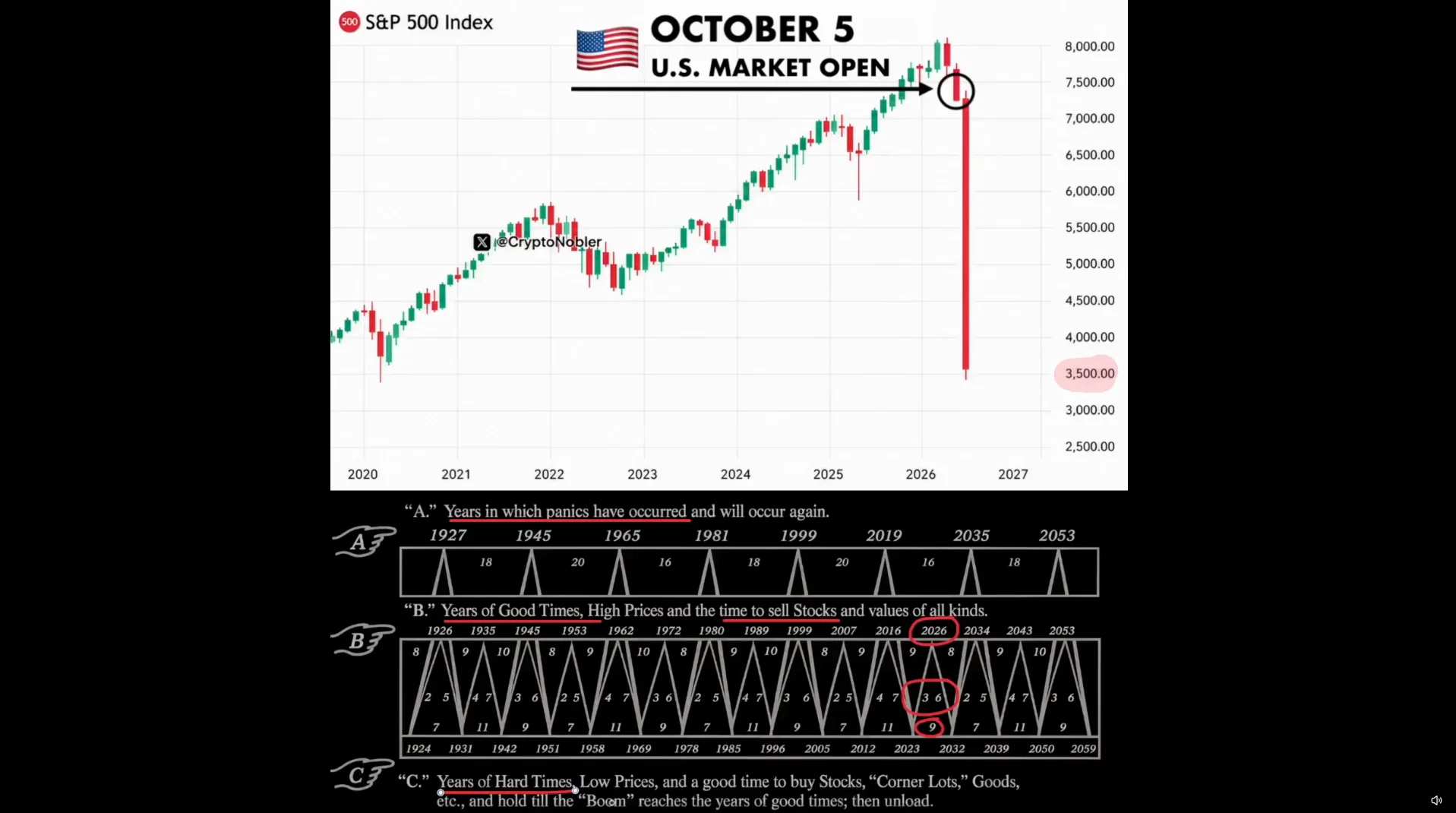
Source: X
Long-term yields differ from the overnight policy rate. Treasury publishes market-based readings across maturities rather than one universal yield. U.S. Department of the Treasury
Official Federal Reserve guidance describes a broader process. Policy changes affect borrowing costs and financial conditions, but their economic effects are neither direct nor immediate. That weakens any suggestion that one rate decision automatically produces a crash.
For the Bitcoin crash warning, the proposed transmission mechanism is tighter liquidity followed by falling asset values. The account includes stocks, bonds, silver and Bitcoin among assets vulnerable to forced selling.
Such selling can occur when investors need cash or leveraged positions breach margin requirements. However, identifying that possibility does not establish its scale, timing or likelihood.
Another distinction concerns the calendar. The Fed lists its next scheduled policy meeting for October 27–28, rather than October 5. Markets can still move before meetings as investors reassess inflation and growth.
The Benner cycle comparison therefore remains an interpretation of past patterns. The Bitcoin crash warning supplies no demonstrated link between that pattern and a particular Monday selloff.
BCH Gains as Thinner Trading Volume Clouds Bullish Momentum
The Bitcoin crash warning contrasts with relative strength in Bitcoin Cash, although that strength does not remove broader risks. Social commentary has linked interest in BCH and Bitcoin SV to derivatives headlines and possible rotation.
That explanation remains tentative. Differences in returns do not prove investors sold Bitcoin to fund purchases of its forks. The rally also lacks a clearly identified BCH-specific announcement in the accompanying market commentary.
Technical readings place Bitcoin Cash above its seven-day simple moving average at $313.88. Its 14-period relative strength index stands at 63.52, indicating positive momentum below the conventional overbought threshold.
However, 24-hour trading volume fell approximately 37% to about $152.9 million. Less turnover provides weaker confirmation of the advance, although volume alone does not measure available market liquidity.
The nearest outlined support is $306.59, corresponding to the 38.2% Fibonacci retracement. Holding that area could support another test of $328.44, followed by the wider 328–330 resistance band. These Fibonacci levels trace the latest correction from a recent BCH swing high of $363.75.
A sustained move through resistance would need stronger participation to improve the technical case. Losing $306.59 would expose the 50% retracement at $288.93.
The Bitcoin crash warning also keeps attention on Bitcoin’s stability and spot ETF flows. Sustained inflows could improve sentiment, while outflows could add pressure across related assets.
Bitcoin Cash remains sensitive to those broader conditions despite its daily outperformance. Bitcoin holding above $84,000 remains a near-term reference point, alongside BCH volume and its response around Fibonacci support.
The post Bitcoin Crash Warning Flags Monday Risk as Bitcoin Cash Gains appeared first on Blockonomi.



 Fork Sympathy Surge: Capital rotated heavily into BCH and BSV following…