Exchange-traded funds (ETFs) linked to bitcoin are going through a delicate period. For the first time since late July, their cumulative net flows over 30 days have returned to negative terri
Exchange-traded funds (ETFs) linked to bitcoin are going through a delicate period. For the first time since late July, their cumulative net flows over 30 days have returned to negative territory. This change occurs while the market is experiencing a new decline and investors are monitoring several price levels. However, outflows remain limited compared to previous waves of withdrawals. Does this signal a real institutional trend change?
In brief
- US spot Bitcoin ETFs show a negative record of $292 million over 30 days.
- This is their first negative period since late July.
- Outflows remain limited compared to previous withdrawal waves recorded this year.
- Bitcoin drops 5.3% in seven days and tests the $76,000 support.
Bitcoin ETFs record their first net outflows since July
US spot Bitcoin ETFs now show a negative record over the last thirty days. According to data relayed by Techgaged, their net flows reached minus $292 million on October 26. This development marks a first since late July, after several months of steady accumulation. It therefore draws attention to institutional investor behavior.
However, the scale of these withdrawals deserves a more precise analysis. On the historical flow chart, the recent negative bar remains modest. It notably contrasts with the significant outflows recorded earlier this year. In other words, the data does not yet show a massive wave of institutional disengagement.
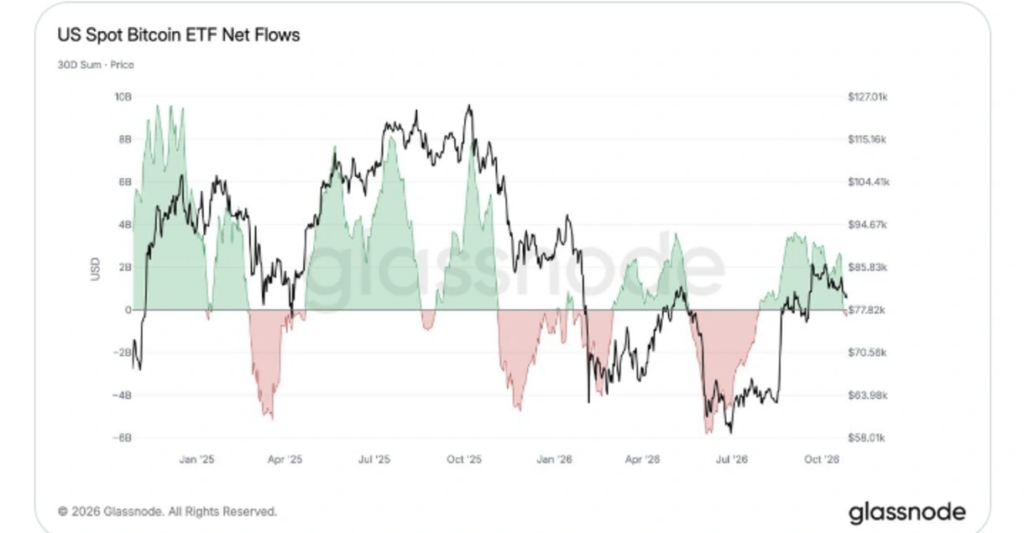 Net flows of US Bitcoin ETFs return to negative territory over 30 days, a first since July 2026. Source: Techgaged.
Moreover, capital inflows have started to increase again over this week. This return to positive territory comes after several sessions marked by withdrawals. It suggests that some investors temporarily prefer to adjust their exposure rather than completely exit the market. Fund flows thus constitute an important indicator to track the evolution of institutional demand.
Start your crypto adventure safely with MEXCThis link uses an affiliate program.
Bitcoin retreats towards $77,000 after the flow decline
The degradation of ETF flows accompanies a new phase of market weakness. On October 30, 2026, at 6 p.m. UTC, the bitcoin price was trading around $77,328. Its price then showed a 5.3% drop over seven days. This development confirms the difficulties buyers face after several consolidation sessions.
For most of the week, the price moved within a range between $80,000 and $82,000. However, the market then experienced a rapid drop, bringing it closer to $76,000. This move interrupted the stabilization phase previously observed. The asset eventually rebounded slightly without regaining its former levels.
Now, investors are watching several crucial technical thresholds. The $79,000 level represents the first immediate resistance for the price. Conversely, the $76,000 zone constitutes a major support for buyers. A new dip below this threshold could heighten concerns about bitcoin’s current momentum.
Can institutional flows signal a trend change?
Despite the market decline, available data do not yet confirm a lasting reversal. Net ETF outflows remain relatively limited compared to previous withdrawal periods. Moreover, the recent return of inflows adds further evidence to this analysis. Institutional investors therefore seem to be adjusting their positions in a less favorable market context.
However, this development does not mean that institutional demand will quickly return to previous levels. The upcoming sessions will notably verify whether capital inflows are sustained. A lasting flow stabilization could reduce selling pressure on US funds. In this scenario, bitcoin could regain support among institutional buyers.
Conversely, a resumption of prolonged net outflows would extend current difficulties. Maintaining the price above $76,000 will also be an important element to monitor. Upcoming ETF movements and price evolution will provide a better measure of demand strength. These two indicators will thus offer a more precise reading of the market situation.
If inflows into ETFs are confirmed, the current decline could remain temporary. On the other hand, new outflows accompanied by a breach of $76,000 would increase downside risks. Bitcoin thus enters the coming sessions with two challenges: preserve its support and regain steady institutional demand.