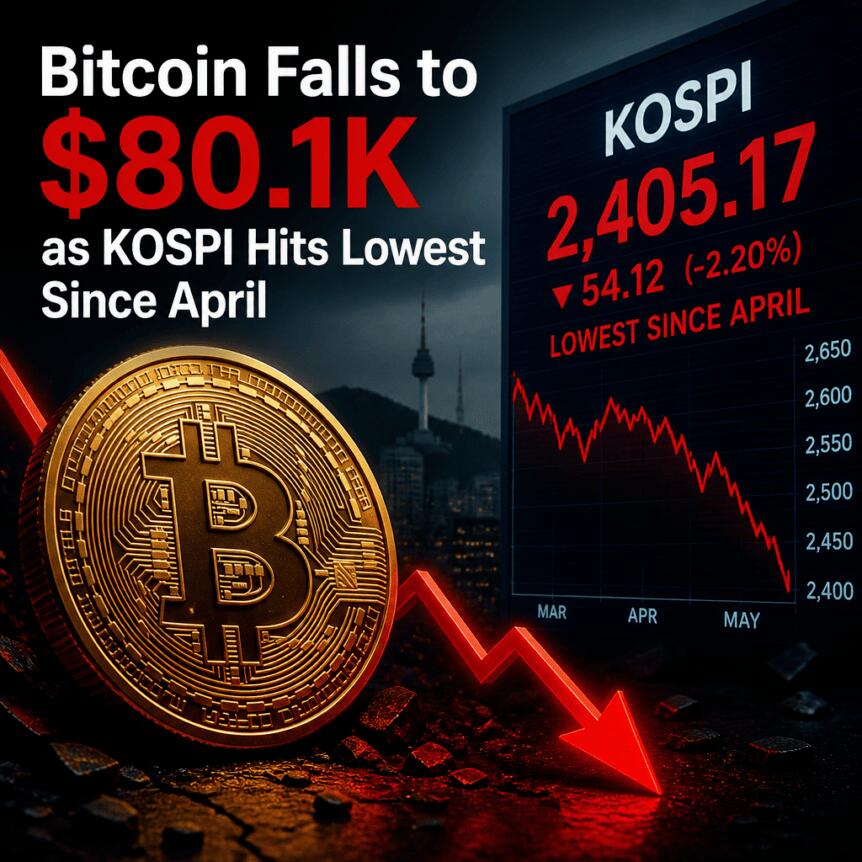
Bitcoin slid to the lowest levels seen in more than three weeks on Thursday, as renewed stress in South Korean equities spilled over into broader risk sentiment. The move came amid another ma
Bitcoin slid to the lowest levels seen in more than three weeks on Thursday, as renewed stress in South Korean equities spilled over into broader risk sentiment. The move came amid another macro-driven selloff after a hotter-than-expected U.S. inflation print helped re-raise expectations for tighter Federal Reserve policy.
Data from TradingView showed BTC/USD reaching $80,154 on Bitstamp, a level last seen on Sept. 20. The decline followed a sharp drop in the Korea Composite Stock Price Index (KOSPI), which closed Thursday down 7.5%—its weakest daily close since April 8.
Key takeaways
- Bitcoin marked new local lows near $80,154 on Bitstamp, last seen on Sept. 20.
- The KOSPI fell 7.5% on Thursday, ending at 5,554 points, the index’s lowest close since April 8.
- Tech stocks led the drawdown in South Korea, with SK Hynix down 11% and Samsung Electronics down 9.5%.
- Oil prices cooled even after a Singapore-registered tanker was sunk in the Strait of Hormuz, with Brent down more than 2%.
- Recent U.S. CPI strength has kept pressure on global markets by shifting expectations toward further rate hikes.
Bitcoin’s dip tracks a fresh wave of weakness in KOSPI tech
Thursday’s crypto drop aligned closely with renewed equity pressure in South Korea. According to TradingView, BTC/USD traded down to $80,154 on Bitstamp, marking the lowest local levels in over three weeks.
The catalyst on the equity side was a broad retreat in the KOSPI. The index ended the session at 5,554 points, its lowest daily close since April 8, and it extended losses for the week to 15.5%. Intraday moves also reflected a deterioration in the market’s technical backdrop: the KOSPI’s 200-day moving average reportedly slipped to as low as 5,450 points, a level not seen since late July.
Selloff pressure was concentrated among major technology names. SK Hynix fell 11%, while Samsung Electronics finished 9.5% lower on the day. Earlier coverage from Cointelegraph pointed to concerns tied to AI-related debt obligations, foreign capital outflows, and intensified competition from China as contributing factors behind the South Korean market rout. Taken together, that mix has made risk assets—including Bitcoin—more sensitive to macro and cross-asset headlines.
Commenting to The Korea Herald, Mirae Asset Securities analyst Kim Seok-hwan cautioned that global headwinds may keep translating into domestic market friction. He warned that volatility is likely to persist and that near-term improvement in the global environment appears unlikely, citing deteriorating local supply-demand conditions that could leave markets more exposed to external shocks.
Investors may also be watching a near-term catalyst in corporate earnings. SK Hynix and Samsung are scheduled to release third-quarter results on Oct. 28 and Oct. 29, respectively. The outcome could further sway tech sentiment—especially if numbers disappoint market expectations. Samsung is expected to report Q3 sales of 195 trillion won (about $145 billion) and an operating profit around 107 trillion won (about $80 billion), according to the figures referenced in the report.
U.S. inflation keeps tightening fears in focus
While South Korea provided the immediate linkage to Bitcoin’s weakness, the broader macro backdrop remains a key driver of volatility. Thursday’s downside pressure on crypto was compounded by momentum from Wednesday’s higher-than-expected U.S. inflation data.
As cited in the report, the September Consumer Price Index (CPI) came in at 3.7% year-on-year. That result triggered a more hawkish shift in market expectations, with traders adjusting pricing toward the possibility of further interest-rate hikes by the Federal Reserve.
QCP Capital, in macro commentary referenced by Cointelegraph, framed the key debate in terms of policy trade-offs—whether the inflation “beat” would force additional tightening, or whether credit stress might instead prompt a recalibration of expectations.
Oil retreats despite Middle East tensions
Oil markets added another layer to the risk narrative. Brent crude dropped more than 2% on Thursday even as tensions in the Middle East remained elevated following the sinking of a Singapore-registered oil tanker in the Strait of Hormuz.
The Maritime and Port Authority of Singapore described the incident as “unjustifiable,” according to the report. Despite that headline, crude prices eased—an important detail given that oil is often closely watched as a component of inflation expectations.
Speaking to CNBC, ICM’s Firas Bechwaty said he saw little chance that Hormuz transit volumes return to pre–U.S.-Iran war levels. He also noted that Saudi crude continues to reach international buyers via alternative routes and that accelerated emergency stock releases by IEA members provide additional buffering, helping prevent a sharper spike in prices despite ongoing geopolitical risk.
At the time of writing in the report, WTI traded below $95 per barrel (down 0.5%) and Brent was 2.2% lower at $103.7 per barrel. That cooling in energy prices may help explain why inflation concerns did not translate into an immediate, runaway move in commodity-linked risk—at least during this session—though the CPI-driven tightening expectations continue to weigh on markets.
What to watch next for Bitcoin
With Bitcoin pressing near $80,000 while KOSPI sentiment remains fragile, the next signals may come from a combination of global macro data and South Korean earnings. Traders are likely to watch whether equity volatility eases before Oct. 28–29, and whether crude prices hold their retreat as markets digest the implications of the latest U.S. CPI print.
This article was originally published as Bitcoin Falls to $80.1K as KOSPI Hits Lowest Since April on Crypto Breaking News – your trusted source for crypto news, Bitcoin news, and blockchain updates.