Bitcoin price action is stuck in a tight range this week. The Fed just held rates steady again, and traders are watching one key level closely. BTC pushed toward $65,000 after the Warsh-led F
Bitcoin price action is stuck in a tight range this week. The Fed just held rates steady again, and traders are watching one key level closely.
BTC pushed toward $65,000 after the Warsh-led Fed decision, then slipped back to around $63,500. That pullback has traders asking if a bigger drop is coming.
What happened after the Fed's rate decision?
The Federal Reserve under Warsh kept interest rates unchanged, matching what prediction markets expected. Odds had priced in roughly a 25% chance of a hike, so the hold wasn't a shock.
Crypto reacted well at first. Bitcoin climbed toward the $65,000 mark before fading back down.
This isn't the market's first hold-and-fade moment. Back on June 17th, Warsh's earlier rate hold also looked bullish in the short term. But traders had already priced in the good news, and Bitcoin dropped about 9% over the following two weeks as the relief rally ran out of steam.
Compare that to Powell's last meeting on April 29th. His comments on easing liquidity concerns helped Bitcoin rally 9% in a week, pushing the price to $82,500.
The pattern suggests these Fed meetings can spark short bursts of buying, but the follow-through depends on what comes next.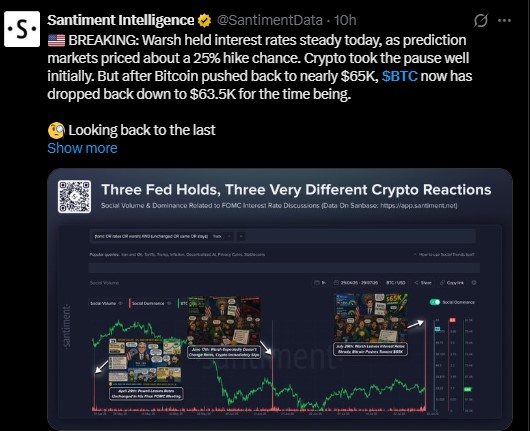
Is a dangerous stablecoin pattern repeating?
One warning many traders are pointing to right now involves stablecoins. During July's relief rally, the total stablecoin market cap declined even as Bitcoin's price rose.
That's unusual. Normally, stablecoin supply grows alongside rallies, since fresh cash flows into exchanges to buy coins.
The last time this specific pattern showed up, Bitcoin lost momentum and dropped 40%. Liquidity draining out of the market while prices climb is generally not a healthy sign for a sustained move higher.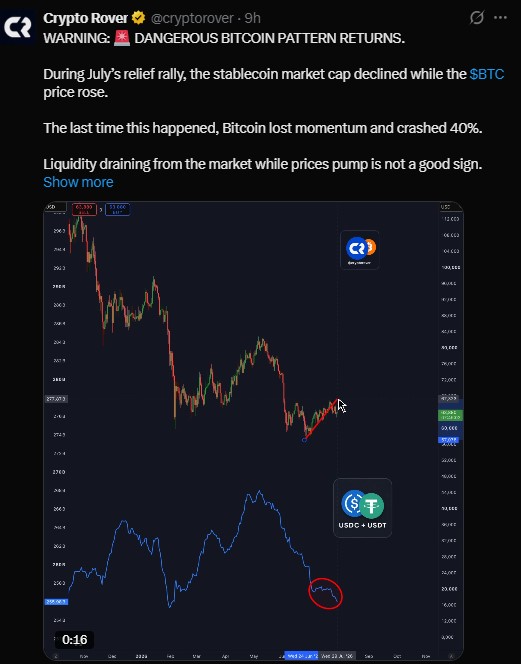
Are Bitcoin whales still buying?
Despite the choppy price swings, big holders haven't stopped accumulating. On-chain data from Santiment shows wallets holding between 1 and 100,000 BTC added roughly 20,000 tokens in July, worth about $1.3 billion.
Both mid-size and large whale wallets, those holding 100 to 10,000 BTC, took part in the buying. That kind of broad participation often signals rising confidence that a price floor is forming.
Analysts have noted that repeated whale accumulation phases have lined up with market bottoms in the past. Still, without a major catalyst, a strong breakout may be hard to trigger.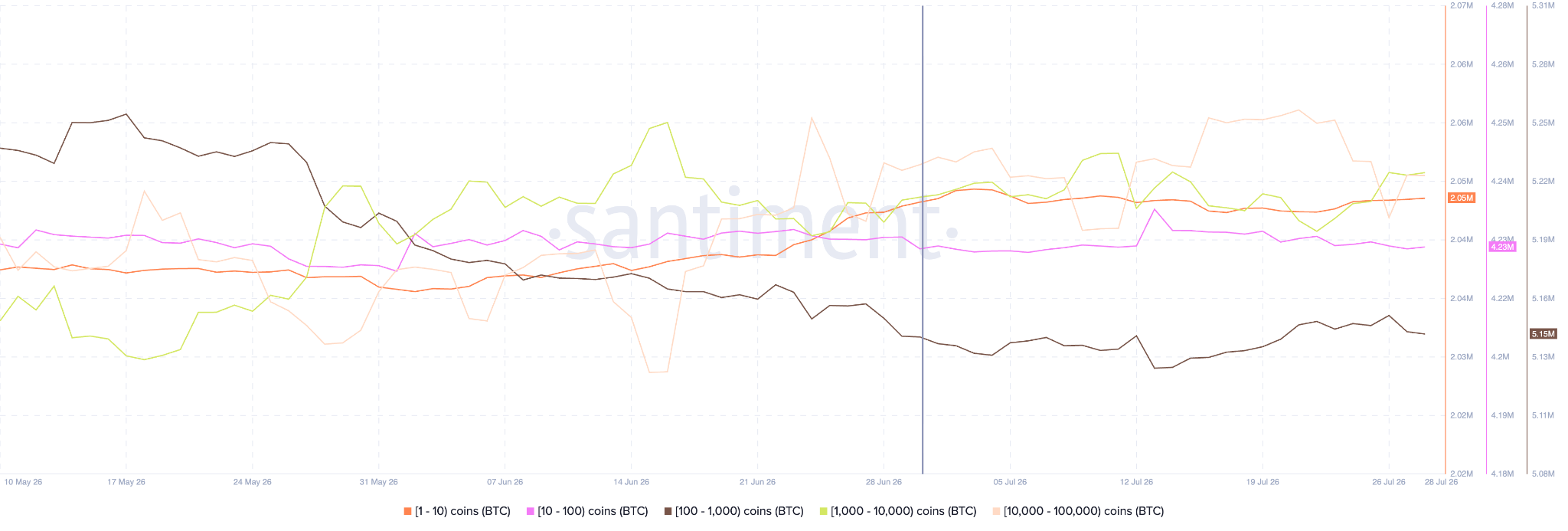
What is the key resistance and support to watch?
On the daily chart, Bitcoin formed a double top near $66,000. This came right after the price rejected a bullish inverse head and shoulders pattern.
The $66,000 zone is now the level to watch. Selling pressure has stayed strong every time price has approached it.
Level
Type
What It Means
$74,000
Upside target
Possible short squeeze if $66K resistance breaks
$66,000
Key resistance
Site of the recent double top rejection
$63,500
Current price zone
Where BTC sits after the Fed-driven pullback
$60,000
Major support
Long-term weekly support, key bear-market signal
$50,000
Downside risk
Possible target if $60K support fails
A move above $66,000 could open the door to a short squeeze, with upside potential toward $74,000 as bears get forced to cover.
On the downside, a retest of the $60,000 support wouldn't necessarily break Bitcoin's broader recovery structure. That level has held for years and has marked the end of past bear markets three separate times over the last eight years.
But if $60,000 fails to hold, the drop could accelerate toward the $50,000 area, based on how the current double-top structure is shaping up.
What does this mean for Bitcoin's next move?
Bitcoin's setup right now is a mix of caution and quiet conviction. Whales keep buying, but liquidity signals like the stablecoin dip raise real questions.
As one market commentator put it, monetary policy expectations haven't shifted much, so there's limited reason to expect an explosive short-term rally.
Much of the crypto market appears to be trading two open questions at once, tied to regulatory clarity and geopolitical tension, keeping range-bound conditions as the more likely near-term path.
Michael Saylor recently reinforced a longer-term view, noting that governments may be able to slow Bitcoin adoption but not stop it entirely, pointing to gradual global uptake over time.
For now, the $60,000 to $66,000 range looks like the battlefield. A breakout in either direction will likely decide Bitcoin's next major trend.
Disclaimer
This article is for informational purposes only and does not constitute financial, investment, or trading advice. Cryptocurrency markets are highly volatile and carry significant risk. Past performance is not indicative of future results. Always do your own research and consult a licensed financial advisor before making any investment decisions.