The Bitcoin Treasury Strategy used by significant corporate owners is once again in the limelight, as experts argue whether rapid Bitcoin acquisition supported by debt and equity benefits or
The Bitcoin Treasury Strategy used by significant corporate owners is once again in the limelight, as experts argue whether rapid Bitcoin acquisition supported by debt and equity benefits or harms the general market. The topic gathered traction amid increased focus on Strategy’s long-term strategy to Bitcoin acquisition and if its funding mechanism may amplify market instability during price declines.
While some market observers argue that corporate leverage introduces additional risks, others believe the concerns are overstated. They point out that Bitcoin’s recent price movements have been driven by a combination of macroeconomic uncertainty, shifting investor sentiment, and changes in capital flows rather than the actions of a single company.
Analysts Question the Bitcoin Treasury Strategy
The Bitcoin Treasury Strategy has grown into one of the most hotly debated subjects in the digital currency markets. Since embracing Bitcoin as its principal treasury reserve asset, Strategy has regularly increased its holdings by raising funds through convertible notes, preferred shares, and equity offerings.
Critics say that this funding arrangement raises risk to finances if Bitcoin suffers a lengthy decline. They feel that relying heavily on borrowed cash will put the firm under strain amid poor market circumstances.
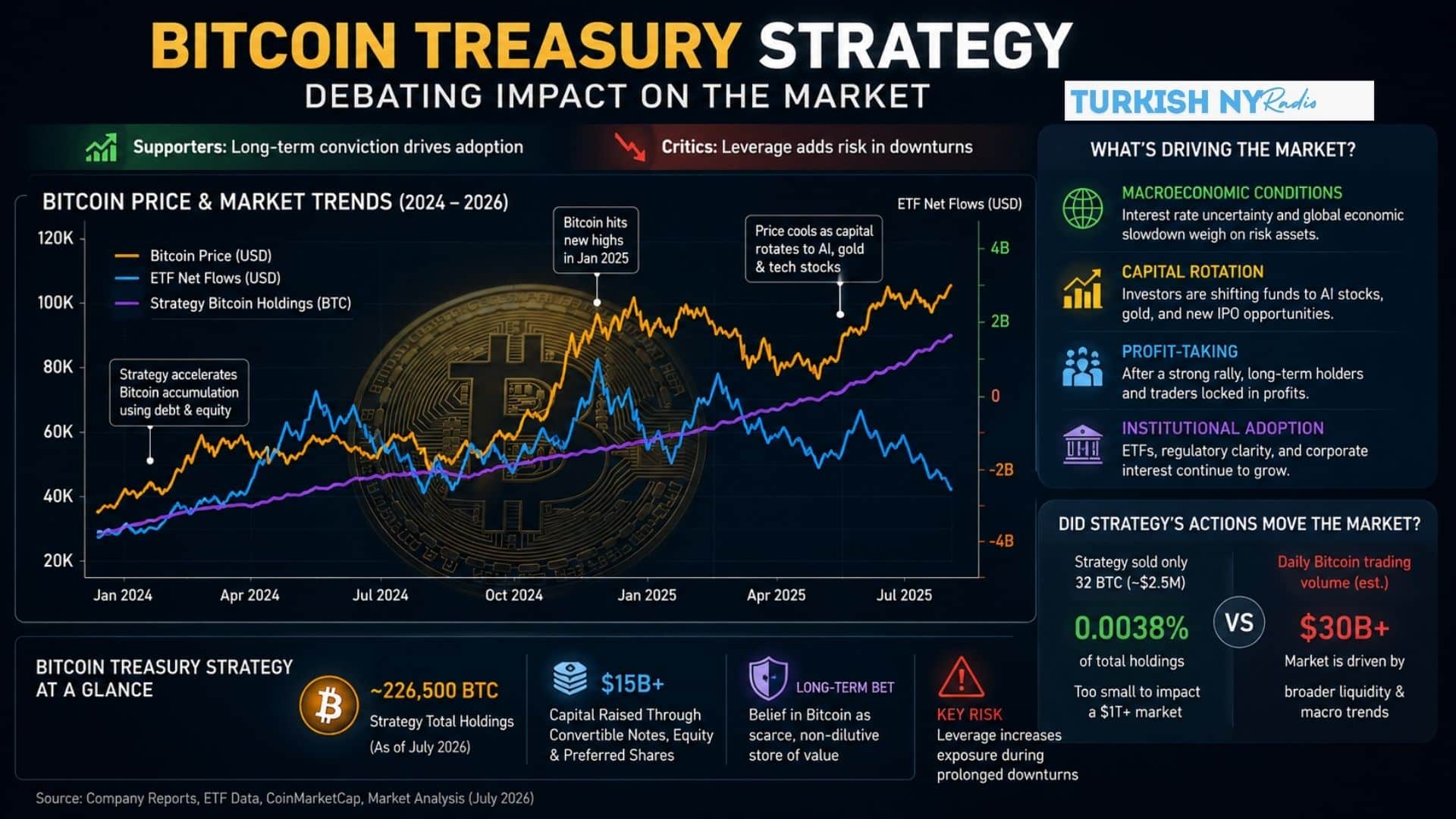
Yet, certain research studies disagreed with this conclusion. They point out that Strategy’s recent sale of merely 32 BTC constituted a minuscule proportion of its total holdings and was much too little to have any significant impact on Bitcoin’s price.
“Market-wide trends are influenced by liquidity, macroeconomic conditions, and investor sentiment, not isolated corporate transactions,” analysts noted while discussing the recent debate.
Supporters also emphasize that the Bitcoin Treasury Strategy has remained consistent over several years despite multiple market cycles.

Broader Market Forces Remain the Main Driver
Many analysts believe broader economic conditions explain Bitcoin’s recent weakness better than the Bitcoin Treasury Strategy itself.
Higher interest rates, cautious institutional positioning, and increased competition for investment capital from artificial intelligence companies, gold, and technology stocks have all contributed to reduced demand for digital assets.
Some researchers also point to profit-taking after Bitcoin’s previous rally, along with changing expectations surrounding monetary policy, as important reasons for recent market volatility.
Although Strategy remains one of the largest corporate Bitcoin holders, analysts say the global Bitcoin market processes billions of dollars in daily trading volume. In comparison, isolated company transactions are unlikely to determine long-term price direction.
For this reason, supporters argue the Bitcoin Treasury Strategy has become an easy target for criticism even though broader market dynamics remain far more influential.
Investors Remain Divided on Long-Term Risks
The discussion over the Bitcoin Treasury Strategy illustrates two distinct investing mindsets.
One side says that employing economic leverage to build up Bitcoin increases exposure during weak markets. If borrowing costs rise or Bitcoin suffers a large fall, businesses may face increasing financial strain.
The other viewpoint claims that long-term conviction has typically rewarded patient shareholders. They feel Strategy’s management has continuously shown faith in Bitcoin as a valuable digital resource with strong long-term potential.
Institutional adoption also continues to grow through spot Bitcoin exchange-traded funds, improved regulatory clarity, and expanding corporate interest. Proponents argue that these events enhance the argument for pursuing an extended Bitcoin Treasury Strategy despite bouts of short-term instability.
Market analysts warn investors against attributing Bitcoin price changes to a single issue. In contrast, they advocate combining macroeconomic factors, liquidity patterns, investor demand, and business basics.
Conclusion
The debate over the Bitcoin Treasury Strategy is unlikely to end anytime soon. While critics question the sustainability of using leverage to accumulate Bitcoin, supporters argue the company’s actions represent only one small part of a much larger global market.
Current evidence suggests that broader economic conditions, investor sentiment, and capital allocation decisions continue to play a far greater role in Bitcoin’s performance than individual corporate transactions. As the digital asset industry evolves, the Bitcoin Treasury Strategy will remain an important case study for investors assessing both opportunity and risk. Whether viewed as visionary or controversial, the Bitcoin Treasury Strategy continues shaping conversations across the cryptocurrency industry.
Summary
The Bitcoin Treasury Strategy has reignited debate about how leveraged corporate Bitcoin purchases influence market stability. Although critics warn that debt-funded buildup may raise financial risks, many experts feel that Bitcoin’s price is still mostly driven by larger macroeconomic conditions, investor mood, and liquidity. Recent debates imply that Strategy’s private transactions are too tiny to have a substantial impact on the global Bitcoin market, making the long-term success of its treasury method a source of controversy.
Glossary of Key Terms
Bitcoin Treasury Strategy: A company strategy that uses Bitcoin as the principal treasury reserves resource.
Leverage: The utilization of borrowed cash to expand financial risk.
Convertible Notes: Are financial instruments that can potentially be converted into business stock.
Institutional Adoption: Investment participation by professional organizations such as asset managers and financial institutions.
Market Volatility: The degree of price fluctuations experienced by an asset over time.
FAQs for Bitcoin Treasury Strategy
1. What exactly is the Bitcoin Treasury Strategy?
It is a company financial approach that involves storing Bitcoin as a reserve asset rather than depending solely on cash or traditional assets.
2. For what reason is Strategy’s method contested?
Critics argue that the use of debt to purchase Bitcoin increases economic risk during market collapse.
3. Will Strategy’s latest Bitcoin sell impact the market?
Researchers believe the sale was too modest in comparison to the entire Bitcoin market to have a significant influence.
4. What are the current variables impacting Bitcoin prices?
Macroeconomic circumstances, interest rates, sentiment among investors, institutions demand, and global liquidity are viewed as the major drivers.
5. Can more corporations use a Bitcoin Treasury Strategy?
A number of analysts believe corporate adoption will continue if corporations see Bitcoin as a long-term strategic resource asset, but each organization must consider the dangers and benefits.
Sources