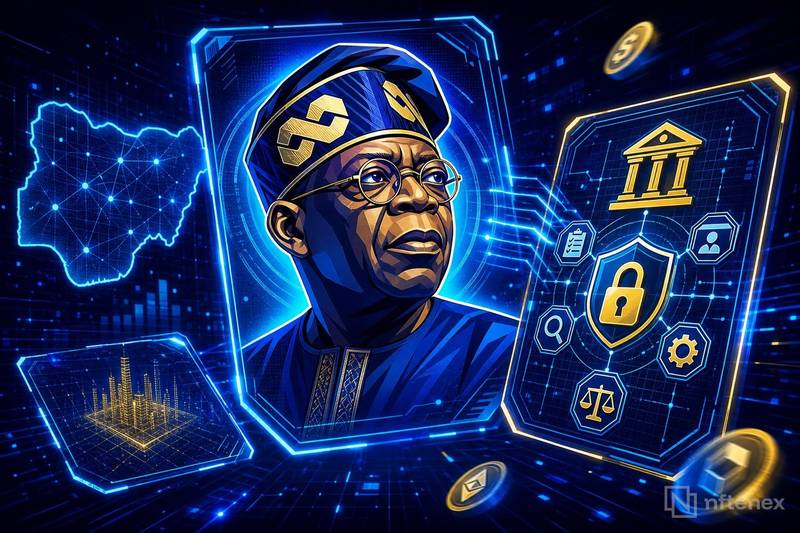
President Bola Tinubu has moved to coordinate Nigeria's crypto oversight, signing an executive order on virtual assets that establishes a council to harmonise regulation of the country's digi
President Bola Tinubu has moved to coordinate Nigeria's crypto oversight, signing an executive order on virtual assets that establishes a council to harmonise regulation of the country's digital economy. The directive places policy alignment, not price action, at the center of Nigeria crypto oversight.
What Tinubu's Crypto Oversight Order Means
The order signs virtual assets into a single coordinated framework and creates a council tasked with harmonising how digital-economy rules are set and applied, according to the Nigerian State House. For related coverage, see Ethena Gains Momentum, SHIB Struggles, but BlockDAG’s F1® Deal Redefines the Future of Crypto.
This is a governance action rather than a market event. The core development is that Nigeria is consolidating oversight of crypto under a defined structure, signalling tighter organisation of national policy. For related coverage, see Kraken Says Simpler Options Could Expand Crypto Derivatives.
Reporting on the order framed it as a step toward centralised crypto regulation through a dedicated virtual-asset council, as covered by Crypto Briefing.
Why Coordinated Regulation Matters for Nigeria's Crypto Sector
Coordinated oversight implies that multiple agencies previously handled crypto supervision with gaps or overlap. A harmonising council is the mechanism intended to bring those actors into alignment.
Nigeria's securities regulator has already set out how it classifies and treats digital assets, in a formal statement and through its published rules and regulations. A coordinating council would sit above such individual mandates.
For crypto businesses, clearer institutional coordination can translate into more consistent compliance expectations and enforcement. Policy clarity of this kind tends to shape confidence and market participation, an outcome regulators elsewhere have also pursued, from Russia's advancing crypto regulation bill to Vietnam's penalties for using unlicensed exchanges.
Stablecoins are a live question inside that supervisory scope, an area the IMF has examined specifically for Nigeria. A harmonised council would be the body positioned to reconcile how such instruments are treated.
What to Watch After the Oversight Directive
A presidential order creates the expectation of follow-through. The next development to monitor is implementation detail: how the council is composed, what powers it holds, and how it interacts with existing regulators.
Watch for agency coordination, published guidance, and any shift in enforcement posture. These signals, rather than the order's headline, will show whether the harmonisation is operational or aspirational.
The broader trajectory ties Nigeria to a widening set of jurisdictions formalising crypto rules, alongside enforcement actions such as the SEC's suit against Mining Automatic. For companies and investors tracking Nigeria, the council's early output will define the country's crypto policy path.
Disclaimer: This article is for informational purposes only and does not constitute financial or investment advice. Cryptocurrency and digital asset markets carry significant risk. Always do your own research before making decisions.
Read original article on nftenex.com