Cardano ADA News: Open Wallet Standard, and Record Decentralization Charles Hoskinson confirmed a major shift for the network this week, announcing support for the Cardano Open Wallet Standar
Cardano ADA News: Open Wallet Standard, and Record Decentralization
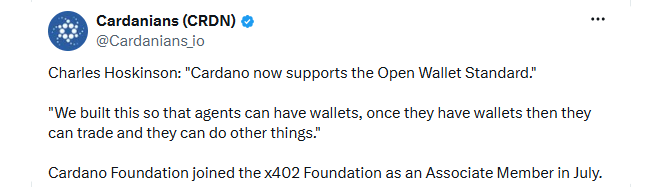
Charles Hoskinson confirmed a major shift for the network this week, announcing support for the Cardano Open Wallet Standard.
This Cardano ADA News update lets software agents hold and manage digital wallets on their own, opening a path toward automated trading and on-chain activity without constant human input.
Source: Cardanians, Official DRep Page
The Cardano Foundation also joined the x402 Foundation as an Associate Member in July. At the same, the network posted a record reading on its decentralization score.
Cardano ADA News Today: Open Wallet Standard Support For AI Agents
Cardano news today centers on wallet security for automated tools. The Open Wallet Standard, known as OWS, gives agents a secure way to hold private keys without exposing them.
Keys stay encrypted at rest, typically with AES-256-GCM, and only unlock inside a protected signing process after policy checks pass. Agents never see the raw key material at any stage as per official Open Wallet doc.
OWS relies on CAIP identifiers, which keep wallet addresses readable across multiple networks. Developers can plug into the standard through several interfaces:
A command-line tool for quick testing
Software development kits for Node.js and Python
A REST interface for web-based apps
An MCP interface built for agent frameworks
Support for this standard means addresses and transactions on the network can now run under the same rules that govern AI-driven wallets elsewhere. A person sets the policy once, and an agent follows it, covering things like:
Cardano Foundation Joins x402 Foundation To Support Agent Payments
The foundation became an Associate Member of the x402 Foundation in July, a Linux Foundation body built around a payment standard for software.
The x402 protocol brings back the old HTTP 402 "Payment Required" status code, letting one program pay another for data or API access without a stored account or a checkout page.
Most x402 payments run through stablecoins. The eUTXO transaction model fits this setup well, since a payer can pre-sign an exact transaction that a facilitator submits without altering it.
That structure limits what a payment processor can change after the fact, which matters for automated systems moving funds without a person checking each transfer by hand.
Paired with wallet support for agents, this membership lets a single automated tool do three things in one flow, across the $ADA ecosystem:
Discover a paid service
Agree to a price
Settle payment
ADA Price Today: Market Cap, Trading Volume, And Supply Snapshot
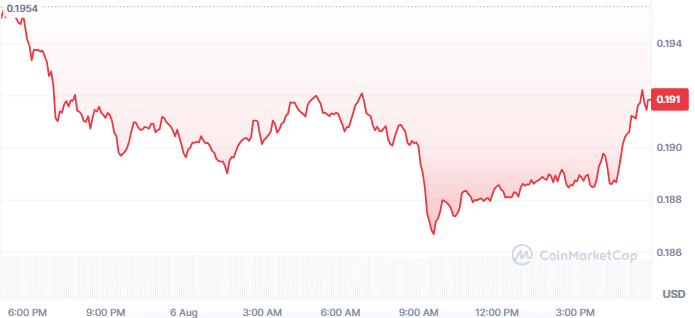
ADA trades at $0.1913, down 1.89% over the past 24 hours. Other figures from the same snapshot include:
Source: CoinMarketCap Official
Market cap: $6.98B, down 1.89%
24-hour trading volume: $377.96M, down 8.83%
Fully diluted valuation: $8.61B
Total supply: 44.99B ADA
Circulating supply: 36.5B ADA
This ADA price today snapshot sits alongside a wider stretch of Cardano news today, from agent wallets to payments and network security.
Cardano Network Decentralization Reaches New Nakamoto Coefficient High
Chainspect data puts the network's Nakamoto Coefficient at 16, an all-time high for the metric.
This number tracks how many independent stake pool operators would need to act together to gain control of enough stake to disrupt the network. That threshold generally sits near one-third of total stake in proof-of-stake systems.
A higher score points to a wider spread of control among validators.
More than 2,000 stake pools currently run on the Cardano blockchain. Reaching this figure reflects a broader distribution of stake among independent operators rather than a rise in small, inactive pools.
This $ADA blockchain update follows the Van Rossem hard fork, activated on July 18, 2026. The upgrade moved the mainnet to Protocol Version 11 as per official $ADA documentation.
The vote ran entirely through on-chain governance, with no direction from Input Output:
Delegated representatives cast their votes
Stake pool operators cast their votes
The Constitutional Committee cast its vote
The fork lowered the cost of running Plutus smart contracts. It also added cryptographic tools such as BLS12-381 multi-scalar multiplication, laying groundwork for the planned Ouroboros Leios scaling update later this year.
In the Last
Taken together, this Cardano ADA update spans wallets, payments, and governance within a short stretch of weeks. Wallet support for agents, a payment standard built for machines, rising decentralization, and the Van Rossem hard fork all point to steady, deliberate work across the network.
These Cardano upgrades 2026 set up the next milestone: Ouroboros Leios, aimed at higher transaction throughput without loosening the network's security guarantees. Tracking Cardano ADA news, the pattern this year favors infrastructure first, price action second.
Disclaimer: This article is for informational purposes only and does not constitute financial or investment advice. Crypto markets carry significant risk. Always do your own research before making any investment decisions.
