

Markets4 min read
Ripple CEO Discusses Path Ahead for XRP
Ripple CEO Brad Garlinghouse has described 2026 as a phenomenal year for the company, citing significant growth in transaction volumes and expanding opportunities to use XRP across its financ
Cardano’s decline from its October peak has brought ADA back to a support area that could determine its November direction. Buyers have recovered some ground after the latest dip, but the dam

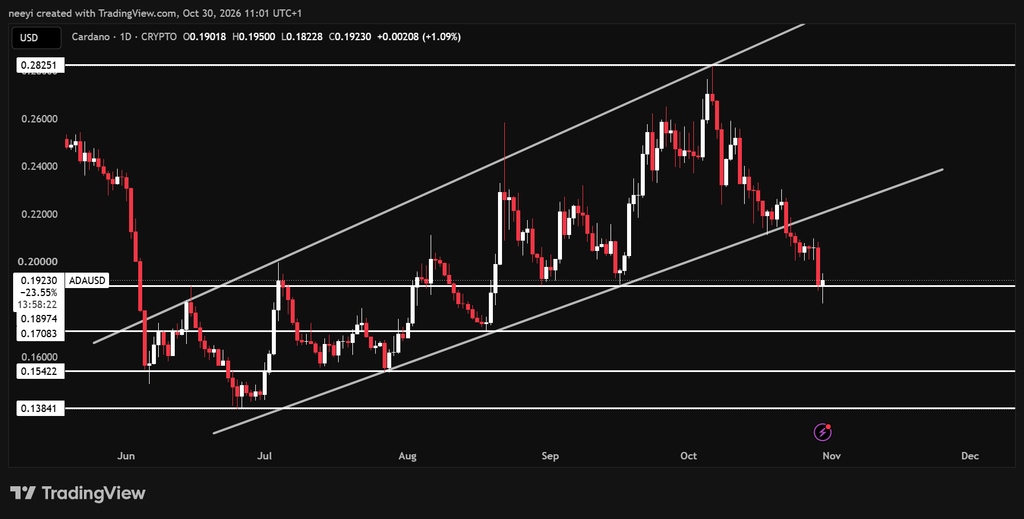
Cardano’s decline from its October peak has brought ADA back to a support area that could determine its November direction. Buyers have recovered some ground after the latest dip, but the damage from a broken price pattern remains difficult to ignore.
November brings an important combination of network development milestones and technical tests. Cardano has potential catalysts ahead, although a sustained recovery will require stronger demand and progress through resistance.
Cardano declined from approximately $0.28 on October 6 toward an October 30 low around $0.18. That move represents a peak-to-trough decline of roughly 36%, before the subsequent recovery above $0.19.
The distinction matters because the decline from the October peak is different from a calendar month return. Nevertheless, the price sequence shows how much ground ADA has surrendered during recent weeks.
Before the October 23 breakdown, Cardano had been trading within an ascending channel. Higher highs and higher lows supported that structure until sellers pushed the price beneath its lower boundary.
The breakdown changed the technical outlook. Recoveries now face the possibility of rejection near former support, which can become resistance after a channel fails.
Cardano’s immediate challenge is therefore to defend $0.19 and recover through the $0.20 to $0.22 area. Until that happens, the recent bounce remains vulnerable to another decline.
Amaru is among the clearest development milestones to monitor. Cardano’s Rust node implementation is intended to provide an alternative to the original Haskell node, with mainnet block production targeted for November 2026. Intersect and Cardano’s project documentation describe this as the next major step after relay functionality.
Successful delivery would strengthen client diversity and reduce dependence on a single implementation. However, its price effect would depend on execution and whether that progress encourages additional demand for ADA.
Leios offers another development theme, although its rollout requires several stages. Dijkstra carries the planned upgrade, followed by operator key registration, network exercises and capacity increases through parameter changes.
That means November updates should be assessed through completed milestones. A development target does not mean the network immediately receives its full planned capacity.
ETF expectations also require care. Grayscale requested withdrawal of its Cardano Trust ETF registration on August 7, 2026 because it no longer intended to proceed with that offering. The earlier GADA filing therefore does not establish an imminent November approval decision.
Ecosystem liquidity remains another practical test. More stablecoin liquidity, lending activity and exchange volume could improve Cardano’s economic use. Technical capacity alone cannot guarantee that capital will enter its applications.
The $0.19 level is the immediate pivot for Cardano’s November outlook. ADA’s temporary decline toward $0.18 shows that this support can be breached, although the recovery above it leaves buyers with another opportunity to defend the area.
 ADA Price Outlook / TradingView.com
A sustained loss of $0.19 would bring $0.17 into focus. Failure to hold $0.17 would expose $0.154, followed by the June low around $0.138.
That final level represents the deepest bearish target in this November framework. Reaching it would mean Cardano had surrendered the recovery from its June bottom.
The bullish route begins with the $0.20 to $0.22 resistance area. Buyers must recover this zone before a return toward $0.28 becomes technically more convincing.
Progress through $0.28 could open $0.30, which represents a stronger November recovery outcome. The $0.43 level belongs to an extended bullish scenario that would require several resistance breaks and a much stronger market.
Read Also: Binance Hack Wasn’t a Private Key Leak. That May Be the Bigger Problem
Cardano’s RSI(14) reads 31.251, close to the conventional oversold threshold of 30. This indicates weak momentum, although it does not confirm that the decline has ended.
The Stochastic(9,6) reading of 15.446 places the indicator in oversold territory. That creates room for a rebound, but persistent downtrends can keep stochastic readings depressed.
MACD(12,26) reads −0.010, consistent with the negative trend. A recovery would become more credible if price reclaimed resistance and MACD subsequently improved.
Bull/Bear Power(13) reads −0.0397, which supports the view that bearish pressure remains dominant. The indicator therefore reinforces the importance of defending support before expecting a sustained recovery.
Indicator Value Interpretation RSI(14) 31.251 Weak momentum near the oversold threshold. STOCH(9,6) 15.446 Oversold conditions allow a possible rebound. MACD(12,26) −0.010 The broader momentum trend remains negative. Bull/Bear Power(13) −0.0397 Bearish pressure continues to dominate.The central outlook remains cautious because Cardano has lost its ascending structure. A recovery is possible, but buyers must prove that they can retain support and reclaim resistance.
Cardano’s November direction will depend on whether development progress is matched by demand and stronger price action. Amaru and Leios provide concrete milestones to follow, but the chart still requires a successful defence of support.
Subscribe to our YouTube channel for daily crypto updates, market insights, and expert analysis.
The post Cardano Price Prediction For November: The Key Levels To Watch appeared first on CaptainAltcoin.